
CHAPTER 3: THE FRICTION OF BOUNDARIES
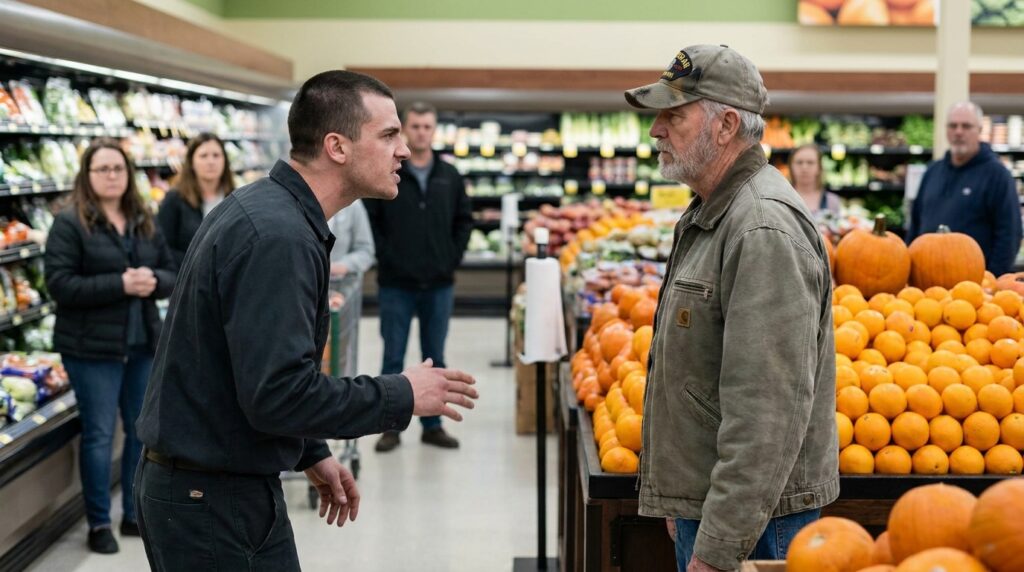
The young man didn’t move. He remained draped over the timber edge of the citrus bin, his chest heaving in short, shallow hitches that sent a tremor through the remaining rows of oranges. The sound of rolling fruit had faded, replaced by the heavy, rhythmic dripping of the misting system two aisles over. Every shopper in the produce section had become a frozen statue, their collective judgment pressing into the air like a rising tide.
“Clean it up,” the stock boy said, his voice cracking. It wasn’t an order; it was a plea for the world to return to its rigid, predictable tracks.
The old man didn’t look at the boy. He kept his eyes on the back of the challenger’s neck, noticing the way the skin had turned a mottled, angry crimson. The grease-stained ring on the young man’s thumb was buried deep in the wood of the bin, a small anchor of steel against the softwood. The old man felt the paper in his pocket—the court summons from Vance Corporate Holdings—and wondered if the boy even knew whose boots he was trying to fill.
“He didn’t hit you,” a woman whispered from behind a pyramid of apples. Her voice was thin, carrying the sharp edge of a witness who had seen the physics of the thing but couldn’t find the malice. “You just… you just fell.”
The challenger finally moved. He pushed off the bin with a grunt of tactical exhaustion, his boots sliding through a mashed orange that left a slick, pulpy streak across the white floor. He stood upright, but the symmetry of his arrogance was gone. His dark sweatshirt was smeared with dust and citrus juice, and his left shoulder hung an inch lower than his right—a classic mechanical failure of the rotator cuff, the price of overextending a committed load.
He didn’t look at the crowd. He looked at the old man, his eyes narrowed into slits of dark, desaturated light. The rage was still there, but it was being suppressed by the overwhelming friction of public shame. In this county, a man could survive a fight, but he couldn’t survive being made to look like a clumsy amateur in front of the people he intended to rule.
“You think this changes anything?” the young man spat. The words were transactional, a desperate attempt to regain the centerline of the interaction. “You’re still sitting on a lot that doesn’t belong to you. You’re just a ghost in a cap, holding up progress.”
The old man reached down and picked up a single orange that had come to rest against the toe of his boot. The skin was ruptured, a small tear leaking clear, sticky juice onto his calloused palm. He didn’t answer immediately. He felt the weight of the fruit, the way the structure of it had collapsed under the sudden impact.
“Progress usually has a cleaner face,” the old man said. He tossed the ruptured orange onto the bin. It landed with a wet thud. “And better balance. You’re working for Vance, aren’t you? Driving that yellow 938 out by the creek?”
The young man stiffened. The mention of the machinery—the specific model of the front-end loader—acted like a physical strike. It pulled the interaction out of the anonymous space of a grocery store and into the gritty, industrial reality of the land dispute. The “Sovereign Protector” lens of the old man was fully engaged now; he wasn’t just defending his space in the aisle, he was defending the perimeter of his history.
“What I drive is none of your business,” the challenger said, though the lie was visible in the way his eyes flicked toward the store exit. “What matters is the notice. You got it. You know the date.”
“I know the date,” the old man replied. He adjusted his veteran cap, the frayed gold thread catching the clinical light. “And I know the soil. You’re digging into a legacy you don’t understand, son. You’re just a lever for a man who’ll replace you the second your joints start to creak like that shoulder.”
The witness layer was beginning to shift. The curiosity was being replaced by a low-level anxiety as the conversation turned toward the local politics of land and eviction. In a town where everyone’s mortgage was tied to the same three banks, the word notice carried the weight of a funeral bell.
The stock boy stepped forward, a plastic broom in one hand, but he kept a three-foot radius between himself and the young man. “Please,” he muttered. “I just have to clear the lane.”
The challenger looked at the broom, then back at the old man. The silence in the aisle had become a vacuum, demanding a resolution that neither man was ready to give. The young man reached into his pocket and pulled out a set of keys on a heavy steel carabiner. They rattled with a sharp, metallic friction that echoed off the cold walls of the supermarket.
“We’ll see how your balance holds up when the fences start moving,” the young man said. He turned on his heel, his boots clicking against the floor in a sharp, defensive rhythm. He didn’t look back. He walked toward the automatic doors, his stride forced and heavy, leaving the scent of crushed citrus and unspent violence in his wake.
The old man stood his ground until the doors hissed shut. He felt the pulse in his split thumb, a rhythmic reminder of the friction he had just survived. He wasn’t relieved. A victory in the produce aisle was a false flag; it was a tactical reprieve in a war that was rapidly moving toward his front porch.
He looked at the oranges scattered across the floor—a messy testament to a failed escalation. The woman with the salad bag finally moved, steering her cart around the pulpy remains of the fruit without saying a word. The grocery store began to hum again, the normal sounds of commerce rising up to bury the incident, but the texture of the air had changed. It was grittier now.
The old man turned back to the bin and selected three more oranges. He placed them carefully in a plastic bag, the crinkle of the film loud in the lingering quiet. He needed to get home. He needed to check the markers on the north ridge. If the boy was driving for Vance, and if the boy had a notched ring like that, he wasn’t just a messenger. He was the one who would be sitting in the cab when the blades finally touched the dirt.
As he walked toward the registers, he noticed a small, oily smear on the sleeve of his canvas jacket—the industrial grease from the young man’s ring. He rubbed it with his thumb, feeling the grit of it. It was a micro-mystery, a discrepancy he couldn’t quite place. That specific grease was only used on the older hydraulic systems, the ones the military had sold off in the nineties.
He stopped at the end of the aisle, his eyes narrowing. Vance didn’t run old equipment. Vance ran new, shiny, lease-protected machinery.
The old man looked at the smear again. The friction was increasing. The threat wasn’t just corporate; it was personal, and it was tied to a ghost he hadn’t seen in thirty years.








