
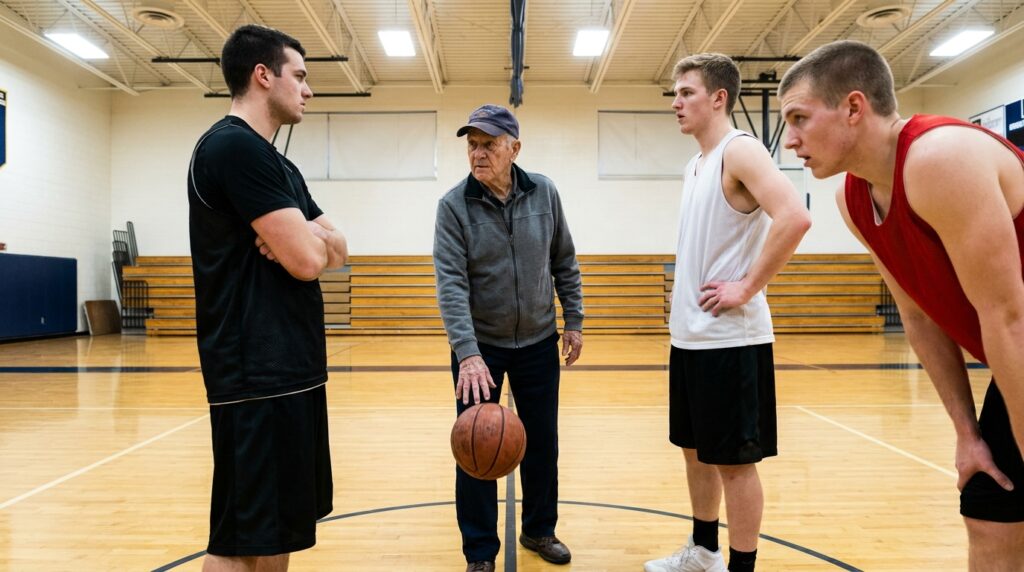
CHAPTER 7: THE RECOVERY AND THE SILENCE
“He didn’t leave the gate because he was the one holding the chain,” the Elder Challenger said, his voice dropping below the steady, low-frequency drone of the dying transformer.
The compression on his arm didn’t change, but the nature of the weight did. The black jersey’s fingers remained locked into the gray fabric of his sleeve, but the mechanical tension had gone out of the muscles. The young man’s frame was suspended under the yellow light pole, his chest motionless, his face fixed in a state of suspended animation as the final, un-ledgistered truth of Section Four filtered through the cold air.
The elder slowly drew his pinned arm upward. He did not use force; he adjusted the angle of his elbow by a fraction of an inch, using a simple leverage shift against the boy’s ungrounded palms. The boy’s hands slipped off the gray cloth, his fingers trailing across the rough limestone aggregate until they rested flat on the freezing concrete, inches from the flaking brass of the whistle.
Time seemed to dilate under the yellow lamp. The wind from the shipping canal had dropped to a thin, iron-scented whistle, but the silence inside the center circle felt dense, structural, like the thick concrete walls of the abandoned bunker three blocks north. The elder reached down with his right hand, his scarred fingers closing over the cold, pitted cylinder of Marcus Vance’s whistle. He didn’t lift it quickly. He felt the weight of the brass, the small flakes of oxidized green sticking to his skin like old rust seeds.
“The order to dismantle the pool didn’t come from the district, son,” the elder murmured, his eyes looking straight through the dark cap shadow into the boy’s face. “The trucks were empty because the fuel had been diverted to the civilian hospital transport lines during the hard freeze of seventy-six. The state didn’t abandon the unit. The unit volunteered to stay behind so the local boilers wouldn’t run dry. Your brother wasn’t left in a locker. He gave me this whistle at the gate and told me to keep walking until the ice broke.”
The black jersey looked down at the empty space on the asphalt where the whistle had been. His mouth opened slightly, but no sound came out. The historical weight of the neighborhood’s anger—the forty years of cultivated betrayal, the graffiti on the brick walls, the generational rage against the gray jackets—collapsed into a single, quiet pocket of local sacrifice. The villain they had constructed to justify their own isolation was just an old man who had spent three decades keeping a promise to a dead supply sergeant.
To the left, the red jersey had backed entirely out of the light cone, his hands flat against his sides, his head lowered as the institutional reality settled over his shoulders. Near the fence, the observer player in the white jersey let his fingers slip from the wire mesh, his boots turning toward the park exit without a word. The gathering crowd on the benches had dissolved into the dark edges of the park; the faint, yellow lights of the streetlights across the canal were the only markers left in the landscape.
The elder slowly slid the whistle into the inner pocket of his jacket, letting it rest beside the heavy brass key. He reached down one last time, his fingers catching the worn grain of the state-issued identification card. He slid the laminate back into the fabric slot, his movements deliberate, entirely procedural, as if he were closing a logbook at the end of a shift.
He looked at the three young men sitting on the split topcoat of the court. They weren’t challengers anymore; they were just tired boys with a basketball and a patch of concrete that had suddenly grown too large for them to hold.
“We’re done here,” the elder said, his voice a low, gravelly rasp that carried no residue of the conflict. He gave a short, restrained release gesture with his right hand, a brief flick of the wrist that cleared the lane. “Get up.”
The black jersey didn’t move immediately, but his chin rose, his eyes tracking the elder as the older man turned his back to the light pole. The veteran’s boots ground into the grit with that same flat, transactional rhythm, his hands deep in his gray jacket pockets, his shoulders square against the freezing canal wind. He walked out of the circle, across the white paint, and through the opening in the chain-link fence without looking back, his figure slowly fading into the desaturated gray of the urban night, leaving the court completely silent under the dying lamp.








