
CHAPTER 3: THE CENTER CIRCLE
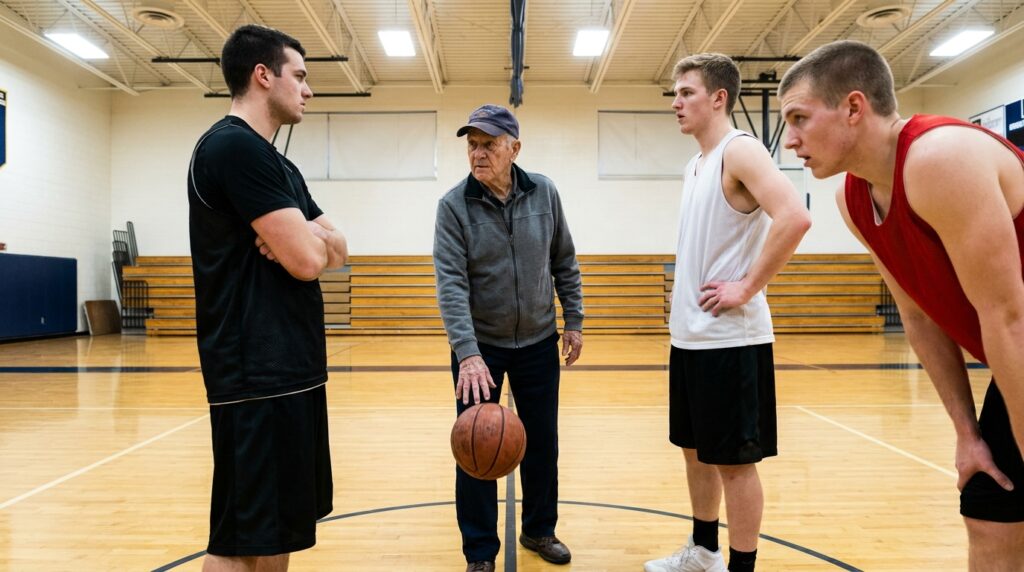
The boundary line beneath the elder’s boot was not mere chalk; it was white municipal paint, thick and deeply blistered by decades of frost and salt. The black jersey’s fingers didn’t just hover—they dropped, a sudden snapping motion intended to grab the zipper of the gray jacket and wrench the older man off balance before he could plant his heels.
The Elder Challenger didn’t pivot. He let his left shoulder drop half an inch, an economy of motion that took his frame out of the direct line of force. The boy’s hand caught only the sliding metal tooth of the zipper, a sharp, metallic ping echoing off the wire mesh of the park fence. The momentum was already wrong. The young man’s weight was carried forward, his center of gravity shifting over his toes as his sneakers scraped against the grinding asphalt grit.
“The lane is closed, son,” the elder said. His voice remained flat, the delivery almost procedural, devoid of the performative anger that filled the playground.
He moved his right foot, releasing the deflated basketball. The leather ball rolled precisely three inches until it struck the rusted steel support base of the light pole, the impact muffled by the flat hiss of its leaked air. As the ball settled, a small patch of nylon netting tangled around its valve stem revealed a wedged object—a heavy, heavily pitted metal whistle, oxidized to the color of dried liver. It lay half-buried in the grime of the leather seams, a relic carried into the game by an entirely different history.
The black jersey didn’t look down at the whistle. His focus was entirely short-range, his recovery violent as he used his athletic frame to crowd the older man, his chest slamming against the elder’s left shoulder check. It was a classic street-court foul disguised as a defensive stance, the wet, hot smell of his skin mixing with the stale river dampness of the canal. To his left, the red jersey moved in parallel, his arms coming up to create an unyielding wall of muscle, effectively boxing the elder inside the white perimeter of the circle.
“You don’t talk to me about lanes,” the black jersey muttered, his face close enough for the elder to note the tiny fracture lines in his lower lip, the skin white with stress. “You don’t know what this circle cost. You don’t know who cleared this dirt when the city left it to rot.”
The elder’s left hand remained flat against his own lower ribs inside the jacket pocket. His thumb was no longer on the brass key; it was anchored against the tough tendon of his thigh, a structural brace. He felt the vibration of the municipal transformer overhead—the low, five-cycle hum that signaled a dying grid. It was the exact pitch of the old industrial generators that used to run behind the brick walls of the decommissioned facility three blocks north.
“I know who built the fence,” the elder murmured, his eyes sweeping across the white jersey, who had now moved into an anchor position near the baseline, his boots locked into the cracked asphalt. “And I know how many tons of gravel went under this court before they poured the topcoat. It was twenty-eight tons of crushed limestone, hauled out of the river docks in seventy-four. The state paid for the stone, but the boys from the district did the grading.”
The black jersey froze for a fraction of a second, his fingers tightening into an involuntary fist against his thigh. The reference wasn’t just old; it was localized. It was a piece of institutional arithmetic that didn’t belong in the mouth of a random wanderer. The tension in the circle didn’t break—it thickened, the air turning dense with the friction of two opposing logics grinding together under the yellow glare.
“Who are you?” the boy asked, his voice losing its rhythmic playground swagger, dropping into a harder, more suspicious register. He didn’t back away; instead, he leaned his weight into the elder’s frame, using his size to assert a physical leverage that was increasingly fragile. “My brother told me about the people who shut the gates. He said they wore gray jackets and didn’t leave names.”
The elder didn’t answer with a name. He shifted his weight back onto his right heel, his posture tightening until his spine was as straight as a surveyors’ transit line. The rusted whistle on the basketball gleamed faintly under the yellow light, its pea long since frozen by corrosion, a silent pocket of authority that had outlived its original purpose.
“The gates were shut because the inventory was empty, son,” the elder said, his hand slowly sliding out of the gray jacket pocket, the palm flat, the skin dry and crosshatched with old scars that looked like fine white thread against the gray fabric. “And the people who shut them didn’t leave names because the ledger was already closed. Now take your hand off my zipper.”
The red jersey lunged then, his movement triggered not by malice, but by the sudden, unnerving collapse of his leader’s confidence. His shoulder came forward in a low, blunt-force tackle designed to drive the elder out of the white circle entirely, his sneakers tearing a gray furrow into the brittle crust of the concrete.








