
CHAPTER 1: THE DUSTY GRAY
The chain-link fence rattled as the wind came off the shipping canal, smelling faintly of rusted iron and dead river water. The Elder Challenger kept his hands deep inside the pockets of his gray zip jacket, his thumb tracing the jagged, oxidized teeth of the brass key hidden against his hip. Every step across the park perimeter felt heavy, his boots grinding into the brittle, sun-baked asphalt where weeds pushed through the cracks like splintered bone. He did not look at the court, but he counted the beats. Thud. Thud. Thud. The ball was heavy, under-inflated, hitting the concrete with a flat, transactional rhythm that he had heard in motor pools and supply depots forty years ago.
The light pole overhead didn’t shine so much as it buzzed, a high-frequency drone that vibrated in the fillings of his teeth. It cast a sharp, cone-shaped glare directly over the center circle, leaving the edges of the park in a desaturated, smoky dark.
He felt the shift before he saw it. The flat rhythm of the ball stopped. A shoe rubber skidded—a sharp, aggressive screech that cut through the low whistle of the canal wind.
“Old man, you’re in the wrong lane,” the boy in the black jersey said, his shoulders leaning forward, casting a long, predatory shadow that stretched across the painted boundary line. “Get off our court before you get hurt.”
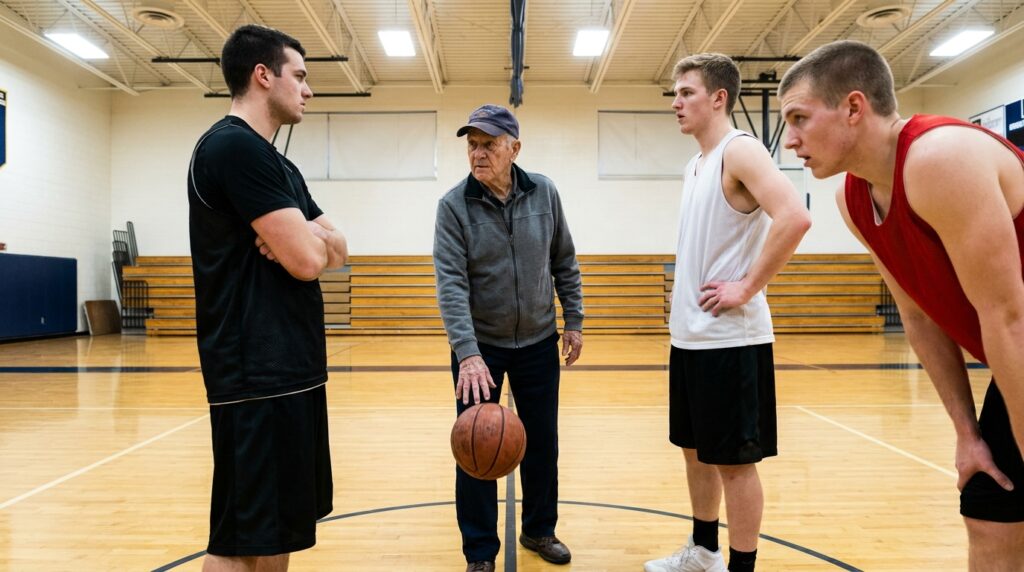
The elder didn’t stop his stride, but his eyes narrowed, calculating the distance. Three of them. Black jersey at the center, red jersey flanking left, white jersey drifting toward the baseline like a spotter in a ditch. They had the tight, lean musculature of young men who lived on adrenaline and short tempers. The air between them tasted of iron filings and stale sweat.
The ball came then. It wasn’t a pass; it was a low, hard drive aimed directly at his shins, meant to trip or force a clumsy scramble.
The elder’s boot didn’t shift. He simply extended one leg, letting the dead weight of the ball strike the thick rubber of his sole. It stopped instantly, trapped against the grit of the ground. The silence that followed was total, save for the rattle of the wire fence.
“You dropped your toy,” the elder said, his voice a low, gravelly rasp that sounded like gravel being turned over with a shovel. He didn’t look down at the ball. He looked directly into the black jersey’s eyes, noting the slight, involuntary twitch in the boy’s left jaw—the universal tell of an amateur who had never been hit by someone who meant it.
The red jersey stepped up, his fingers curling into the fabric of his shorts. The trap was closing under the yellow light, the circle tightening until the smell of their youth was a physical pressure against his chest. In his pocket, his fingers pressed so hard against the sharp edge of the brass key that the metal bit into his skin, leaving a cold, pale indentation. He had spent thirty years avoiding this exact density of air.
“I told you to move,” the black jersey whispered, stepping across the white line into the circle, his hand rising, fingers hooked like iron talons ready to catch the elder’s collar.








