
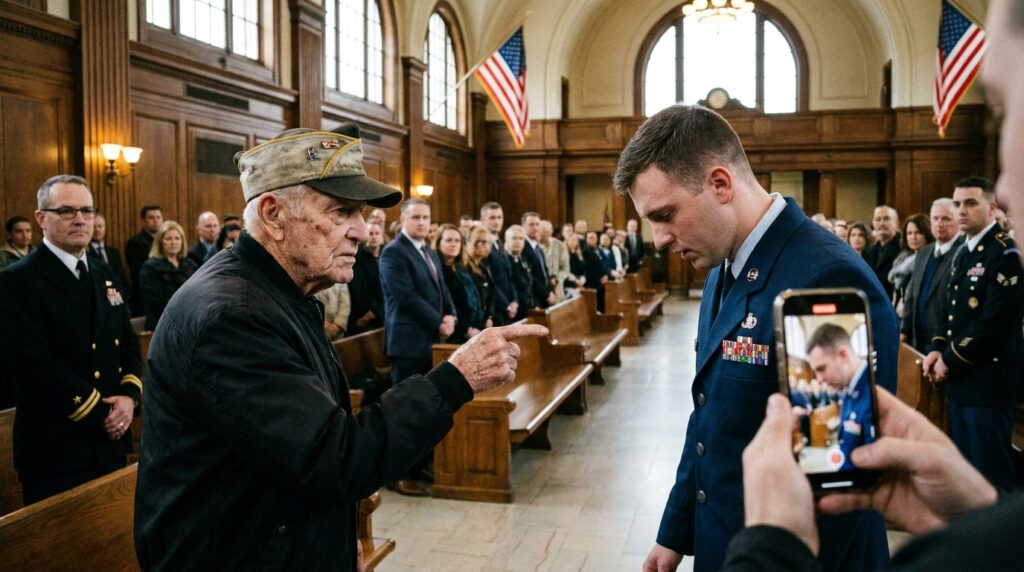
CHAPTER 6: THE PARADE SHIFT
The lead suit’s hand came up, a flat, grey bar of meat designed to block Thomas’s forward line of sight. To his left and right, the remaining two investigators took precise half-steps, their shoulders overlapping to create a wall of dark wool that smelled faintly of dry-cleaner fluid and gun-oil. They didn’t reach for their belts yet; the presence of the general and the open vault doors meant the room was still governed by the cold architecture of protocol.
“The two minutes are running, sir,” the lead suit murmured. His chin was tucked into his collar, his eyes tracking Thomas’s breathing pattern to gauge when the physical contraction would begin.
Thomas didn’t drop his center of gravity. His eyes shifted past the wall of wool, locking onto the general’s retreating spine. The four silver stars on the general’s collar caught the sharp glare of the track lighting as he approached the grand rotunda double doors. Beyond those doors, the low, mechanical thudding of the ceremonial band had ceased. A new sound took its place—the heavy, rhythmic slapping of a multi-service honor guard forming a two-line corridor for the VIP arrivals.
The room was transitioning from an office to a stage.
“Sergeant,” the general’s reedy voice barked, his back still turned as he reached the threshold of the rotunda. “Take your position at the marker. The Undersecretary’s vehicle has crossed the outer checkpoint.”
Thomas felt the air change behind him. The ceremonial guard didn’t snap his heels together this time. The iron report that had defined his institutional discipline since Chapter 1 was absent. Instead, there was a slow, deliberate shifting of leather—the sound of a man sliding his boots across the marble seam to adjust his vector.
“Sir,” the guard said, his voice carrying a raw, unpolished vibration that shattered the standard ceremonial cadence. “The seventy-series prefix… it’s verified on my grandfather’s retirement warrant. The signature on this civilian’s document matches the handwriting on the unit’s final casualty manifestation.”
The general stopped. His right boot remained hovering one inch above the polished brass sill of the rotunda threshold. The silence that fell over the corridor was different from the physical vacuum that followed the guard’s fall in Chapter 2; it was an institutional freeze, the absolute locking of gears when an administrative asset speaks out of sequence.
The lead suit didn’t wait for an order. His left hand shot forward, targeting Thomas’s shoulder to force him behind the velvet rope before the conversation could bleed into the public space.
Thomas didn’t let the glove touch the synthetic fabric of his jacket a second time. With an economic twitch of his shoulder, he dropped his weight three inches, allowing the suit’s hand to slide harmlessly over his collarbone into empty air. Before the investigator could adjust his balance, Thomas’s right elbow clicked into the man’s ribs—not a strike, but a blunt leverage point that pinned the suit’s torso against the marble column behind him.
“Stay on the perimeter,” Thomas warned the other two suits without looking at them. His gravelly voice was a low, transactional rasp that carried no heat. “The sergeant is asking a command question.”
The general turned around slowly. His face was no longer the gray mask of a logistics chief; it was the pale, lined countenance of a man who had spent forty years realizing that some graves don’t stay covered if the soil is too dry. He didn’t look at Thomas. He looked directly at the ceremonial guard, his eyes tracking the slight tilt of the young man’s service cap and the tiny, tarnished brass split-ring tucked into his collar lining.
“Your grandfather was an administrative officer, Sergeant,” the general said, his reedy tone dropping into a register that was nearly inaudible past the velvet ropes. “His records are closed under the fifty-eight retention act. You are out of line.”
“His records were altered,” the guard countered. He took a full step forward, breaking his ceremonial marker entirely, his immaculate blue trousers crossing the path of the three suits. He reached inside his tunic, his gloved fingers clamping onto the edge of the unmarked black leather folder he had hidden in Chapter 4. “The annex cleanup order isn’t an efficiency directive. It’s a removal. My grandfather didn’t die in Frankfurt, General. He died three miles from this building, forty years ago, while your predecessor was rewriting the log.”
The lead investigator, still pinned against the column by Thomas’s elbow, hissed through his teeth. “General, the asset has breached security classification. We need to secure the floor.”
“No,” the general whispered. He stepped back over the brass sill, his oiled leather boots clicking with a heavy, dead sound against the marble chevron. He looked at the yellowed document in Thomas’s hand, then at the guard’s face, realizing the family line hadn’t just survived—it had been stationed at his own gate. “The formation is already outside the door, Sergeant. If you pull that folder out in front of these men, you aren’t just breaking protocol. You’re committing an act of unauthorized disclosure under active operational rules.”
The trap had widened, but the false victory of Thomas’s physical mastery was gone. He was still holding the citation, but the names of the twelve men were no longer just paper; they were a trigger for a blood-feud that had been buried beneath four stars and sixty years of institutional marble. The room was shifting into a mandatory formation, the shadows of the pillars stretching out like iron bars as the advanced party doors at the far end of the gallery began to swing inward.








