
CHAPTER 3: THE ANATOMY OF MOTION
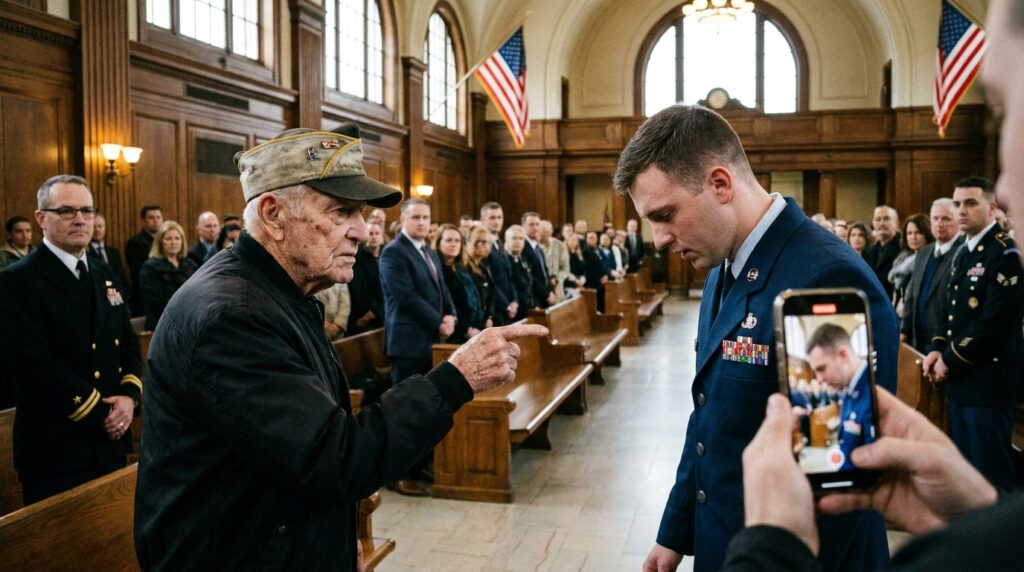
The yellowed document lay precisely between Thomas’s scuffed leather shoe and the guard’s stained white glove. The blue ink of the military seal seemed to absorb the cold overhead lighting, its jagged edges sharp against the white marble. Thomas did not bend his knees to retrieve it. To drop his head now would be to forfeit the precise, geometric perimeter he had just cleared with the younger man’s weight.
Instead, he watched the guard’s throat move—a frantic swallow that rattled the stiff, high collar of his dress tunic. The kid was reconstructing the event internally, looking for the mechanical flaw in his own posture that had allowed a seventy-eight-year-old skeleton to drop eighty pounds of starched muscle. There was no flaw in the guard’s training; there was only a fatal gap in his operational context. He had been taught to manage crowds with presence, not to survive an encounter with a human fulcrum.
“The registry doesn’t show those prefixes,” the guard whispered, his fingers curling against the cold floor. His voice was lower now, stripped of the administrative bark that had filled the hall two minutes ago. His eyes remained locked on the serial numbers printed along the top margin—specifically the small, deformed ‘4’ that had been struck by a misaligned typewriter key forty years in the past. “Those are seventy-series black-line identifiers. My father had three of them in his desk. The same ink. The same broken font.”
Thomas felt his jaw stiffen. The Strategic Pursuit lens clicked into place. Every piece of information an adversary offered was a vulnerability disguised as communication. The guard wasn’t just talking to heal his pride; he was drawing a line between the paper on the floor and a private room somewhere outside these marble walls.
“Your father didn’t earn seventy-series headers by sitting at an entry desk, son,” Thomas said. His hand remained dead at his side, his fingers perfectly loose, ready to capture the next vector if the kid’s adrenaline spiked a second time. “And he didn’t leave them around for children to count.”
“He didn’t leave them at all,” the guard said, and for a micro-second, the rigid mask of institutional authority cracked, revealing the raw, unpolished grit of a family trait Thomas recognized from a hundred wet trenches. “He died in a transit camp near Frankfurt before the wall came down. The files were redacted. Everything except the headers.”
Thomas didn’t let his expression soften. Empathy was an operational weight that dragged down the precision of a move. In his mind, he was already calculating the distance from the desk to the main rotunda doors. The three junior officers near the entrance hadn’t moved; they were paralyzed by the protocol paradox. To arrest an old man who had just effortlessly dismantled a ceremonial guard required an order, and the only man capable of giving that order was currently checking the dust on the floor tiles with his hip.
“Get up,” Thomas commanded. The words were short, dry, and clean, lacking the heat of anger. “The floor is for things that have finished moving.”
The guard’s boots scraped against the marble as he pulled his center of gravity back under his chest. He didn’t rise to his full height immediately. He stayed low, his shoulders slightly rounded beneath the tight blue wool, his hand reaching out to claim his fallen white service cap. The silver insignia on the front was smudged with gray wax, the polished visor holding a thin scratch from its flight against the pillar. He wiped it with the back of his sleeve, a mechanical, defensive gesture to buy time while his lungs recovered their full volume.
Behind the plexiglass partition, the clerk finally found her voice, though it was thin, stripped of its bureaucratic venom. “I’ve… I’ve signaled the duty sergeant’s desk. The escort is on its way from the lower bay.”
Thomas didn’t look at her. “Tell them to bring an archivist who knows how to read an unlisted log. Otherwise, they’re just wasting the brass’s time.”
He reached down then, his movement economic and fluid, his fingers pinching the corner of the yellowed document before the guard’s glove could wander near it again. The paper crackled—a dry, ancient sound that seemed louder than the distant brass band still thumping through the ventilation shafts. As he straightened, he noticed a tiny detail that hadn’t been visible from three feet away: the guard’s collar wasn’t held by standard issue hooks. Beneath the immaculate silver braid, a tiny, tarnished brass split-ring was tucked into the lining—the exact modification field-operatives used in the old sectors to keep their throat microphones from crushing their windpipes during long surveillance details.
The kid hadn’t just inherited his father’s papers; he had inherited his rigging.
“You’re standing in the transit lane, Sergeant,” Thomas noted, his eyes tracking the shadow that was beginning to expand beneath the grand archway at the far end of the corridor. The VIP procession was twenty minutes out, but the advanced security detail—the men with short hair, dark suits, and ear-pieces that didn’t match the ceremonial uniforms—were already moving through the double doors of the gallery.
The guard adjusted his cap, pulling the visor down until the shadow cut across his gray eyes at the exact same angle as the brim of Thomas’s ballcap. The transformation was subtle but complete. The administrative tool was gone; the junior hunter had taken its place.
“The blue bin is where they put things they want to lose,” the guard said, his voice dropping into a register that didn’t carry to the clerk’s desk. He stepped closer, but his weight was distributed evenly between his heels now, his hands clear of his hips, his posture displaying a calculated silence. “The gala today isn’t a celebration, sir. They’re clearing the seventh floor of the annex. If that citation goes into the standard intake, it won’t survive the weekend.”
Thomas held the paper by its edge, his thumb pressing against the deformed ‘4’. The decoy was already forming in the corridor—the appearance of an administrative error, an old man causing a scene over a lost pension or a forgotten ribbon. But the kid’s eyes were too steady now. He wasn’t looking at a civilian nuisance; he was looking at an unexploded ordnance that had just rolled into his specific sector.
“Who told you they were clearing the seventh floor?” Thomas asked.
The guard didn’t answer with words. He merely shifted his right shoulder forward, allowing the track lighting to catch the edge of a small, rectangular leather folder tucked into the interior breast pocket of his dress blues—a folder that bore no crest, no name, and no institutional serial number.








