
CHAPTER 1: THE MARBLE THRESHOLD
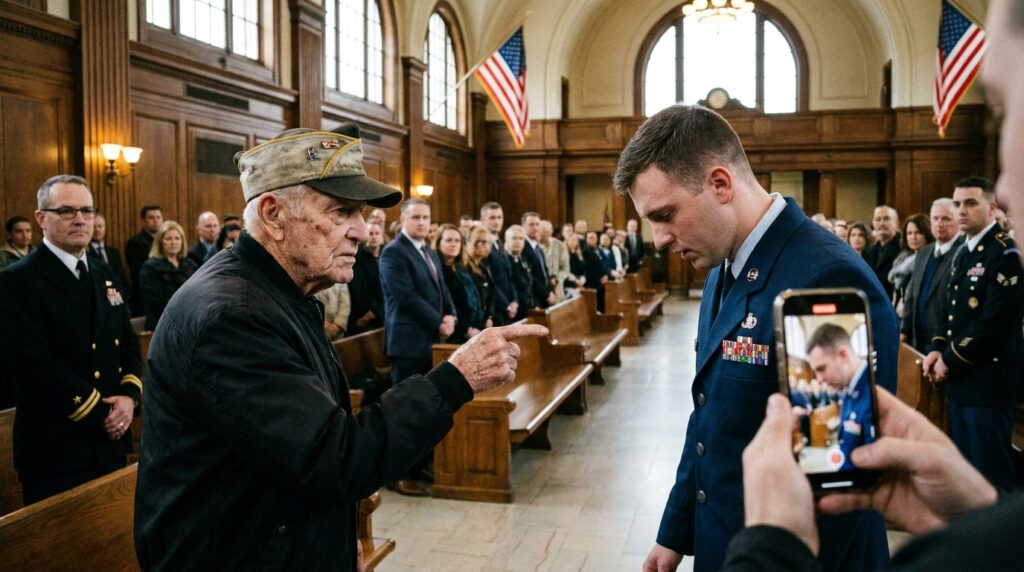
The administrative desk at the entrance of the General Omar Bradley Memorial Hall did not click or hum; it swallowed sound entirely. Thomas stood on the perimeter of the chevron-patterned marble, his calloused thumbs hooked into the shallow pockets of his black windbreaker. The fabric was thin, cheap synthetic that rustled whenever the air conditioning unit overhead cleared its throat.
Across the counter, a civilian clerk with an institutional lanyard didn’t look up from her monitor. Her fingers moved with a rhythmic, rhythmic tapping, entering codes that had nothing to do with sixty years of salt-crusted history.
“It doesn’t go in the bin,” Thomas said. His voice was too low for the cavernous ceiling, a gravelly vibration that barely carried past the plexiglass partition. He laid the document down. The edges of the paper were yellowed, the fiber thick and heavy, bearing the distinct blue-ink stamp of a Department of the Army citation from a budget cycle that had been dead since the Ford administration.
“Everything for the archive goes in the blue bin, sir,” she said, her eyes tracking a progress bar on the screen. “Items are cataloged within forty-eight business hours. If the curator finds a display affinity, you’ll receive an automated notification.”
Thomas watched her hand hover over the sheet. To her, it was a voucher. To him, the faint smell of oil and old mimeograph ink on the page brought back the exact humidity of the Mekong delta, the sound of a rotor blade chewing through wet mountain air, and the specific grease they used to clean the receivers of weapons that officially didn’t exist. He didn’t move his hand from the corner of the page.
A shadow broke the glare of the track lighting.
“Is there an issue with the transit lane, Ma’am?”
The voice was crisp, starched, and entirely devoid of dust. The Ceremonial Guard stepped into the space between the marble column and the desk. He was a foot taller than Thomas, his blue dress uniform tailored so tightly across the shoulders that the silver aiguillette on his left arm didn’t even sway. His medals—clean, modern theater ribbons for logistical support and domestic merit—clinked with a small, metallic precision as he shifted his weight. His face was a mask of high-gloss discipline, clean-shaven to the point of redness.
The clerk didn’t look up, but her typing slowed. “The gentleman is refusing the standard archival intake protocol, Sergeant.”
The guard turned his head toward Thomas. His eyes were light gray, steady, and narrow. He didn’t look at Thomas’s face; he looked at the faded black ballcap with its single, tarnished campaign pin. He looked at the gray hair curling over the ears, and the way Thomas’s left shoulder hung three degrees lower than his right—the permanent signature of an old mortar plate landing five yards too close in 1969.
“The corridor needs to remain clear for the official party, sir,” the guard said, his hand resting naturally near the white leather frog of his ceremonial sword bayonet. “The intake area is for active drop-offs only. If you’ve submitted the paperwork, you need to step behind the velvet rope. Now.”
Thomas didn’t pull his hand back. He felt the subtle vibration of the floorboards—the distant, heavy thump of a military band tuning their brass instruments three floors down. The VIPs were arriving. The air smelled of floor wax and the specific brand of pomade the guard used to keep his side-parts sharp.
“This document isn’t an artifact,” Thomas said softly, his thumb pressing into the yellowed bond. “It’s a correction.”
The guard took one step closer, his chest expanding until the polished buttons of his tunic were inches from the old man’s face. “Move along, old man. This area is restricted for active operations, you’re in the way.”
Thomas noticed the tiny tremor in the guard’s jaw—not from fear, but from the raw, unearned adrenaline of a young man who believed the uniform was the skin rather than the clothes. In the reflection of the guard’s silver breastplate, Thomas could see his own reflection: small, dark, and entirely out of place. But beneath the jacket, his weight shifted two inches to the left, his heels locking into the marble seam.
The guard’s hand reached out, the white cotton glove remarkably clean as it targeted Thomas’s shoulder.








