
CHAPTER 4: THE GROUND UNDERFOOT
The iron bench sat in a pocket of cold purple shadow when Arthur reached the park gate. The storm had held off, but the air had the sour, yellow weight of a stagnant river pool. He could feel the vibration of the valley roads in the arches of his feet—the low, continuous groan of empty flatbeds moving toward the rail yards, their steel tailgates rattling against the frames.
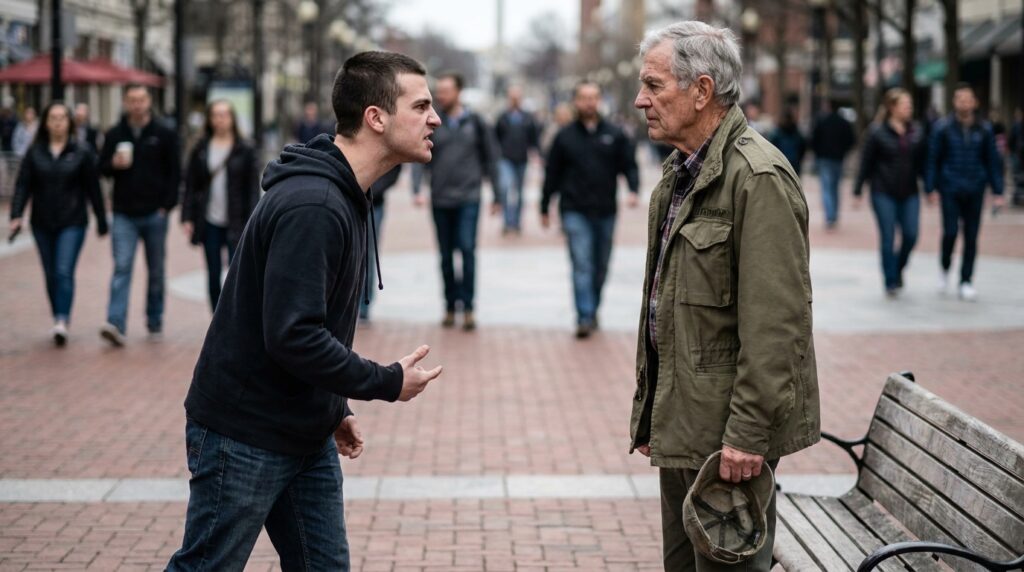
The boy was already there. He was sitting on the grass five yards from the concrete walkway, his knees pulled up to his chin, his oversized pullover smeared with dark grease from the overpass ditch. The heavy canvas ledger lay between his boots like a block of unhewn stone. His hands were tucked inside his sleeves, hiding the fingers that had bled into the rotting twine of the spine.
Arthur didn’t sit. He stopped beside the rusted iron leg of the bench, his palm coming down on the top slat where the green paint had entirely flaked away, leaving the bare, rough metal exposed to the salt of the air.
“They didn’t follow you,” the boy said without looking up. His voice was thin, scrubbed of the mocking bite he had used in the afternoon. “The marshal took the bypass road toward the development office. I saw the lights from the water tower.”
“They won’t come until dawn,” Arthur said. He pulled the yellow register sheet from his coat pocket and let it drop onto the grass near the boy’s sneakers. It didn’t flutter; the paper had absorbed too much dampness to catch the low wind. “David’s checking the land register records at the municipal basement. He thinks I have the original deed from seventy-two.”
The boy reached out a foot and touched the edge of the paper with the toe of his shoe. “Your name is on the fence line, Arthur. My mother told me. She said your family owned the drainage rights from the upper culvert all through the thirty-year run.”
“My grandfather owned the surface,” Arthur said softly. He reached into his coat and pulled out the old pocket watch. The crystal was cracked across the center, a thin white line dividing the copper face into two unequal halves. He didn’t look at the hands; he turned the winding stem three times until the internal spring gave a dry, metallic screech and stopped. “The town council took the depth rights in fifty-one when they laid the main conduit for the foundry cooling beds. They paid us three hundred dollars and a brass voucher for the municipal company store.”
He moved around the bench, his boots crunching into the yellow clover until he stood directly over the circular concrete cap that marked the old unmapped well. The concrete was five feet across, its surface pitted by decades of acid rain until the limestone aggregate showed through like tiny, white teeth. A heavy iron inspection plate was set into the center, secured by four square-headed bolts that had rusted into solid lumps with the casing.
“Open the book,” Arthur said.
The boy shifted, his shoulders dropping as he pulled his hands out of his sleeves. He turned the canvas ledger over, his thumbs finding the back cover where the lining paper had separated from the board. Inside the split, tucked between the pasteboard and the moldering gray cloth, was a single sheet of tracing linen—the blue ink faded to the color of wood smoke, but the lines still sharp, drawn with the heavy, unyielding ruling pens of the old plant engineers.
Arthur knelt. His knees hit the pitted concrete with a dull, wet sound. He didn’t look at the boy’s face; he kept his eyes on the linen layout as the boy unrolled it across the iron inspection plate.
The map didn’t show the streets or the houses or the third forge. It showed lines of flow. A cluster of thick, red-inked arrows originated at the base of the old chemical leaching vats two miles north, following the natural limestone fault lane directly down the dip of the basin. The arrows didn’t stop at the boundary of the yard. They converged into a single, dense spiral centered exactly where the concrete cap sat beneath the bench.
“They filled the ditch with lime in ninety-six because the state inspectors found the sulfur count was too high in the creek,” the boy whispered, his finger tracing the red lines until his nail rested on the spiral. “But they didn’t seal the bottom. They just turned the overflow into the old municipal pump line. My father drank from the Third Street pipe until the day he went into the hospital.”
Arthur reached down and touched the iron inspection plate. The metal was freezing cold despite the June heat, coated with a thin, greasy film that tasted of sulfur and iron-scale when he drew his finger across his lip. “The company didn’t hide the maps from the council, son. The council gave the maps to the company because the town couldn’t afford the remediation bonds. If the state had found out about the well-leak in ninety-six, they’d have cordoned the whole basin from the highway to the ridge. No one could have sold their house. No one could have stayed.”
The boy looked up, his eyes wide and dark in the gathering dusk. “Your boy knew. David knew when he signed the clearance order for the greenway.”
“David knows the land is unbuildable,” Arthur said. His voice came out flat, without anger, the finality of forty years of small compromises settling into the gray gravel around them. “He’s not building houses here. He’s putting five feet of river silt and clay over this acre so the surface runoff doesn’t show the lime-bleed when the county does the ten-year test. He’s capping his own birthright so the firm can sell the upper valley to the rail company.”
He stood up slowly, his joints groaning against the weight of his frame. He reached down, took the tracing linen from the boy’s fingers, and folded it twice before sliding it into the back pocket of his trousers, right against the brass fob of his watch.
“What do we do?” the boy asked. His hand was still resting on the ledger, his body small against the blackening silhouette of the bench.
Arthur looked toward the northern gate where the lights of the sedan were visible now, two pale yellow discs cutting through the dust of the service road. “Go home to your mother, son. Tell her to pack the bedding into the truck. The water from the Third Street tap isn’t going to turn clear because we stayed to watch the grader.”
He turned back to the bench, his canvas coat catching on the iron slats as he sat down, his boots finding the same worn hollows in the gravel where he had spent every afternoon of his retirement. He didn’t look back as the boy rose and began to run toward the gully, the heavy canvas book left behind on the concrete, its pages rustling softly in the first cold wind of the storm.








