
CHAPTER 1: THE FAULT LANE
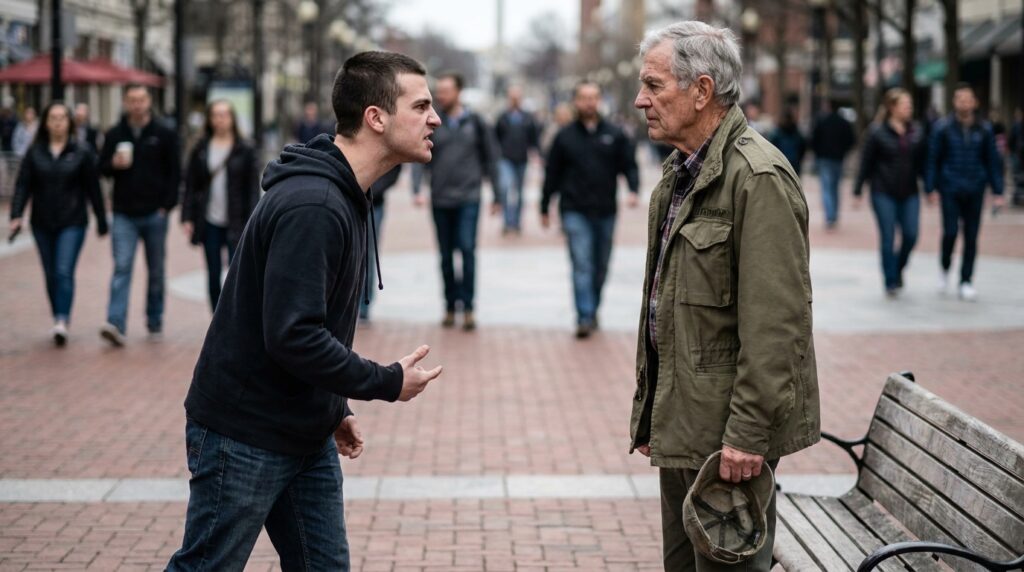
“You should walk away before this gets embarrassing for you.”
The voice was too loud for the heat of the afternoon. It had the sharp, tinny edge of an engine running without enough oil.
Arthur did not shift his weight on the green-painted iron slats of the bench. His hands stayed flat on his thighs, the skin there cross-hatched with pale scars from the old lathe work at the valve plant, forty years of oil-grease ground so deep into the prints it looked like charcoal. He kept his eyes on the far side of the walkway, where the weeds were pushing through the cracked asphalt of the old rail spur.
The boy—man, technically, though he had the narrow, unpadded shoulders of someone who hadn’t finished growing into his ribs—took another half-step forward. His sneakers made a dry, scraping sound against the gravel. He was wearing an oversized black pullover despite the heavy June air, the fabric clean but stiff.
“I’m talking to you, old man,” the boy said. He leaned down, bringing the smell of stale tobacco and cheap mints into Arthur’s space. His shadow fell right across Arthur’s boots, cutting off the small patch of yellow clover growing near the base of the iron frame. “People are tired of looking at you sitting out here like you own the block. Move it along.”
Arthur let the silence stretch. In the valley, if you didn’t answer a dog right away, it either barked harder or it moved on to a different fence. He waited to see which way the boy’s blood would run. The park was empty except for an old woman three hundred yards down by the dry fountain, shaking out a plastic grocery bag. No one was coming to change the math.
The boy’s right hand was tucked deep into his pouch pocket, his wrist turning inward. A small, rhythmic click-click came from the fabric—the latch of a cheap folding knife, or maybe just a heavy set of keys being thumbed over and over.
“I know who your people are, son,” Arthur said. His voice didn’t rise above the drone of the locusts in the dead elms behind them. It came out dry, like two shingles rubbing together in a low wind. “Your grandfather had the third forge from the gate. He didn’t leave his tools to someone who spends his two-o’clock hours running errands for a landlord.”
The boy flinched, his jaw tightening until a small white knot appeared near his ear. “You don’t know anything about my family. The forge closed before I was born. My house is on the list for the July demo.”
“I know,” Arthur said. He finally turned his head, his gray eyes fixing on the boy’s face with the flat, heavy stare of an inspector checking an engine block for cracks. “That’s why you’re standing here instead of doing something that pays. You think if you clear the bench, the town looks bigger to the people with the papers.”
The boy’s hand came out of his pocket, empty but white-knuckled. He reached for the back of the bench, his fingers curling over the iron. “Get off the seat.”
Arthur looked down at the boy’s hand. There was a small, blue ink tattoo between the thumb and the forefinger—a crude line drawing of a broken wheel, the mark the local casual crews used down by the railyards. But underneath the fresh ink, the skin was raw and yellowed by a massive, deep-tissue bruise that ran all the way up under his sleeve. It wasn’t an injury from a fight; it was the distinct, mottled discoloration of chronic chemical exposure, the kind Arthur had seen on forty men before the foundry pumps were sealed.
Arthur didn’t rise. He reached into his casual jacket, his fingers wrapping around the cold, heavy casing of his grandfather’s iron pocket watch. He didn’t pull it out. He just held it against his ribs, feeling the mainspring hum its broken, frantic rhythm.
“I gave you every chance,” Arthur said, his voice dropping into the low, stone-gray register that used to quiet the floor when the cranes were moving overhead. “Now we’re finished here.”
The boy opened his mouth to speak, but the words seemed to stick behind his teeth. He looked at Arthur’s shoulder—upright, unyielding—and then down at the old man’s boots, which hadn’t shifted an inch since the shadow first fell. The bravado went out of his shoulders like air from an unknotted tube, leaving him looking smaller, the streetwear suddenly too large for his frame.
He took a slow step back, his heel catching on the edge of the concrete walkway before he found his balance. His eyes stayed on Arthur’s hands, which were still flat, still still.
“Understood,” the boy muttered, his voice dropping an octave as his eyes darted toward the gravel path behind the bench. “I’m done.”
He didn’t turn around immediately. He backed away three paces, his hands deep in his pullover again, before turning his hip and striking out toward the northern gate where the abandoned freight cars sat rusting in the sun.
Arthur watched him go until the black pullover disappeared behind the gravel bins. Then he let his left hand fall from his jacket. As he pulled his fingers out, his nail caught on the small brass fob of the watch, dragging a small, folded strip of heavy yellow paper out of the lining. It wasn’t his. It had been slipped into his pocket while he’d been watching the boy’s face—a legal description for the land parcel directly beneath the park bench, stamped with an official corporate seal that bore his own last name.








