
CHAPTER 3: THE COLD OFFICE
The black door of the sedan didn’t swing; it clicked with a heavy, oiled precision that belonged to things kept away from valley dust.
A man stepped out into the gravel, his leather-soled shoes making a sharp, unyielding crunch that seemed to strike a chord in the rusted underbelly of the bridge. He was forty, maybe forty-five, his graying hair cropped with the same geometrical accuracy as the corporate headings on the yellow paper. His lightweight gray wool suit looked entirely separate from the damp heat of the ditch, like something sealed behind plate glass.
David didn’t look at the trailers. He didn’t look at Martha or the dog, whose throat was still rattling with an old, wet hate. He looked straight at Arthur.
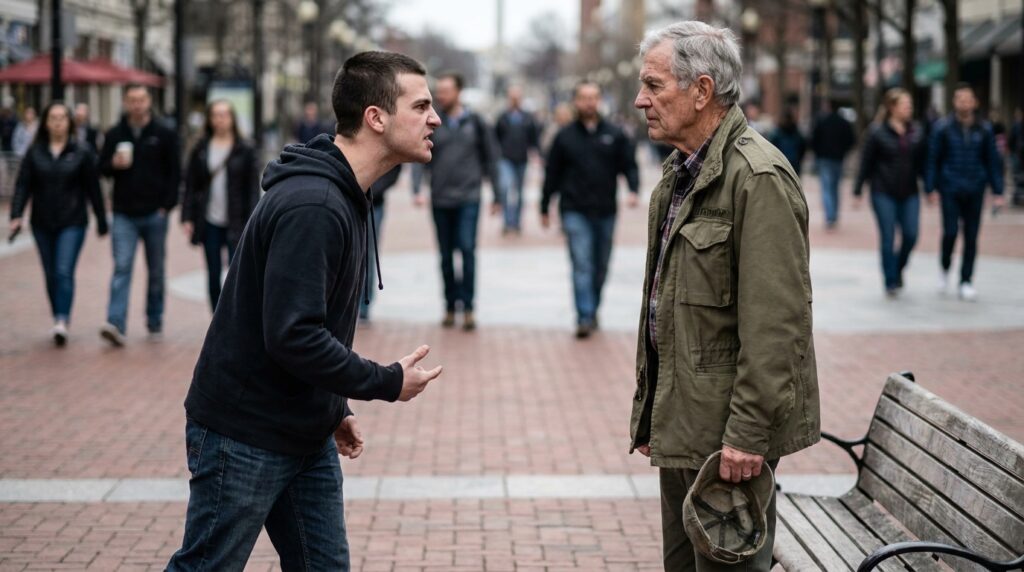
“You shouldn’t be out here, Dad,” David said. His voice was smooth, trained to level out any local vowels that might hint he had spent his first twelve years running down these same slag heaps. “The air near the old spur isn’t clear. You know what the county reports say about the particulate count.”
Arthur didn’t drop his cap. He held it against his stomach, his thumb tracing the worn sweatband where his own salt had stained the leather over thirty seasons. “The county reports are written by people who live sixty miles north, David. This is Martha’s lane. Her boy’s grandfather worked the third forge.”
David took a pair of thin leather driving gloves from his pocket and tapped them against his palm. The motion was small, rhythmic, and perfectly controlled. “The third forge has been dead since eighty-eight, Dad. The property belongs to Valley Holdings now. We took title to the three acres behind the spur three weeks ago. The people here are occupying corporate staging ground.”
“They’re living in their houses,” Arthur said, his voice dropping into that stone-heavy register that used to halt the yard engines.
“They’re shacks on unzoned ballast,” David replied, his eyes moving for a fraction of a second toward the trailer door where the ledger books sat under the unshaded bulb. His expression didn’t change, but his fingers tightened on the gloves. “The county signed the clearance order on Tuesday. I have the master plan in the car. It’s a greenway, Dad. It’s light commercial and a historical park. We’re putting five million into the soil to cap the old industrial footprint. It’s what you and the committee wanted ten years ago.”
Arthur looked down at the yellow paper still crumpled in his hand. “The committee wanted the town kept whole, David. We didn’t ask for the names on the mailboxes to be scraped off with a grader.”
David took a step closer, his leather shoes slipping slightly on the loose slag before his weight adjusted. For a second, the light from under the overpass caught his face, and Arthur saw the faint, pale line of a scar near his chin—the mark from an old bicycle fall on the very rail ties they were standing near. It was the only part of him that looked like it belonged to the valley.
“The town is dead, Dad,” David said softly, his voice dropping enough so Martha wouldn’t catch the edge of it. “It died when the boilers were dumped. You’re sitting on an iron bench waiting for people who went into the ground twenty years ago to come back and take their shift. I’m trying to bring capital back into the basin. If we don’t clear the liability, the state won’t release the highway funds.”
“What liability?” Arthur asked.
David reached out, his gloved hand coming down on Arthur’s forearm with a firm, checking pressure. It wasn’t an attack; it was the gesture of a doctor holding a patient down. “The structural kind. The old foundations are rotting into the water table. The town hall has a four-inch list to the east because the old drainage tunnels beneath Third Street are collapsing. If we don’t cap the whole sector, the center of the block goes down.”
Arthur pulled his arm back, his old skin scraping against the tight grain of David’s leather glove. The friction left a thin white line on Arthur’s wrist. “You signed the eviction for the boy, David. He’s got the mottled skin. His father died of the lung-rot, and now you’re turning him into the ditch because he looks bad from the road.”
David’s face finally hardened, the smooth corporate mask settling until his eyes looked like two cold rivets. “The boy broke into the vault at the old administrative building, Dad. He took six boxes of archived maps and three ledgers that belong to the receiver’s estate. That’s a felony. I’m here with the county marshal to secure the company’s property before he does something that can’t be settled with a check.”
As if on cue, the rear door of the black sedan opened another three inches. A man in a brown uniform with a heavy brass star on his pocket sat in the shadow of the wheel, his hand resting on the rim of the steering column. He didn’t get out, but the interior light stayed on, illuminating a stack of red-stamped warrants on the dashboard.
Arthur turned his head toward the trailer door. The boy was standing there now, his black pullover bunching around his throat, his face pale except for the bright red circles around his eyes. He had the heaviest canvas ledger tucked under his left arm, his hand gripping the rotting binding so hard his fingernails were bleeding into the cloth.
“Don’t let them take the books, Arthur,” the boy yelled, his voice cracking into a high, frantic scream that made the red setter jump to its feet. “They’re hiding the numbers from forty-four! The maps show where the pipeline ran before they filled the ditch with lime!”
David didn’t look back at the boy. He kept his eyes locked on his father’s weathered face. “The maps are public record, Dad. They’re in the courthouse index. The boy is reading old rumors from the union newsletters. There is nothing under the park but six feet of gravel and two hundred miles of dead wire.”
He reached out his hand, palm up, toward the paper in Arthur’s fingers. “Give me the register sheet. Let me do my job, and I’ll have the marshal drive you back to Fourth Street before the storm hits.”
Arthur looked at his son’s open palm. The leather was clean, without a single spot of grease or rust. Then he looked past him, down the gully toward the southern gate where the park bench sat in its small circle of yellow clover, directly above the deep, silent stone well that had been boarded up since the year David was born. He didn’t give him the paper. He tucked it back into his jacket pocket, right next to the iron watch that was ticking too fast against his ribs.
“The courthouse burnt its records in ninety-six, David,” Arthur said, his voice dropping into a register that wasn’t heavy anymore—just cold and flat like a winter creek. “I was on the council that year. We didn’t burn the maps. We gave them to your office for safe-keeping.”
He turned away from the sedan, his boots turning toward the trailer door where the boy stood with his bleeding fingers. Behind him, the car door clicked again, louder this time, as the man with the star put his boots into the gravel.








