
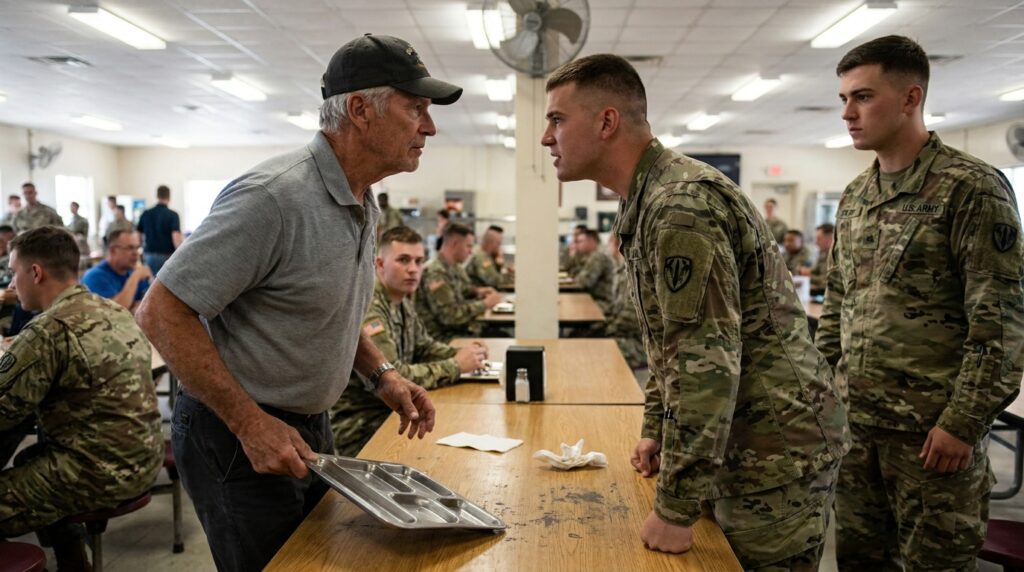
CHAPTER 3: THE LINE OF FRICTION
The step I took wasn’t large—maybe six inches of clearance into the gray space between our tables—but it locked my boots into the line of friction. Ramos didn’t drop his chin. The tactical vest across his ribs creaked as his breath hitched, a stiff, synthetic protest from the nylon weave. He was trapped between the instinct to hold his ground and the sudden, cold intelligence coming from his perimeter. His partner was already backing away, his heels rhythmically ticking against the baseboards of the tray return station.
“You’ve got thirty seconds before the shift whistle blew for the fuel pool mechanics,” I said, keeping my gaze level with the top button of his combat shirt. “When they hit that double door, they don’t look for individuals. They look for clearance. If you’re standing in the central aisle with your fingers on an unassigned tray, you’re the bottleneck.”
Ramos glanced down at his hand, which still hovered an inch above the green plastic tray. The irregular vertical scratch in the laminate seemed to split his reflection in two. He wasn’t stupid. He’d survived a deployment cycle or at least a high-stress garrison rotation; he knew that everything on a base this size moved by weight and velocity. But his pride was a physical drag, pulling his jawline down into a hard, stubborn wedge.
“We aren’t third platoon,” he muttered, his voice losing its public resonance, dropping into the dry sand of a private calculation. “We’re out of the support detachment. We don’t take the fuel pool whistle.”
“Then you’re five minutes late for the logistics log-in at building four,” I replied, my fingers tapping the corner of the leather folder. The water had soaked into the pigskin, but it stopped exactly where the standard barcode sticker should have been. The clean, white adhesive square was gone, peeled back down to the fiber years ago, leaving only a dark residue that caught the glare of the fluorescent tubes. A regular retirement file carried three separate tracking strips. This one was naked.
Ramos noticed it. His eyes traced the missing label, then flicked to the heavy silver ring on my left hand. The deep structural gouges across the face of the metal weren’t decorative; they were the precise signature of hydraulic equipment failures—the kind that happened when a hydraulic hatch dropped three inches too fast on a submarine deck or a heavy transport ramp.
“Who gave you that folder?” he asked, his posture dropping another two inches, the aggressive slant of his shoulders flattening out into the wary stance of a scout who just found an unmarked wire across the trail.
“The kind of man who doesn’t use the front gate,” I said.
The silence around us was no longer a localized bubble. The corporal two rows over had set his fork flat on the aluminum surface with a clean, metallic ring. Three other junior soldiers from the logistics crew turned their heads, their faces silhouetted against the bright, dusty glare of the western windows. They weren’t looking at a civilian anymore. They were watching a dynamic they couldn’t categorize, a breakdown in the daily cadence of the facility that carried the distinct smell of an inspection.
The shorter soldier, the one who’d been pulling Ramos toward the scullery line, stepped fully out of the lane. His boots made a sharp leather scuff against the linoleum. “Ramos. Seriously. Look at the cap. That’s an unpatched cover from the ninety-first group. They deactivated that unit before we were in middle school.”
Ramos didn’t move his head, but his fingers finally left the plastic tray, his hands dropping down to his sides where they hooked into the webbing of his belt. The grease prints he’d left on the green laminate began to fade, the thin film of moisture evaporating under the dry heat of the overhead blowers. He was looking at the bill of my cap now, searching for a name tape or a unit pin that wasn’t there.
“My grandfather was in the ninety-first,” Ramos said, the words coming out tight and defensive, a shield manufactured from family history to cover the retreat. “He went out through Fort Hood.”
“Then he knew how to clear a table when an officer walked into the box,” I said, my voice dropping an octave, carrying the dry, unyielding weight of an old-school logbook entry. “And he knew that when an older man stands up, you don’t keep your hand pinned to the grease line.”
The tension didn’t break; it simply rolled backward, transferring from the kid’s chest to the narrow space between the table legs. The air felt thin, full of the stale scent of industrial dishwashers and the metallic tang of old copper piping under the sinks. Ramos took his first full step back, his right boot crossing the center line of the linoleum tile. His partner followed immediately, his shoulder checking the edge of the adjacent partition with a low, wooden thud.
“We’re moving,” Ramos said to the room at large, though his eyes never left the silver ring on my finger. “We’ve got the logistics detail at thirteen-hundred.”
I didn’t answer him. I watched the space between us widen to three feet, then four, until the dark shadows of the warehouse doors behind the tray line absorbed their silhouettes. The green tray remained on the corner of my table, the irregular vertical scratch catching a single, cold line of fluorescent light like an open seam in the plastic.
I sat back down, my knees giving a short, silent click as the joint settled into the frame of the aluminum chair. The leather folder was still wet, the tan hide turning a darker shade of rust under my palm. The first phase of the friction was over, but the room hadn’t gone back to chewing. The silence stayed heavy, waiting for the secondary weight to hit the floor.








