
CHAPTER 2: THE SHIFT IN GRAVITY
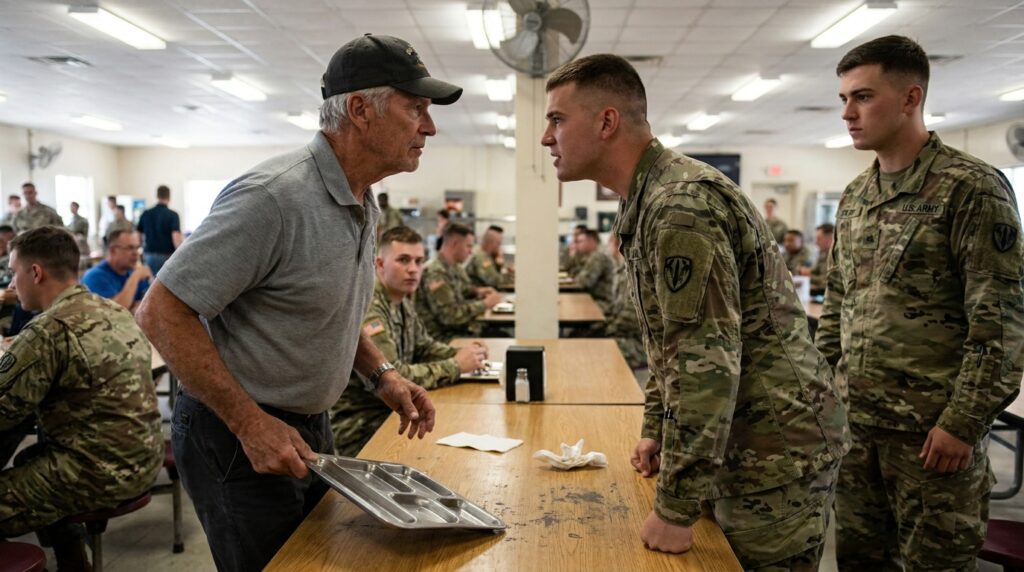
The transition from sitting to standing was an exercise in calculated leverage. My knees didn’t pop, though the fluid in the left joint burned like cold oil. I let the center of my mass settle forward, my broad shoulders squaring under the faded gray polo shirt until the brim of my dark cap intercepted the harsh glare of the fluorescent tubes directly above the kid’s face. Up close, the green of his camouflage uniform wasn’t a solid tone; it was an intersection of sharp, digital squares designed to break up a silhouette in a forest, but inside the sterile, white-washed box of the dining facility, it just made him look loud. Monstrously loud.
He didn’t step back. His boots stayed glued to the red-speckled linoleum, but his weight shifted instinctively from his toes to his heels. His eyes, small and bright with the cheap adrenaline of a twenty-year-old who hadn’t seen anything bloodier than a training dummy, flicked down to my hands.
My left hand remained flat on the Formica, two inches from the heavy plastic lip of his tray. Between his fingers and mine lay a deep, irregular vertical scratch cutting through the lower half of the green laminate—a scar in the plastic where someone had dragged a combat knife or a broken cleaning rod years ago. It was grey with embedded grease. I didn’t take my eyes off that scratch. It was a fixed point in space.
“You’ve got a loose thread on your left shoulder tab, son,” I said, my voice dropping back into that low, flat cadence that doesn’t ask for permission to be heard. It was the tone used in briefing huts when the generators were failing and the fuel trucks were forty minutes out through the mud. “And your partner’s standing in the grease trap line. If someone comes out of the scullery with a rack of wet steel, he’s going to take a five-foot drop onto his spine.”
Behind him, the kid with the high-and-tight haircut made a small, wet sound in his throat—a half-finished grunt that died before it hit his teeth. His heels clicked back two inches. He’d recognized the rhythm. A civilian doesn’t talk about scullery racks or shoulder tabs with that specific, dry lack of emphasis. A civilian looks at the uniform; they don’t look at the maintenance of the man inside it.
The lead kid—the one whose tray was still pinning the corner of my old leather folder—tightened his jaw until the tendons pulled tight against his ears. He was committed now. Six hundred people were still chewing their meatloaf and Salisbury steak within earshot, but the immediate cluster of four tables had gone completely dark. A corporal two rows over stopped his fork halfway to his mouth, his eyes locked on the gray fabric of my shirt.
“I don’t care if you used to drive a truck in Nam, old man,” the lead kid muttered, but the edge had gone blunt. The words were there, but the spacing between them was uneven. He was looking for an exit sign that didn’t make him look like a coward in front of his squad. “This area is reserved for the third platoon rotation. You’re occupying space.”
“The space belongs to whoever’s holding the paper,” I said.
I reached down with my right hand, my fingers wrapping around the frayed edge of the leather folder. The water from his tray had soaked through the lower three inches of the hide, turning the tan pigskin a deep, bruised black. When I lifted it, the wet cardboard interior didn’t bend; it remained perfectly rigid, the weight of the thick administrative sheets inside keeping it square. I didn’t open it. I didn’t show him the red stamp on the first divider or the unique, seven-digit clearance string that wasn’t formatted like a standard Department of Defense serial number. I just set it back down on the dry section of the table with a dull, heavy thud that sounded like a brick hitting a mattress.
The shadow of the table edge caught the kid’s boots as he took his first true half-step backward. His fingers drifted off the green plastic tray, leaving ten distinct grease prints where his skin had been pressing down hard enough to whiten the nails.
“We’re on a schedule,” the shorter one behind him said, his voice lacks the sharpness it had thirty seconds ago. He was looking at the old silver ring on my left hand now—specifically at the deep structural gouges across the face where the metal had been compressed under extreme pressure. “Ramos, let’s go. The line’s moving.”
The lead kid—Ramos—didn’t look at his buddy. He kept his eyes on the bill of my cap, his chest rising and falling beneath his load-bearing vest with a short, shallow rhythm. He could feel the room turning. The silent weight of three hundred other junior enlisted men wasn’t supporting him anymore; it was waiting to see how far he’d sink before he found bottom. The sharp edges of the aluminum chairs around us felt closer now, narrowing the lane until there was only room for one of us to move forward without clearing a path with his elbows.
I didn’t give him the room. I took one slow step toward the center line of the table, my shoulder catching the light from the western windows where the dust motes hung like iron filings in the sun.








