
CHAPTER 1: THE WEIGHT OF THE TRAY
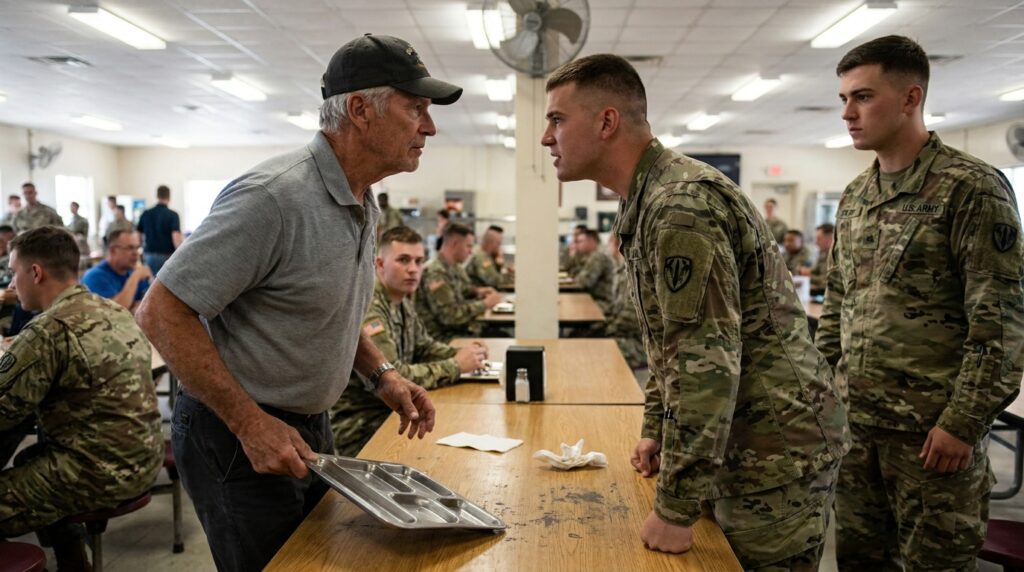
The fluorescent tubes hummed with a flat, industrial vibration that rattled the back of my jaw if I sat too still. Around me, six hundred active-duty bodies moved through the dining facility with the loud, unthinking momentum of machinery that hadn’t yet hit its first major breakdown. They smelled of sweat, damp canvas, and the cheap high-fructose syrup from the beverage dispensers near the line. To them, I was just a gray polo shirt, a dark cap pulled low to hide the thinning hair at my crown, and a pair of hands skin-mapped with liver spots resting flat on a Formica tabletop.
I looked at the leather folder sitting beside my half-empty water glass. The edge was frayed, exposing the gray cardboard binding beneath the hide. It was a heavy piece of business, the kind that didn’t exist in the digital tracking logs of the junior clerks at the front gate.
Then the air changed. It wasn’t a sound—the clatter of aluminum forks against thick ceramic plates remained constant—but a shift in the local gravity behind my left shoulder. Two pair of boots, their rubber lugs heavy and unpolished from a field rotation, stopped right at the perimeter of my chair legs.
“Hey old-timer, you’re in the wrong lane,” the kid in the clean camouflage said, his voice dropping into that specific, performance-grade register meant to carry across a room without triggering an NCO’s radar. “This mess hall is for real soldiers.”
He didn’t wait for me to look up. He shoved his tray down—a hard, metallic crack as the green plastic struck the exact boundary line where my water glass sat. The impact sent a thin sheet of water across the laminate, soaking into the edge of my old leather folder. His buddy, shorter with a razor-close high-and-tight haircut, stepped into the gap between the adjacent tables, blocking the path back toward the exit doors. They were testing the friction. They wanted a civilian to shrink, to apologize for taking up space in their world, to acknowledge that seventy years of life was a liability inside an active fence.
My fingers didn’t leave the laminate. I watched the water pool against the silver ring on my left hand—the metal was scratched down to the dull gray core, the old seal worn smooth from three decades of contact with steering wheels and steel desk edges.
The kid was leaning forward now, his chest three inches from my cap brim. He thought he had the corners covered. He thought the physics of the room belonged to him because his knees didn’t ache when the weather turned.
I took a slow breath, letting the institutional grease and hot coffee fill my lungs until the old rhythm took over—the one that doesn’t calculate fear, only distance and mass. My hands moved back from the wet Formica, clearing the tray by less than an inch. I didn’t look at his eyes yet. I looked at the pulse point vibrating at the base of his jawline, right where the stiff collar of his utility uniform met his skin. It was beating too fast for a boy who thought he was in control.
“You boys should think twice,” I said, my voice rising from the bottom of my throat like gravel turning over under a tire, “before making that mistake again.”
I didn’t rush the movement. I pushed up from the chair, letting the weight shift clean through my heels, rising until the dark cap brim cleared his shoulder line.








