The Cold Geometry of the Curb: A Study in Suburban Reckoning and Concrete Fact
CHAPTER 1: THE FRONTWHEEL EMBARGO
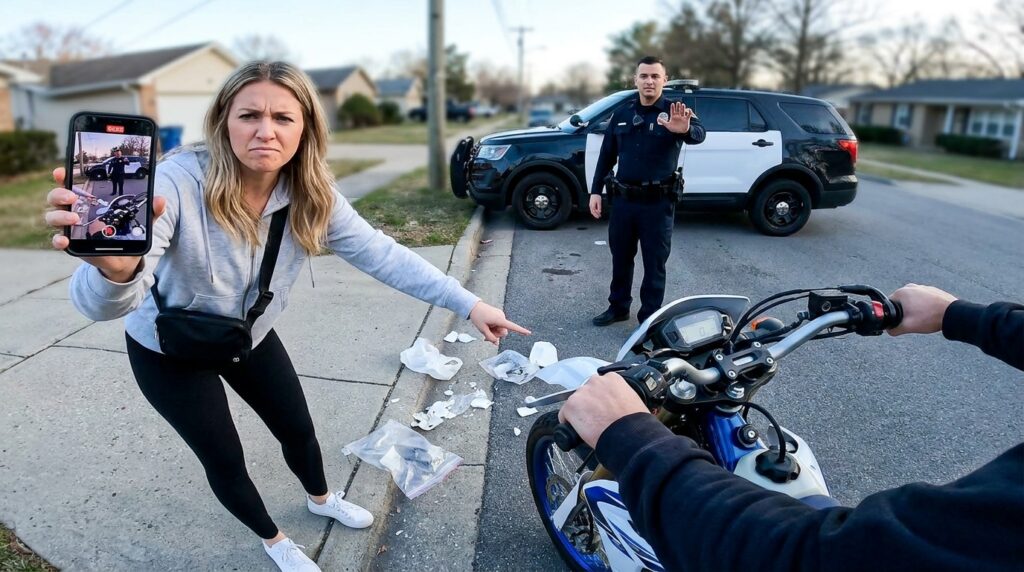
The blue fiberglass of the front fairing was three inches from the gray fabric of her zip hoodie when she hit the record button.
Leo Vance didn’t kill the engine. The 750cc twin-stroke sat beneath his thighs in a rhythmic, oily low-register vibration, its heat rising against the inside of his heavy riding sleeves. He kept his gloved palms fixed flat over the rubber grips, his fingers resting precisely on the cold steel levers of the brake and throttle. He did not look up at her face. Through the dark tint of his visor, his world was limited to the sharp edge of a black smartphone case and the twitching white rubber soles of Sandra’s sneakers planted flat on the asphalt grit.
“Stop right there, you are not leaving this mess!”
Her voice had the dry, rattling texture of wind through dead hedges. It carried across the manicured turf of the Whispering Pines easement, cutting through the thin morning air. To his left, three clear polyethylene contractor sacks sat slumped against the concrete curb line. Through the stretched plastic, the jagged, chalky white profiles of broken plaster molds and unmixed cement chunks pressed outward like skeletal knuckles. White powder had already leaked from a torn seam, tracing a pale, dusty crescent across the dark gutter.
Sandra leaned lower, her broad shadow blotting out the glare of the digital dash display between Leo’s handlebars. The plastic lens of her phone camera hovered inches from his face shield, catching the reflection of his matte-black helmet. Her arm was rigid, the black crossbody bag pressed taut against her ribs as her chest heaved. “I am recording you too, do not twist this!” she yelled, her fingers tightening around the edge of the screen until the knuckles showed white. “Look at me. Look at the camera.”
Leo remained perfectly still within his leather shell. He didn’t blink. His left wrist remained dropped, keeping the clutch fully compressed, holding the transmission in its neutral, waiting notch. He could feel the small, cold drip of sweat trailing down his temple, but his face remained a mask behind the polycarbonate glare. He had calculated the distance to the curb strip. If he tilted the chassis five degrees to the right, the rear tire would clear her left hip by an inch, but the maneuver would require an abrupt twist of the throttle—a gesture she would interpret, and document, as vehicular assault.
She wanted the reaction. She needed the physical escalation to validate the stack of orange violation notices currently sitting in a neat file on his kitchen table.
“Touch that bike again and you answer for it!” Sandra snapped, stepping closer until her leggings brushed the black metal of the engine guard. Her index finger stabbed downward toward his throttle hand, her loose blonde hair swinging forward into the shadow of the bike’s fairing. “You think because you drive a commercial rig you can turn this cul-de-sac into a landfill? The board is done with you, Leo. I’m done with you.”
Across the two-lane street, a slatted window blind inside the brick facade of number forty-two shifted upward by half an inch. A pale forehead pressed against the glass. Behind Leo’s back, the distant, hydraulic wheeze of a delivery van slowing down at the intersection signaled the arrival of a wider audience. He didn’t turn his head to look. His gaze remained locked on the small, silver screw heads holding Sandra’s phone case together. He knew the camera was rolling, but he also knew his own helmet mount was humming with a faint, steady green indicator light.
Then came the low, heavy thrum from the end of the block—the unmistakable, flat weight of a standard municipal V8 engine shifting down into second gear.

CHAPTER 2: THE ARCHITECTURE OF HARASSMENT
The heavy thrum of the approaching municipal V8 engine didn’t break Sandra’s stare; it anchored it. She didn’t drop the phone. The glare of the morning sun caught the smooth, greasy smudges left by her thumbs on the screen glass, a shifting prism of blue sky and gray asphalt crossing over Leo’s reflection.
Leo didn’t move his boots from the pegs. The vibration of the 750cc block was a steady, metallic pulse against his shins, the heat radiating off the cooling fins with the scent of unburned premium fuel and hot oil. Through the dark tint of his visor, the world was a calculated grid of boundaries. He noted the sharp yellow utility flags stuck like tiny plastic graves along the edge of his property line—flags Sandra had ordered placed three days ago under the guise of an upcoming county drainage audit. Every move she made had a paper trail, a slow, bureaucratic strangulation designed to turn his thirty-year tenure into a series of costly line-item infractions.
“You think you can just sit there and let it idle?” Sandra’s face tightened, the skin across her cheekbones pulling taut as she leaned her hip closer to the front tire’s blue fiberglass fender. Her white sneaker shifted, grinding a loose fragment of white plaster dust into the dark asphalt until it smeared like chalk. “The noise ordinance for non-standard exhausts kicks in at seven-thirty. It’s seven-thirty-four, Leo. That’s another fifty bucks to the district court. Go ahead. Leave it running.”
Leo didn’t answer. He adjusted his index finger over the brake lever, his leather glove creaking softly against the metal. In his chest, the old wound of the last six months burned with a cold, dull precision. First came the certified letters about his commercial ladder racks. Then the double-fines for the gravel dust on his rear bumper. Sandra didn’t just want the curb clean; she wanted the street entirely scrubbed of anyone who worked with their hands. She viewed the neighborhood through the lens of a pristine corporate ledger, and Leo’s blue-collar presence was an unapproved expense she was determined to write off.
He reached down with his left hand, his thumb catching the edge of his zip pocket. Inside, his fingers brushed against the cold, notched edge of a rusted brass key—the key to the old tool shed at the back of Sandra’s lot, a structure he had helped her reinforce three summers ago before her husband cleared out the garage and left the state. It was an old piece of metal, forgotten by her, but preserved by him as a reminder of a time when boundaries weren’t drawn with legal threats and smartphone lenses. He kept his hand there, calculating the risk.
“The whole board is watching this stream,” Sandra whispered, her voice dropping into a raspy, intimate cadence that barely carried over the idle of the engine. She brought the phone closer, her eyes darting toward the distant slatted blinds at number forty-two. “They’re seeing the contractor who refuses to comply. They’re seeing the trash you brought home from your site because you didn’t want to pay the commercial dump fee at the county line. It’s all right here on the screen.”
Through the clear polyethylene sacks at the curb, Leo could see the distinct, grey-green logo of Mid-Atlantic Masonry Supply stamped onto a torn sheet of internal lining paper. He knew that logo. He had used the same supplier for a retaining wall three miles south last November. But these bags weren’t his; the tie-strings were a cheap, yellow nylon braid that his crew never carried. Sandra had bought these from the local depot on the highway, likely using the HOA’s preferred commercial discount code. The trap was clumsy, but in the court of suburban opinion, visibility was ninety percent of the law. If his bike was framed next to the bags when the patrol car stopped, the narrative would lock into place before he could even unbuckle his helmet.
The shadow of a mature oak tree stretched across the driveway, its branches throwing long, jagged knives of black across Sandra’s gray hoodie. She didn’t notice the cold air dropping as the sun dipped behind a low ridge of clouds, but Leo felt the engine temperature gauge click upward by two degrees on his digital dash. The black-and-white SUV was fifty yards away now, its roof-mounted light bars dark but its front grill pushing through the morning haze like an unblinking eye.
Sandra straightened her spine, her arm rising an inch higher as she prepared to hand over her curated reality to the law. She thought she had established the perfect perimeter—a line of white dust, a trapped biker, and a clean digital record. She didn’t know that every targeted citation she had slipped into his mailbox over the last ninety days had been scanned, logged, and cross-referenced with the county zoning maps currently cached on the tablet inside his riding pack.
He let the clutch out a fraction of a millimeter. The motorcycle gave a short, heavy twitch against the asphalt, the chain tightening against the sprocket with a sharp, dry snap of iron. Sandra didn’t flinch; she leaned her weight directly onto the front tire’s track, her teeth showing behind her thin lips.
“Go on,” she whispered against the glass of her phone. “Move.”
CHAPTER 3: THE ARRIVAL OF THE CRUISER
The front bumper of the Ford Explorer came to a stop exactly two feet behind Sandra’s left shoulder, its heavy rubber tires biting down on the loose gravel at the lip of the driveway with a dry, grinding crunch. The engine didn’t cut out. It remained idling in a low, heavy bass register that instantly competed with the twin-stroke vibration between Leo’s thighs, creating a strange, discordant frequency that rattled the plastic housing of his side mirrors.
Leo didn’t shift his gaze from the reflection in her phone screen. He watched the white flash of the vehicle’s reverse lights drop into park, followed by the hydraulic hiss of the door seal breaking.
Officer Miller stepped out into the grey morning light. His boots—heavy, black, leather-topped service issue—hit the asphalt with a dense, unyielding thud. The links of his duty belt clicked together in a rapid metallic sequence as he adjusted his stance, his gloved right hand resting naturally over the plastic retaining clip of his holster. He didn’t drop his chin to look at the scattered bags of plaster; his eyes scanned the space between Leo’s front tire and Sandra’s waist with the flat, mechanical neutrality of an insurance adjuster.
“Everyone back up,” Miller said. His voice wasn’t loud, but it had a clean, structural weight that seemed to drop the ambient temperature of the street by five degrees. “Hands off the motorcycle now.”
Sandra’s arm flinched upward, her phone swinging in a jagged arc as she turned her head toward the cruiser. The hard line of her frown broke for a fraction of a second, replaced by a quick, hungry twitch at the corner of her mouth. She didn’t lower the device; she angled the lens toward the officer’s badge, her white sneakers shifting two inches to the left to ensure she maintained her blockade of Leo’s front fairing.
“Officer, thank god,” she began, her breath rattling through the light gray mesh of her hoodie. She reached down with her free hand, pointing a manicured nail directly at the white powder trailing from the polyethylene sacks into Leo’s grease strip. “He’s been idling here for ten minutes, trying to push past me to get away from the cleanup. I caught him red-handed. The whole block has the stream.”
Miller didn’t answer her. He walked three steps forward, his silhouette broad against the glare of the cruiser’s overhead strobe bar, which remained dark but metallic in the overcast light. He stopped at the exact point where Leo’s front wheel met the gutter line. His thumb, marked by a fresh smear of black machinery grease near the nail, traced the top edge of his leather notebook pocket. He looked at Leo’s visor, then down at the gloved hands still clamped around the chrome grips.
“Sir, turn the ignition off,” Miller said.
Leo didn’t hesitate. He maintained his left hand’s lock on the clutch lever while his right index finger reached up, flipping the red kill switch. The 750cc engine gave a short, heavy cough and died, dropping the driveway into a sudden, vacuum-like silence where the only sound was the clicking of the cooling fins and the distant hiss of Sandra’s phone battery warm against her palm. He didn’t remove his helmet. He kept his visor down, keeping the digital HUD display on his right lens locked on the storage space under his seat where the scanned HOA receipts were saved.
“Ma’am,” Miller turned his shoulder toward Sandra, his body effectively cutting off her angle of view into the motorcycle’s cockpit. His dark uniform fabric was dusty along the seams, smelling faintly of stale cruiser upholstery and industrial laundry detergent. “Step away from the vehicle. Move back to the concrete curb line.”
“I’m the vice-president of the association, Officer,” Sandra said, her voice rising an octave as she thrust the phone case closer to Miller’s chest. The black strap of her crossbody bag slipped down her arm, her fingers tightening around the synthetic webbing. “This is our easement. He’s violating section four of the municipal waste code. I have a right to document the vehicle identity before he destroys the physical evidence.”
“I didn’t ask for your title, ma’am,” Miller said. He didn’t take the phone from her. He didn’t look at the screen. He simply stood between her and the blue fiberglass fairing, his chest a solid barrier of dark wool and ballistic nylon. “I told you to step to the curb. Now.”
The silence that followed was sharp, defined by the dry rustle of the oak leaves overhead. Across the street at number forty-two, the slatted blinds dropped back into place with a hollow click, but the front door opened by three inches, a white sliver of an apron showing through the gap. The delivery van at the corner remained parked, its hazards pulsing a rhythmic amber glow against the gray brick of the neighborhood entrance pillars.
Sandra’s foot moved back one inch. Then another. Her white sneakers found the hard, square edge of the concrete gutter, her shoulders tensing beneath the gray hoodie as she realized the perimeter had just shifted three feet away from her control. She kept the phone lifted, but her lens was now tracking the grease stain on Miller’s thumb instead of Leo’s face shield.
Leo slowly released the clutch lever. The bike sat balanced between his boots, heavy and cold, a raw piece of machinery waiting for the next structural calculation to drop into place.
CHAPTER 4: THE INVERSION OF PROOF
“Let me see the manifest,” Officer Miller said, his boots grinding a fresh pocket of plaster dust into the asphalt as he knelt beside the primary contractor sack.
Leo watched the heavy black leather of the officer’s gloves press against the crinkling clear plastic. The material buckled under the weight, releasing a small puff of chalky white residue that settled onto the clean chrome of Leo’s lower exhaust pipe. With a sharp tug, Miller tore a six-inch flap down the side of the polyethylene wall, his fingers digging past the jagged chunks of gray mortar until they caught the corner of a folded, multi-page paper sheet. It was damp from the morning humidity, the ink slightly bleeding into the pulp, but the bold, block letterhead of Mid-Atlantic Masonry Supply remained perfectly legible against the grimy background.
Sandra took a half-step forward from the concrete gutter, her white sneakers hovering right on the dividing line of the curb strip. The phone in her raised hand tilted downward, the lens struggling to focus through the shadow cast by Miller’s broad shoulders. “That’s his delivery slip,” she asserted, her breath hitching slightly behind the tight zipper of her gray hoodie. “He uses that company weekly. I’ve logged his trucks entering the gate with that exact logo on the manifests.”
Miller didn’t look up to acknowledge her. He flattened the damp invoice across his knee, his grease-stained thumb tracing the column of line items: sixteen bags of structural lime, four sheets of reinforcing wire, and two pallets of premium flagstone. He reached the bottom of the page where the blue-ink signature sat beneath a stamped verification code.
“This isn’t signed by a Vance,” Miller observed, his voice completely flat as he turned the page toward Sandra. “The authorized signature here reads Richard Vance. Address listed for drop-off is number thirty-six Whispering Pines Lane.”
The phone in Sandra’s hand dropped three inches, the screen catching the flat glare of the overhead sky. Her jaw remained open for a micro-second, her teeth dry under the cool air. “That’s impossible,” she muttered, her fingers tightening around the synthetic strap of her crossbody bag until it bit into her shoulder. “Richard hasn’t lived at thirty-six for eight months. His name is still on the title account, but he doesn’t have access to the building permits. He’s doing this out of spite. He’s trying to destroy my standing with the district board.”
Leo slowly reached down to his handlebar controls, his gloved thumb pressing the auxiliary toggle on his digital dash. The small green indicator light on his helmet-mounted camera blinked twice, transferring a data packet directly to the display screen of his mounted smartphone. He didn’t unbuckle his helmet; his voice came through the integrated chin-guard mesh, low and completely devoid of inflection.
“The delivery didn’t happen at thirty-six, Officer,” Leo said. “Check the time-stamp on the gate ledger. And check your terminal.”
He unclipped the phone from its secure cradle on the handlebars, holding the screen out through the small gap between Miller’s shoulder and the motorcycle’s blue fiberglass fairing. The high-definition doorbell security feed from Leo’s front porch was playing in a continuous loop. On the crisp, wide-angle lens display, the time read exactly 5:14 AM. The footage showed a white unmarked flatbed truck backing up to Leo’s driveway curb strip. Two men in unmarked gray vests were actively tossing the clear bags onto the asphalt. Standing under the amber glow of the streetlamp, directing them with a heavy plastic clipboard and pointing directly at Leo’s grease strip, was Sandra herself, her light gray hoodie pulled up over her loose blonde hair.
Miller stood up slowly, the leather of his duty belt creaking with a heavy, institutional finality. He took the phone from Leo’s glove, his eyes tracking the movement on the screen for three full rotations of the video loop. He didn’t look at Sandra’s face; he looked at the specific yellow nylon twine braid the men on the video were using to tie off the sacks—the exact same yellow twine currently snagged beneath the rear turn signal casing of Leo’s motorcycle, left there when Sandra had leaned over the chassis to block his exit path.
“Ma’am,” Miller said, turning his chest fully toward the curb line until his bulk completely blotted out Sandra’s view of the street. “Keep your hands where I can see them. Drop the phone onto the hood of my vehicle.”
Sandra’s defensive facade didn’t break; it shattered into an erratic, rapid sequence of micro-movements. She tucked the phone against her ribs, her white sneakers stepping back two inches onto her own manicured lawn turf as the slatted blinds across the street at number forty-two began to lift fully, revealing three separate faces pressed against the glass.
“It’s a fabrication,” she stammered, her hand trembling so violently that the crossbody bag bounced against her hip. “He’s a contractor. He knows how to edit digital feeds. Richard gave him the invoice to frame me. They’re working together to get the lien removed from his property.”
Miller didn’t reach for his cuffs, but his hand moved back to the plastic retaining clip of his holster, his boots locking into a defensive frame on the asphalt. “I suggest you stop speaking, ma’am. The regional supply house logs every automated transaction through an integrated GPS tracking system. We’re going to look at the account number that paid for this plaster.”
Leo sat back onto the leather seat of his bike, his hands dropping to his lap as the cold architecture of the trap flipped entirely. The decoy was broken, but as he watched the frantic twitch of Sandra’s fingers against her phone, he knew the paper trail went deeper than an estranged husband’s signature.
CHAPTER 5: THE SWEEPING OF THE LANE
“Drop the phone, ma’am,” Officer Miller repeated. His glove didn’t touch her arm, but his shadow widened across the curb, a solid bulk of dark wool that completely blotted out the pale morning glare on Sandra’s hoodie.
The smartphone case hit the painted steel hood of the cruiser with a hard, flat plasticky clatter. It slid three inches across the polished black surface before stopping against the wiper arm, its active camera lens now staring directly up into the grey, empty belly of the suburban sky. Sandra’s hands dropped back to her leggings, her fingers twitching against the synthetic seams in a rapid, silent rhythm.
Miller didn’t reach for his belt. He pulled a yellow municipal ticket book from his rear pocket, the thick carbon-backed pages rustling with a dry, stiff friction as he flipped the cover back. He used his grease-smeared thumb to press the paper flat against his steel citation board. The silver clip snapped down over the forms with a sharp, echoing ring that carried across the lawn to number forty-two, where the front door had now swung completely open. Three neighbors stood on the concrete porch steps, their arms crossed over their aprons, their eyes fixed on the white sneakers at the gutter.
“You’re being cited for illegal commercial disposal on a public right-of-way, section twelve-B,” Miller said, the heavy black ink of his ballpoint pen tearing slightly into the top yellow layer of the carbon sheet as he wrote. He didn’t look up to check her expression. “You’re also being cited for creating a hazardous roadway obstruction and filing a deceptive civil complaint. The county attorney’s office will receive the digital packet from the rider’s helmet system by noon.”
“He modified the timestamp,” Sandra whispered, her voice dropping its administrative edge completely, flattening into a thin, raspy wheeze that barely reached past the cruiser’s front grill. She didn’t look at the neighbors. Her gaze remained pinned to the grimy edge of the invoice slip Miller had laid flat against the hood. At the bottom of that slip, beneath the forged blue-ink name of her husband, a sequence of twenty-four small, printed digits marked the automated payment source. It wasn’t a personal credit line. The routing sequence matched the off-books capital improvement account Sandra managed for the Whispering Pines civic landscaping fund—an account she had drained over three months to mask her own backyard patio overages. “The camera angle doesn’t prove the intention, Officer. It doesn’t show what happened before the truck arrived.”
“The file is locked, Sandra,” Leo said.
He unbuckled his helmet, the heavy plastic strap clicking apart under his chin as he lifted the shell clear of his ears. The cool morning air hit his face, sharp and smelling of damp cedar mulch and raw asphalt. He didn’t step down from the motorcycle pegs. He remained mounted, his boots balanced flat against the iron chassis, his eyes tracking the rapid rise and fall of her gray shoulders. “The camera has three lenses. One tracks the curb, one tracks the driveway, and the third mirrors the street-level entry ledger. Your laborers didn’t just dump the bags. They used your code to bypass the overnight security gate at four-forty.”
Sandra’s mouth closed into a dry, straight line. The loose blonde hair along her cheeks didn’t stir as the delivery van at the corner finally shifted into drive, its heavy diesel engine pulling past the driveway with a slow, mechanical thrum that scattered the loose white plaster dust across her sneakers. She looked at the neighbors on the porch, her eyes blank, her fingers frozen against the black crossbody bag. The power dynamic that had sustained her paper-trail siege for six months hadn’t just stalled; it had completely evaporated into the dry pavement.
Miller ripped the yellow carbon copy from the book with a long, tearing screech that ended the deadlock. He held the slip out, his gloved thumb pointing toward the line at the footer.
“Sign the acknowledgment, ma’am,” Miller said. “Then you’re going to pick up these three sacks. You’re going to clear the plaster dust from the public lane using your own equipment before the school bus route hits this block at eight-fifteen. If any portion of this polyethylene lining remains in the storm drain when I return for the shift log, the municipal citation upgrades to a criminal misdemeanor for environmental negligence.”
Sandra didn’t speak. She took the silver pen from Miller’s glove, her signature a small, jagged scratch that barely stayed within the margins of the carbon paper. She dropped the pen back onto the hood, turned her body away from the cruiser, and knelt directly in the grey grit of the gutter. Her manicured fingers dug into the heavy plastic casing of the primary bag, her gray hoodie dipping into the white powder as she strained to lift the forty-pound mass of broken mortar back toward her own driveway line.
Leo pulled his helmet back over his chin, the heavy foam padding deadening the sound of the street once more. He clicked the clear visor down into its lower notch, locking out the smell of the plaster and the low, dry rattle of Sandra’s sneakers on the concrete. He reached up, his glove flipping the red ignition switch back to its active position.
The 750cc engine fired instantly, its heavy, twin-stroke pulse roaring through the chrome exhaust pipes with a clean, metallic snap that scattered the remaining dust from the front fairing. He didn’t look back at the curb. He twisted the throttle once, feeling the rear tire bite down hard into the clean, gray asphalt lane, and pulled out into the open street, leaving the enforcer of Whispering Pines alone with her own debris under the unblinking glare of the neighborhood.