The Measured Boundary of Everything We Own Under the Cold Eye of the Suburbs
CHAPTER 1: THE TENSION AT THE MESH
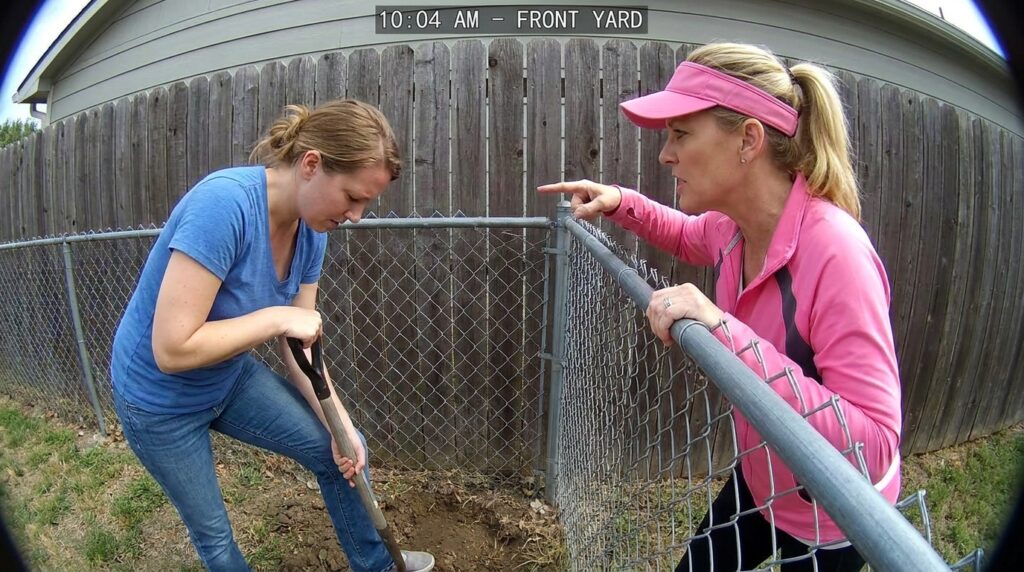
The steel edge of the spade hit a shelf of buried limestone with a dry, jarring shock that vibrated straight up through the ash wood handle and into the bones of my wrists. The sound was flat—a hard, metallic clink that broke the steady rhythm of the afternoon and hung in the close, hot air between the two houses. I didn’t look up yet. I kept my work boots planted on the shoulder of the blade, weight leaned forward, watching a small trickle of grey dust sift down into the shallow trench I had spent two hours clearing. The soil along the fence line was sour, choked with old construction debris and the thick, fibrous roots of a neighbor’s unpruned honeysuckle.
“You can’t step onto my side and dig there.”
The voice arrived before the click of her latch. It was sharp, practiced, and tight with the specific kind of administrative confidence found only in subdivisions with strict paint codes.
I left the shovel upright in the dirt, the blade wedged into the limestone seam, and let my hands drop to my sides. Across the grey zinc mesh of the chain-link fence, Brenda stood exactly three inches from the boundary. Her pink athletic top was stark against the dry, unwatered rye grass of her lawn. A white visor cast a straight line of shadow across her eyes, but it didn’t hide the rigid set of her jaw or the white-knuckled grip she had on a silver-rimmed phone. She was leaning into the wire, her index finger already extended, pointing at the small heap of dark earth I’d piled on the western lip of the trench.
The silence between us stretched until the compressor on her central air unit kicked on with a heavy, rattling groan. I didn’t shift my feet. I didn’t wipe the sweat from my temple. In the dusty gray of the block, you don’t give up an inch of posture before the terms are laid out.
“The grade is failing, Brenda,” I said. My voice sounded dry to my own ears, scraped clean of everything except the facts. “The runoff from your downspout is pooling against my lower sill. If I don’t drop this trench six inches before the weekend rain, the crawlspace takes water again.”
“I don’t care about your crawlspace,” she snapped, her finger twitching closer to the metal links without quite touching them. She knew the line down to the millimeter. “That dirt you’re shifting is supporting the root system on my side. You’re altering the common easement. I have the municipal bylaws right here on my screen, and if that spade breaks through the perimeter grid by so much as a fraction, it’s a civil violation.”
I looked down at the spade. It sat entirely within my shadow. The rusted tip was scarred from three seasons of clearing rock, but it was three inches clear of the wire.
“I’m on my side,” I said, lifting my chin to meet the dark lenses of her sunglasses. My fingers tightened slightly as I re-established my grip on the wood handle, feeling the rough grain against my calluses. “And I’m not crossing over.”
Brenda didn’t flinch. Her mouth thinned into a pale, bloodless line, and she shifted her weight, her sneakers crunching on the dry grass as she took a single, aggressive step lateral to the fence. She pointed directly at a small, rusted iron pipe barely visible beneath the weeds near the corner post—a marker that didn’t align with the current string line. “That still affects my property. And you aren’t the only one who keeps a record around here.”
Behind her, the blinds of the corner house shifted a quarter of an inch.
CHAPTER 2: THE ANOMALY IN THE DIRT
The click of Brenda’s back porch latch felt like a distant gunshot in the quiet, humid dark of the three-in-the-morning block. I stayed dropped in the shadow of the honeysuckle tangle, my work boots sunk two inches into the raw, freshly turned earth of the trench. The flashlight between my teeth tasted of cold rubber and old copper batteries. I didn’t breathe until the amber security light across the chain-link grid flickered once, hummed through its old transformer, and went dark again. Brenda’s house remained a flat, featureless block of grey siding against the starless sky, but the silence she left behind was different now—it had teeth.
I took the small brass trowel from my back pocket, the metal handle cold against my palm, and leaned into the narrow cut. My knuckles brushed the lower galvanized weave of the fence. The wire was coated in a thin, powdery skin of zinc oxidation that left a chalky smudge across my skin.
The spade in Chapter 1 had struck a ledge, but it hadn’t been limestone. The sound had been too hollow, too focused.
Working by touch alone, I cleared the loose clods of clay, casting them behind me into the center of my yard. The soil here was packed hard, compressed by two decades of lawnmower tracks and the slow, heavy settling of the earth along the subdivision’s perimeter. My fingernails scraped against something stubborn—not the rough, granular texture of the native bedrock, but the flaky, abrasive crust of heavily degraded iron.
I cupped my left hand over the lens of the flashlight, leaving only a hairline crack between my fingers, and clicked the switch. A thin, blood-red pencil beam pierced the bottom of the trench.
It was an iron collar. It didn’t look like the standard survey pins the county used—the bright, yellow-capped rebar spikes I’d seen in the developer’s brochure. This was older. The cylinder was thick, easily three inches in diameter, its surface eaten away by rust into a landscape of deep pockmarks and orange scales that flaked off under the edge of my trowel. Around the neck of the collar, half-buried in a pocket of gray sand, sat an intentional, deep double groove. It was an engineering mark, clean and deliberate, preserved beneath twenty years of subterranean damp.
I cleared the dirt further back toward my house, mapping the trajectory of the metal with the flat of my thumb. The pipe didn’t run parallel to the chain-link mesh. It angled sharply beneath it, a straight mechanical line pointing directly toward Brenda’s property. If this was the true corner landmark—the primary baseline stake from before the earth was scraped and leveled for the foundation pours—then the current fence line wasn’t just slightly crooked. It was eighteen inches out of alignment, carved out of my deeded lot and handed to her side of the ledger.
A dry leaf skittered across the concrete pad of Brenda’s heat pump. I cut the light instantly, freezing with my palm pressed flat against the cold iron of the newly found pipe. My heart hammered a steady, rhythmic pulse against my ribs, each thud amplified by the enclosed space of the trench.
Through the mesh, less than ten feet away, the dark silhouette of Brenda’s detached garage loomed against the sky. The shadow it cast was massive, its concrete footings sitting dangerously close to the current string line. In the daylight, that garage looked like an immovable monument to her authority—the pristine white trim, the security cameras tracking the driveway, the immaculate vinyl siding. But out here in the dark, with my hand resting on the corroded iron core of the block’s history, the structure looked fragile. It was an overreach built on a foundation of shifted dirt.
The micro-mystery of the double-grooved collar didn’t make sense yet. A developer wouldn’t leave a secondary marker this deep without an amendment to the plat maps. I reached deeper into the hole, my fingers following the contour of the iron cylinder until they hit a secondary lip—a lip that felt suspiciously like a heavy municipal sleeve rather than a residential pin.
The cold grit under my nails bit into the small cuts from yesterday’s labor. The pragmatic reality of the suburbs was simple: nothing stayed buried forever if the water started to pool. Brenda wasn’t just protecting a few square feet of rye grass; she was guarding a border that she had spent twenty years believing was absolute law. And if she had been pacing that fence line at sunset, she already knew someone was digging close enough to find the iron.
A shadow broke the straight line of her kitchen window above the heat pump. A thin vertical sliver of yellow light appeared as the blinds parted, no wider than the blade of a knife. I didn’t move. I let the trowel slip silently into the loose mud, my body melting back into the shadow of the honeysuckle until the wire grid between us was the only thing keeping the dark from falling apart.
CHAPTER 3: THE SEIZURE AT THE CURB
“You can drop the shovel now. It won’t save you from a formal lean.”
The words cut through the heavy morning heat before I even reached my driveway. Brenda was standing by the mailboxes, her bright pink athletic gear replaced by a crisp, tailored tan linen suit that looked completely unsuited for the ninety-degree humidity already radiating off the asphalt. She didn’t have her phone out this time. Instead, her hands were locked across her chest, pinning a bright white cardboard folder to her ribs. Beside her sat a white compact crossover with an orange magnetic strobe light resting silently on its roof—the property manager’s vehicle.
I didn’t slow my stride. The wooden handle of the spade was slick with sweat against my palms, and a crust of dried gray clay from last night’s excavation was caked around the steel collar. I stopped at the lip of my concrete apron, the sun beating down on the back of my neck with a dry, relentless itch.
“The trench is on my plat,” I said. I let the metal tip of the spade drop onto the concrete with a sharp, heavy clack that made the property manager shift his weight inside the idling car. “If the drainage isn’t cleared before Friday, the runoff will split the foundation block. Your bylaws don’t cover hydrostatic pressure, Brenda.”
“No, but they cover unapproved structural soil disruption within ten feet of a primary common line,” she countered. She stepped forward, her leather flats clicking on the sun-baked curb. The movement was practiced, her eyes tracking the precise line where my blacktop met her manicured turf. She pulled a folded sheet of yellow paper from the folder and held it out, her fingers stiff. “This is a formal cease-and-desist from the architectural committee. Effective at seven fifty-five this morning. Any further modification of that perimeter results in an immediate seven-hundred-dollar administrative fine per calendar day.”
I took the paper with my left hand, keeping my right wrapped tightly around the shovel’s ash-wood shaft. The document was warm from the sun, the ink fresh enough to smell of hot chemical toner. At the top, the bold lettering of the development’s management company was clear, but my thumb brushed the official validation stamp at the bottom corner. The purple ink was slightly smeared, the digital date code altered with a heavy black line through the original tracking number.
Brenda wasn’t waiting for me to read it. She took another half-step, her proximity close enough that I could smell the sharp, artificial lavender of her perfume mixed with the dry scent of her parched lawn. “The board doesn’t negotiate with new owners who treat the easement like a drainage ditch. The fence stays where it is, and that ditch gets backfilled before sunset, or the association handles it with an outside contractor at your direct expense.”
“The committee didn’t vote on this last night, Brenda,” I murmured, my eyes still fixed on the smeared ink of the validation stamp. The physical reality of the paper didn’t match the timeline of the board’s monthly meetings. “The office doesn’t open until nine on Wednesdays. Who signed off on the emergency variance?”
Her jaw tightened, the linen of her jacket wrinkling as her arms locked even harder against her chest. “The executive council has emergency oversight when a structural threat is identified by a resident of good standing. I don’t need a quorum to protect my foundation from someone with a hardware-store spade and an internet mapping tool.”
She reached down, her manicured hand moving toward the upper grip of my shovel as if to enforce the paper with a physical extraction. Her fingers closed around the dry, weathered wood just above my hand.
I didn’t pull back. I simply shifted my weight, driving the heel of my boot downward onto the spade’s metal shoulder, pinning the blade into the narrow gap between the concrete driveway and the edge of the lawn. The wood groaned slightly under the counter-pressure, but it didn’t budge. The absolute finality of the tool stayed locked between us, a vertical bar of iron and hickory that separated her linen suit from my dirt-smudged jeans.
Through the rolled-down window of the compact car, the property manager finally spoke, his voice thin and raspy over the hum of his air conditioning. “We just need the digging to pause until the county surveyor clarifies the baseline, ma’am. That’s all. No one’s touching the fence today.”
Brenda let go of the handle, her fingers leaving a pale, clean print on the dust-covered wood. Her eyes drifted down to the yellow paper in my hand, then back to the house behind me, where the dark dome of the security camera on the porch sat motionless under the eaves. Her performance of absolute authority had a crack in it now—a small, barely visible line that had nothing to do with the bylaws she kept quoting.
“Friday morning,” I said, my voice dropping into the quiet space between the idling car engine and the dry rustle of the honeysuckle. “The surveyor comes out with the original municipal stakes. If that iron pipe I found last night is the real baseline, your garage is eighteen inches over the mark, Brenda. Let’s see what the executive council says about structural threats then.”
She didn’t answer. She turned toward the white car, the linen of her skirt flashing starkly against the dark asphalt as she opened the passenger door, leaving the altered notice vibrating in my hand under the glare of the suburban sun.
CHAPTER 4: THE MEASUREMENT UNDER THE SUN
The optical lens of the surveyor’s transit caught the direct glare of the ten o’clock sun, throwing a blinding needle of white light across the yellowed rye grass. I stood by the corner post of the chain-link fence, my shoulder blades tight under my sweat-dampened shirt. The heat was a heavy, physical weight pressing down into the yard, drawing up the sharp, bitter smell of the turned earth from the un-backfilled trench.
At the center of the yard stood Miller, a county-certified surveyor with twenty years of field grit on his leather vest. He didn’t look at me, and he didn’t look at Brenda, who was stationed precisely on her concrete patio under the shade of a wide green umbrella. Miller’s boots crunched through the parched weeds as he walked a slow circle around the deep hole I’d cleared near the honeysuckle roots.
“Hold that prism rod steady on the line,” Miller muttered to his assistant, his hand reaching down to adjust the heavy brass leveling screws of the tripod. The metal was hot enough to hum under his fingers.
I watched the assistant place the tip of the red-and-white striped pole directly into the gray sand at the bottom of the trench, right on top of the heavily oxidized iron collar I had unearthed. The steel tape measure between Miller’s fingers made a sharp, rhythmic zip-zip-zip as he hauled it out from its leather case. The metal ribbon was old, its black numbers partially eaten away by rust and scratched from years of dragging across gravel and concrete. Near the three-foot mark, the steel was notched with a rough, jagged edge where the original tension loop had snapped and been crudely re-riveted.
Brenda’s chair scraped against the concrete of her patio. She walked down the step, her sunglasses pushed tight against her brow, her bright pink visor a sharp punctuation mark against the dull gray siding of her garage. Her phone was locked between her hands, but she wasn’t filming. She was watching Miller’s hands on the brass transit with a cold, unblinking intensity.
“That pipe she dug up isn’t a residential pin, Mr. Miller,” Brenda said, her voice cutting through the heavy drone of a distant lawnmower. It was quieter than it had been on Wednesday, stripped of its administrative flourish and reduced to a tight, defensive strain. “The original developer’s survey from 2006 clearly places the boundary line three inches to the east of the wire. This entire neighborhood was recorded under that plat.”
Miller didn’t raise his head from the viewfinder. He clicked a dial on the side of the instrument, his thumb scarred and gray with graphite dust from his field notebook. “Developers lay pins to sell lots, ma’am. The county lays anchors to clear infrastructure. There’s a difference between a sales map and a benchmark.”
He stood up straight, his knuckles popping as he reached into his leather vest and pulled out a rolled bundle of translucent blue vellum—the original 1984 municipal municipal utility map, stamped with the heavy, purple ink seal of the county clerk’s office. He unrolled it against the warm hood of my lawnmower, using two rusted iron spikes to pin the corners against the wind.
“Come here,” Miller said, looking at me first, then nodding toward Brenda.
I stepped up to the mower, my boots leaving dark tracking prints of wet clay on the dry blacktop. Brenda hesitated, her linen-clad shoulders stiffening before she made her way to the opposite side of the engine shroud. Her gaze stayed fixed on the blue paper.
Miller’s stubby index finger traced a heavy, double-grooved line that cut straight across the residential blocks. “The young lady was right about the eighteen inches. The developer’s crew misaligned the corner hubs when they cleared the grade for the second phase of the subdivision. They dropped the chain-link right along the secondary line to save a retaining wall.” He pointed his finger directly at the bottom of the trench, where the assistant was holding the prism rod on the double-grooved pipe. “This iron collar here? This is the primary regional benchmark for the main high-pressure sewer easement. It hasn’t moved since the township laid the pipe forty-two years ago.”
A sudden, heavy silence fell over the yard, broken only by the dry hiss of the hot wind through the chain-link mesh.
Layer 1 was unlocked. The fence was wrong. The eighteen inches belonged to my deed. I felt a cold surge of vindication rise in my throat, but when I looked up across the blue vellum to see the collapse of Brenda’s posture, I didn’t see the panic of a defeated bully. I saw something else—a calculated, desperate lock of her eyes onto the western quadrant of the map where the lines didn’t stop at the fence.
Miller’s finger didn’t lift from the vellum. It drifted another two inches across the paper, crossing the newly discovered eighteen-inch border and moving directly under the heavy, solid black rectangle marked Structure 4B—Brenda’s detached garage.
“The misalignment doesn’t just shift the turf,” Miller said softly, his voice dropping into a flat, institutional cadence that carried no malice, only the cold finality of geometry. He looked up, his grey eyes settling under his weathered brow directly on Brenda. “If this benchmark is the absolute legal zero point for the utility easement, then your garage isn’t just over her lawn. It’s sitting twelve inches inside the county’s primary concrete utility conduit corridor.”
Brenda’s hand went completely still against her phone, her fingers turning the exact shade of chalk dust as her eyes locked onto the black ink lines that ran like iron rails right through the center of her home’s legacy.
CHAPTER 5: THE EVIDENCE IN THE GLARE
The door clicked shut against the suffocating ninety-degree humidity, sealing the kitchen in a stale, air-conditioned chill. I didn’t turn on the overhead lights. The only illumination came from the sharp blue glow of the desktop monitor sitting on the edge of the linoleum counter, its light throwing long, skeletal shadows across the floorboards. My forearms were coated in a fine, gray paste of dried clay and salt sweat that dried into an itchy crust as I sat down in the wooden stool.
On the screen, the high-angle file directory from the porch doorbell camera was unrolled like an administrative ledger.
Miller’s vellum map had proven the physical lines of the lot were wrong, but the victory felt brittle, almost synthetic. Brenda’s total freeze at the sight of the municipal utility stamp hadn’t been the shock of a clean discovery; it had been the look of someone whose hidden numbers had suddenly run out. I pushed the small metal thumb drive into the USB port—a drive I’d pulled from the lockbox forty-eight hours after the first shovel hit the dirt.
The hard drive inside the casing spun up with a low, whirring whine that vibrated through the formica.
I pulled up the directory for Tuesday night, precisely twelve hours before Brenda had marched down to the wire in her bright pink athletic gear to deliver the cease-and-desist. The video files were small, heavily compressed blocks of gray and green night-vision footage. The wide-angle lens captured the entire rear boundary—the chain-link mesh running like a pale spine down the center, the shadow of the honeysuckle, and the white vinyl bulk of her detached garage.
At exactly two fourteen in the morning, the green-tinted dark on the screen flickered.
A figure emerged from the side door of Brenda’s garage. The resolution was grainy, pixelated by the low-light sensor, but the physical outline was unmistakable—the wide silhouette, the hair tied back under a tight visor, the heavy, deliberate steps of someone moving with a focused mechanical purpose. It wasn’t an aimless trespass. She was carrying a long, straight iron rod—a heavy tamping bar used for compaction—and a square-point shovel with a weathered blade that didn’t catch the moonlight.
I leaned closer, my breath clouding the lower rim of the glass screen.
The figure on the monitor didn’t walk toward my trench. She stopped exactly four feet north of the double-grooved utility benchmark, right where the old boundary string line had been pinned to the limestone shelf. Working with rapid, rhythmic thuds that had no sound on the muted file, she drove the iron bar down into the sod, twisting it to clear a hole before shoving something small and metallic deep into the clay.
She wasn’t trying to destroy my work. She was planting a secondary rebar stake—a brand-new, yellow-capped residential survey marker—and covering it with loose grass clippings and dried pine needles.
The camera angle didn’t lie. She spent eight minutes packing the earth down with the heel of her shoe, then stood back to check the alignment against her garage footings. When she turned her face toward my porch, her features were wiped out by the infrared glare of the night-vision bulb, leaving only two empty white circles where her sunglasses usually sat.
I paused the frame. The digital time stamp at the bottom corner read 02:22:14 AM.
The decoy secret was bare now. The yellow-capped pin she had quoted during our first argument hadn’t been laid by a developer’s crew twenty years ago. She had driven it into the dirt herself to create a false trail for the code enforcement officer she intended to call. She knew the original fence was misaligned by eighteen inches—she had known it for years—and she had built that detached garage knowing she was shaving the line down to the raw bone of my property sheet.
But the realization didn’t clear the air. My fingers stayed locked on the plastic rim of the keyboard, the cold grit under my nails scratching against the keys.
If she had gone to that extreme—if she had risked a nighttime tampering charge just to establish a three-inch margin of error—it meant she wasn’t just fighting for eighteen inches of weeds and honeysuckle roots. She was trying to prevent any certified county transit from checking the primary regional baseline at the bottom of my trench. Because the moment Miller pulled his steel tape from that grooved cylinder, the measurement wouldn’t stop at the grass. It would legalise the absolute destruction of the concrete slab supporting her garage roof.
Outside, the heavy thump-thump-thump of a contractor’s truck idling at the curb vibrated through the kitchen window pane. The shadow of the utility strobe light crawled up the kitchen wall, orange and rhythmic, like a warning pulse. The final numbers were laid out on the vellum, and the digital record was locked on the drive, but the real weight of the boundary was still sitting out there in the heat, waiting for someone to drop the spade.
CHAPTER 6: THE FINAL MEASURE AT THE BOUNDARY
“The physical grid doesn’t lie, Brenda. You can’t rewrite an easement with an adjustable fence.”
The county surveyor’s voice was completely flat, stripped of any neighborly politeness or bureaucratic hesitation. Miller stood directly on the line, his scuffed work boots straddling the open trench where the rusted iron collar sat exposed like an old tooth. He held a heavy brass plumb bob suspended by a braided nylon cord, its pointed steel tip hovering precisely three millimeters above the center notch of the benchmark.
Brenda stood entirely outside her green umbrella now. The shadow of her massive, white-trimmed detached garage fell across her face, but it couldn’t hide the grey, drawn tint of her skin. The linen suit she’d worn to the curb looked completely wrinkled, its hem stained with dark gray splashes of limestone dust from the surveyor’s boots. Her hands were dropped to her sides, the silver-rimmed phone tucked away into her pocket.
Beside her, the property manager from the HOA didn’t say a word. He was looking down at a fresh copy of the city-stAMPED municipal easement map unrolled across the hood of my lawnmower, his thumb pinning a brass surveyor’s rule against the grid lines.
“The original hubs from the 2006 phase were dropped completely blind,” Miller continued, his index finger tracing the solid black line where the concrete footing of Brenda’s garage met the soil. The paper made a dry, brittle crinkle under his callused thumb. “The developer built the perimeter retaining wall to match a misplaced fence line instead of pulling the true coordinate from the county baseline. If this iron pipe is the primary high-pressure utility hub, your garage isn’t just crossing onto her deeded turf.”
He paused, the heavy hum of the county truck’s diesel engine at the curb filling the silent gap.
“It’s sitting exactly twelve inches into the main county infrastructure channel,” Miller said softly. “The city has immediate, non-negotiable right-of-way for any excavation or structural clearance along this entire run. No board variance can override a stamped municipal utility line. If the township orders a line inspection, that whole eastern wall has to come down.”
The silence that followed was total. It was a dense, suburban silence that had nothing to do with birds or lawnmowers—it was the sound of twenty years of performative authority evaporating into a single sheet of paper.
I stepped forward, my hands resting on the ash-wood handle of my spade, which remained planted deep in the limestone trench like an immovable marker. The dried clay on my fingers flaked off, dropping small gray crumbs into the dirt. I didn’t smile, and I didn’t raise my voice. In the gritty reality of the block, you don’t need a villain speech when the math has already closed the door.
“The fence stays on the true mark, Brenda,” I said, my voice steady, carrying the physical exhaustion of three nights of digging. I pointed down toward the exposed iron collar at the bottom of the cut. “And the trench goes down another six inches to clear the grade. I’m not changing my drainage project just because your contractor built a foot past your legal rights.”
Brenda looked from the surveyor’s transit to the unblinking black dome of the doorbell camera mounted on my porch eave. She knew what was on the drive—the night-vision footage of her planting the false yellow-capped survey stake at two in the morning, the desperate attempt to manufacture an HOA violation before the official trucks could arrive. The record was locked. Every movement she had made to protect her border had only served to draw the county’s attention directly to her own structural overreach.
The property manager finally rolled up his ruler, the brass clicking softly against the metal trim of his clipboard. He looked at Brenda, then turned his back toward the car. “The association is pulling the citation, ma’am. We’re non-parties to a county utility easement dispute. You’ll have to handle the variance with the city engineering office directly.”
Brenda took a slow, heavy step back toward her patio, her leather shoes crunching softly on the dry rye grass. Her shoulder line had completely dropped, the rigid posture she had maintained at the curb shattering into a limp, defeated retreat. She didn’t look at the fence, she didn’t look at the trench, and she didn’t look at the neighbors who were now standing openly on their porches down the block, watching her walk toward her side door.
I turned back to the trench, my boots finding the familiar ledge of the limestone shelf. I gripped the wood of the handle, lifted the spade, and drove the steel blade back into the earth with a clean, heavy clink that sounded like an absolute resolution.
“The fence doesn’t move just because you scream at it,” I muttered to the empty air between the houses, the grit under my nails pressing into the hickory as the afternoon sun finally cleared the ridge of the roof.