
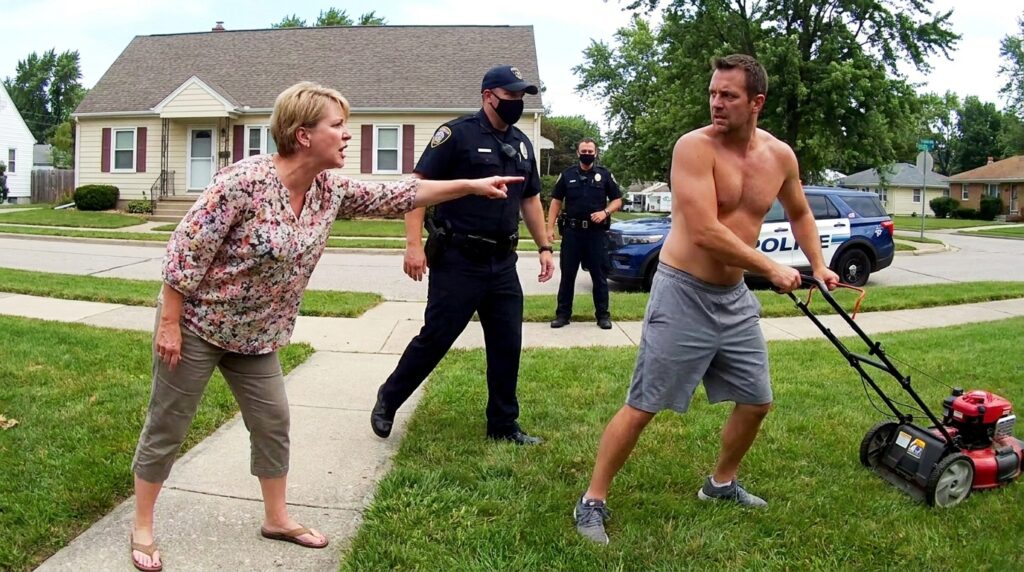
A Passive-Aggressive Suburban Dispute Over Strict Property Boundaries
CHAPTER 1: THE DUSTY EDGES
The pull-string on the Briggs & Stratton engine always bit into the skin of Mark’s palm before the piston caught. He gave it one short, hard yank, feeling the dry vibration of old iron travel up through his forearm as the red deck rattled against the uneven turf. The air smelled of burnt oil, unwashed gray sneakers, and the bitter sap of wild onions sliced clean by the blade.
He didn’t look toward the white house with the green shutters, but he knew the slats of the living room blinds had shifted three degrees. They always did when the shadow of the red mower crossed the third expansion joint in the concrete walk. It was an old game played on a small field.
Mark wiped a smudge of black grease onto his shorts, his thumb tracing the worn steel handle of the machine. The lawn wasn’t lush; it was a patchwork of coarse fescue and crabgrass that had survived three weeks without rain. Every blade of grass near the edge grew under the weight of an invisible tape measure. He kept his feet on the dirt, his shoulder blades tense with the knowledge that someone was calculating the velocity of his turn.
He reached the end of the second pass where the grass gave way to the flat, pitted surface of the city pavement. Right there, embedded in the dirt beside the curb, was the tiny iron survey pin—rusted down to the color of dried blood, nearly hidden by the clover. It was the only thing that didn’t change in the valley between the two properties.
As he turned the machine, the engine sputtered on a pocket of air, the blade slowing to a low, mechanical moan. Through the haze of exhaust, a shape moved across the gravel driveway next door. The bright, sharp print of a floral blouse cut through the glare of the afternoon sun.
Evelyn didn’t walk; she marched with her heels hitting the concrete like small, deliberate hammer strikes. In her left hand, she carried a heavy manila folder with three rubber bands holding the edges together—the weight of forty years of subdivision history compressed into yellowed pulp. Her sunglasses caught the reflection of the idling patrol car that had just turned the corner at the end of the block, its tires low and rhythmic against the asphalt.
Mark left his hands on the black rubber grip of the mower, his chest rising against the hot wind. He didn’t drop the handle. He didn’t step back onto the turf. He stood right on the seam where the concrete met the weeds, watching the shadow of her wide silhouette stretch across the very line she claimed he had stolen.
Beneath the top flap of the manila folder she held tightly against her hip, the edge of a fresh, bright white paper map peeked out—marked with a thick, red surveyor’s stamp that hadn’t been there the week before.

CHAPTER 2: THE DEW AND THE RUST
The heavy aluminum flag of the mailbox didn’t drop clean; it ground against its copper rivet with a screech that set Mark’s teeth on edge. The morning humidity had settled over the subdivision like wet flannel, pinning the smell of stagnant ditch-water and hot asphalt to the lawns before the sun could even clear the power lines. Mark reached into the hollow metal tube, his knuckles scraping the rough, pitted zinc interior. His fingers closed on a pulp that had begun to dissolve before it ever met his hand.
It wasn’t a standard bill. The paper was heavy, legal-grade stock, the kind used by the county clerk’s office three miles west, but it hadn’t come through the federal postal system. There was no cancellation stamp, no bar code, no ink-jet tracking lane along the lower margin. It had been slipped past the rubber seal between midnight and dawn, when the only sound on the cul-de-sac was the automatic cycling of Evelyn’s lawn-sprinklers five feet from his boundary stake.
He pulled it into the light. The ink had run along the fibrous grains of the paper, turning the block letters of his name into fuzzy, dark grey caterpillars. It was an unofficial citation—a warning typed on an old IBM Selectric with a dying ribbon, the “e” and the “o” filled in with solid black grease. It cited Municipal Ordinance 404-B: Maintenance and Visual Encroachment of Unimproved Public Rights-of-Way.
Mark leaned his hip against the cedar post of the mailbox, the wood soft and damp against his jeans. He didn’t look back toward her house. Instead, he looked down at the concrete sidewalk seam where his turf met her gray pavement. A single line of dried, orange-brown rust ran from the base of his mailbox post, directly across the concrete expansion joint, terminating at the exact point where Evelyn’s property began. It was the residue of the iron-heavy well water he used for his garden hose, a permanent stain that documented every drop that crossed the line.
The language in the note was clinical, written by someone who had spent thirty years reading code books until their brain thought in sub-paragraphs and indented clauses. It claimed his mailbox post sat two and a half inches inside the municipal easement—an easement that, according to the document, had been granted to the adjoining property owner for “aesthetic buffer maintenance” during the original 1984 platted survey.
Mark’s thumb dug into the soft pulp of the paper, tearing the corner where a hand-drawn diagram had been sketched in blue ballpoint. The ink had bled into a dark smear, but the lines were clear enough: a box representing his lot, a larger box representing hers, and a cross-hatched dead zone that swallowed the entire outer edge of his front lawn. It wasn’t just about an inch of grass anymore. Someone had gone into the old records, or manufactured something that looked like them, to turn his morning chore into a civil violation.
He folded the damp sheet twice, shoving it into the back pocket of his shorts where the grease from the mower handle had already left a dark crescent moon. The metal box of the mower was still warm from yesterday’s run, the scent of parched grass clippings trapped under the deck turning sour in the morning fog. He reached down to check the oil dipstick, his fingers registering the gritty coat of dust that had settled over the yellow plastic cap. The oil was low, dark as molasses, and flecked with microscopic shavings of steel from a cylinder wall that had been scraping against its housing for a decade.
A low, metallic click sounded from across the lawn. It wasn’t the sound of a door opening; it was the distinct latch-snap of a heavy-duty vinyl storage locker—the kind Evelyn kept behind her garage to house her brass edging tools and her collection of orange boundary flags.
Mark didn’t look up from the dipstick. He wiped the steel tongue clean with his bare palm, tracking the clean line of grease against the callused skin of his thumb. He knew the sequence by heart now: the latch, the heavy step of her orthopedic shoes against the gravel, the small, dry cough she used to clear her throat before she reached the edge of the asphalt. Every sound was an anchor, a physical weight pulling him into a defensive circle on a three-quarter-acre lot that was shrinking by the hour.
He inserted the dipstick back into the dark throat of the engine, twisting it until the plastic threads locked against the iron block with a dull, final thud. When he finally straightened his spine, the white morning mist was beginning to lift off the asphalt, revealing the sharp, floral print of her smock standing exactly twenty-four inches behind the rusted iron survey pin.
CHAPTER 3: THE PRECISION LINE
The sun had burned the morning flannel out of the sky by one o’clock, turning the subdivision into a blinding sheet of white concrete and dry, pale dirt. The heat rose off the asphalt in transparent grease-ribbons, distorting the lower frame of Evelyn’s house until the foundation seemed to float an inch above the scorched lawn. Mark didn’t check the sky. His eyes were locked on the thin line where his coarse green weeds met the perfectly square edges of her gray cement.
He stood on the parched earth of his own yard, his callused thumb resting on the cold throttle lever of the red mower. The engine was cold now, its cast-iron housing ticking as the metal settled in the heat. Across the boundary seam, the bright pattern of Evelyn’s floral smock seemed almost static against the gray backdrop of her garage door. She hadn’t moved since the mist cleared, her shoulders square, her weight planted entirely on the heels of her heavy shoes.
Between them lay the red lawn mower, its metal frame serving as a low barrier. Mark had stopped the left wheel exactly one inch short of the concrete expansion joint. He knew the legal measurements of his parcel down to the millimeter—he had spent the previous evening reading the county deed under a flickering forty-watt bulb in his kitchen, tracing the coordinates with a pencil tip until the paper wore thin.
Evelyn took two steps forward, her heels grinding a thin layer of limestone dust out of the pavement. The manila folder was still tucked firmly beneath her arm, its bottom corner showing the bright, unweathered edge of a fresh municipal printout. She pointed a short, thick index finger toward the rusted survey pin near the curb, her voice cutting through the heavy hum of distant air conditioners like an old saw through pine.
“You’re tracking grease across the seam again, Mark,” she said, her chest rising under the floral fabric. “The town ordinance is explicit about aesthetic degradation. You have twenty-four hours to scrub the concrete before the administrative assessment is finalized.”
Mark didn’t drop his chin. He let his forearm rest against the worn rubber grip of the mower handle, his knuckles white against the black plastic. The heat was real, pressing down on the back of his neck like a flat iron, but his voice came out flat, level, and dry as the grass beneath his boots.
“I’m just mowing my grass, Evelyn,” he said, keeping his eyes on her glasses. “The pin says the turf is mine. The mower hasn’t touched the gray side.”
“The turf follows the historic easement,” she countered, her hand tightening around the manila folder. The blue ink sketch peeked out from the folder’s mouth, showing the cross-hatched dead zone that cut six feet into his property line. She tapped the cardboard cover with her finger. “I have the 1984 platted maps right here. The town clerk verified the maintenance lanes before they closed the office on Friday. If you don’t pull the machine back past the mailbox line, I have every right to file for a public injunction.”
Mark’s internal calculation didn’t slow. He noticed the slight tremor in her pointing finger—not from fear, but from the raw frustration of an old authority structure slipping out of her grip. He also noticed something else. Beyond her shoulder, tucked into the narrow space between her chain-link fence and her tool locker, a fresh wooden survey stake was driven into the dirt. A bright orange plastic ribbon was knotted around its neck, the plastic pristine and completely free of the sun-bleaching that ruined everything left outdoors for more than a month. It was a professional marker, the kind used by real county survey crews when they laid out a modern tax parcel, not a thirty-year-old historic easement.
He looked back down at her folder. The decoy was right there in her hands—the old, defunct 1984 map she was using to squeeze his space. She was pushing the old code because it was the only document she had that gave her permission to cross his boundary. She needed him to back up, to concede the two inches near the sidewalk seam, because once he did, the historic easement would legally re-establish itself through default usage.
“The 1984 plat was updated when they put the city water lines through in ninety-six, Evelyn,” Mark said, his voice dropping into a transactional rhythm. He didn’t offer a defense; he simply stated the physical fact like he was counting bolts on a cylinder head. “The easement was re-routed to the south ditch lane. This patch belongs to the deed holder.”
Evelyn’s mouth tightened into a thin, bloodless line. She didn’t offer a counter-argument or look at the orange ribbon behind her garage. Instead, she lifted her right hand, her thumb clicking the screen of her phone until the glass reflected the white glare of the sun.
“We’ll let the city code enforcement unit read the coordinates,” she said, her voice dropping into a tight, sharp whisper. “I’ve already logged the complaint. They’re on their way down the avenue now.”
Mark didn’t pull the mower back. He shifted his weight to his heels, his gray shorts catching the low breeze off the pavement as the distant, rising whine of a municipal siren began to cut through the heavy summer air.
CHAPTER 4: THE CONFRONTATION LANE
“You keep stepping into my space like it’s nothing,” Evelyn said, her voice rising to carry across the narrow strip of asphalt separating their driveways. She didn’t shout, but she threw the words with a sharp, practiced resonance that brought three different garage doors down the street to an immediate halt.
Mark didn’t let go of the red mower handle. The metal had grown hot enough under the midday glare to leave a white, indented line across the leather of his palm. He kept his feet planted on the coarse, yellowed fescue of his side of the seam, his boots half-buried in the dry trimmings. He looked down at her feet. She had advanced until the rubber tips of her sneakers were touching the gray edge of the expansion joint, her shadow falling directly across the rusted iron pin that marked the legal corner of his lot.
“The machine stays on the grass, Evelyn,” he said, his voice flat, dry, and balanced against the steady hum of the neighborhood’s external compressors. “The wheels haven’t crossed the concrete.”
“The air space follows the platted line, Mark,” she said. She leaned forward, her shoulders rigid beneath the loud, floral pattern of her smock. Her arm shot out across the gap, her index finger jabbing within two inches of his collarbone. It was an old gesture, honed by decades of subdivision committees and municipal zoning boards, designed to force a retreat through sheer social proximity. “You’ve got six inches of deck overhang passing the property boundary every time you make the turn. Look at the dirt. Look at the oil stains on the curb. You’re eroding the municipal frontage.”
Mark didn’t back up. He watched the white corner of the document inside her manila folder vibrate with the tremor of her hand. From this distance, less than eighteen inches away, he could see the gray, blurred ink of the surveyor’s seal on the top sheet. It was a photocopy of the 1984 city grid, but there was a dark, square patch over the revision block at the bottom—a heavy ink smudge that looked less like age and more like a deliberate thumbprint meant to obscure a date.
She wanted him to jerk his torso back. She wanted him to lift his hands off the mower or make a sudden, aggressive move toward her pointing finger while the porch watchers across the street had their phones out. He could see them now out of the corner of his eye: old man Miller sitting on his plastic lawn chair three doors down, his hands resting on his knees, watching the boundary lane like an umpire at a regional match.
“The 1984 grid was abandoned when they laid the asphalt for the cul-de-sac,” Mark said, his tone transactional, empty of any anger she could use as leverage. “The county updated the parcels. The line is the pin, Evelyn. Not the folder.”
“The town hasn’t cleared the updated registration,” she hissed, her face tightening until the pale skin around her lips turned the color of dry salt. “Until they stamp the variance, the old easement is the only active deed on record. You’re violating a public right-of-way to clean your own private weeds.”
The sound of a shifting transmission cut through her next word. A dark blue municipal cruiser rounded the corner of the avenue, its tires crunching slowly against the loose limestone chips at the edge of the asphalt. It didn’t have its lights flashing, but the slow, deliberate speed of the vehicle carried the weight of a formal dispatch. It glided to a halt right at the curb, its front bumper aligning perfectly with the red mower and the rusted survey pin.
The engine of the cruiser died with a low, heavy hiss from the exhaust. For three seconds, nobody moved. The heat-ripple off the patrol car’s hood distorted the image of Evelyn’s neat white garage behind her, turning her entire property into a unstable, watery reflection. Mark kept his fingers locked around the black rubber of his throttle. He knew the protocol for a nuisance dispatch in this county—if he backed up now, he was admitting the mower was an obstruction. If he advanced, he was crowding a complainant.
The driver’s side door clicked open with a heavy, metallic thud that echoed off the brick fronts of the surrounding houses. A pair of polished black leather boots hit the gravel, followed by the stiff, dark blue fabric of a county uniform. Officer Miller stepped out into the sun, his dark cap pulled low enough to cast a shadow across his masked face, his eyes already tracking the direct, narrowing line between the floral smock and the red machine.
Behind him, from the passenger side, Officer Davis emerged, his short hair catching the glare as he took a supportive position near the rear quarter-panel of the cruiser, his hand resting loosely on his utility belt.
Evelyn didn’t drop her arm. She kept her finger extended toward Mark’s chest, her head turning slightly toward the incoming boots as if she were welcoming her own personal security detail to the line.
“He’s operating an uncertified machine within the civic easement zone, Officer,” she said, her voice dropping into a tight, official cadence. “I’ve asked him three times to clear the walk.”
Officer Miller didn’t answer her. He walked with a slow, heavy stride that had no rhythm other than the click of his equipment belt, his eyes fixed entirely on the small rusted iron pin hidden in the clover between their feet.
CHAPTER 5: THE INTERVENTION LINE
The heavy leather of Officer Miller’s service boots split the space between them with a dull, physical crunch. The scent of hot asphalt mixed instantly with the clean, synthetic tang of laundry starch and the chemical musk of a sweat-soaked uniform vest. He didn’t look at Mark, and he didn’t look at Evelyn. His eyes remained fixed on the lower plane of the yard—the low, rusted survey pin half-strangled by clover and the black rubber wheels of the red walk-behind mower.
Mark felt the air pressure shift as the officer’s wide torso blocked the heat radiating from Evelyn’s floral smock. He didn’t drop his hands from the mower’s rubber grip, but he let his shoulders drop two inches, his spine adjusting to the sudden, authoritative partition of his front lawn.
Officer Miller raised his left hand, his palm flat and dry, pointing directly toward the center of the gap. His voice was clipped, balanced by the rhythmic, low-frequency vibration of the patrol car’s engine idling fifteen feet away.
“Both of you step back,” Miller said, his eyes tracking the narrow line of turf between Mark’s boots and the concrete pavement. “We’re going to sort this out.”
Evelyn didn’t retreat. She maintained her position on the concrete seam, her orthopedic shoes squeaking against the grit as she tilted her chin upward to meet the dark rim of the officer’s cap. Her fingers tightened around the edges of the manila folder until the old cardboard groaned.
“He’s deliberately blocking the municipal walking path, Officer,” she said, her voice dropping into that tight, sharp register that had governed thirty years of neighborhood association hearings. “The machine has been sitting over the easement line for twenty minutes. It’s a civil obstruction, and I have the platted registration to prove it.”
Miller didn’t reach for the folder. He leaned his weight back onto his heels, his heavy duty belt clicking as the leather loops shifted against his hips. He looked down at the mower’s red deck, then at the tiny rusted iron pin embedded in the dirt. Right beside his boot heel, half-buried under a clump of parched dandelion roots, a small circle of bright blue plastic glinted in the sun—a modern, high-visibility surveyor’s cap capping a secondary steel rod. It wasn’t thirty years old. The edges were sharp, unweathered, and clean of the gray limestone dust that coated everything else at the curb.
Mark watched Miller’s eyes drop to the blue plastic cap. The officer didn’t comment on it. He didn’t ask Evelyn why her 1984 map didn’t include the blue marker. Instead, he reached toward the small digital terminal mounted on his belt harness, his thumb tapping the glass screen until the blue light reflected off his sunglasses.
“We don’t arbitrate deed text on the sidewalk, ma’am,” Miller said, his tone flat and empty of any deference to her floral smock. “The county dispatch received a complaint regarding an active property breach. Until I pull the current county parcel registry on the terminal, nobody touches the machine, and nobody crosses the expansion joint.”
Behind him, near the rear door of the cruiser, Officer Davis shifted his stance. His boots remained on the hot asphalt of the street, his eyes tracking the windows of the surrounding houses where three separate sets of blinds had shifted to reveal the pale faces of the neighborhood’s silent watch. The public pressure was live now, a heavy, unblinking circle of attention that pinned all four of them to the tiny strip of grass at the curb.
Mark stood his ground on the turf, his gray shorts catching the low, grease-heavy exhaust from the idling cruiser. He knew the look on Evelyn’s face—it was the calculation of an opponent who had just realized the rules of the table had changed without her consent. She wasn’t looking at the officer anymore; her eyes were locked on the blue plastic cap near his heel, her fingers twitching against the yellow folder as if she wanted to drop it over the marker before anyone else noticed the date stamped into the plastic.
“The 1984 registration is the active civil benchmark,” she whispered, her lips turning gray under the harsh noon sun. “The city clerk hasn’t signed the revision.”
“We’ll see what the server says,” Miller said. He turned his shoulder, blocking her view of the terminal screen as the machine began its slow, cellular handshake with the county records office three miles away.
CHAPTER 6: THE TERMINAL LOG
The mobile data terminal didn’t beep; it gave a low, dull buzz that vibrated against Officer Miller’s nylon gear belt like a trapped beetle. The sun hit the small glass screen at a flat angle, turning the county parcel map into a chaotic grid of glare and oily finger-smears. Miller didn’t look up at either house. His thick thumb dragged across the digital border lines, tracing the edge of Lot 14-B where Mark’s dry fescue met the concrete sidewalk seam.
Mark kept his weight locked onto his rear heel, his hands still bridging the weathered rubber handle of the red mower. The engine casing between his boots was radiating a silent, intense heat-ripple that distorted the lower hem of Evelyn’s floral smock across the gap. He watched Miller’s face. The officer’s eyes under the dark visor didn’t widen, but his jaw muscle clamped tight beneath his mask, his skin shifting against the fabric.
“What’s the system showing, Officer?” Evelyn asked. She had moved her orthopedic shoes an inch closer to the curb, her knuckles white against the yellowed corners of her manila folder. “The 1984 platted benchmark explicitly designates that six-foot perimeter as a public right-of-way. The drainage variance hasn’t been dissolved by the municipality.”
Miller turned his shoulder three degrees to the left, using his wide blue torso to completely block her view of the screen. His voice was flat, empty of the local deference she usually extracted from the town hall staff.
“The system is pulling the general registrar’s database from ninety-six, ma’am,” Miller said, his boots grinding a few loose limestone chips into the asphalt. “The server is lagging on the plat verification. Davis, check the regional dispatch log on the dash.”
Officer Davis didn’t answer. He turned on his heel, his heavy leather duty belt creaking as he strode back to the idling patrol car. The door remained open, the interior radio spitting a low, rhythmic pattern of coded static that drifted across the parched front yard.
Mark didn’t drop his gaze to the terminal. He was looking at the bottom margin of the yellow folder in Evelyn’s hands. The blue ink sketch she had displayed earlier was sliding out, and beneath it, tucked tightly against the cardboard backing, lay a thin sheet of waterproof synthetic paper. It was a recent county GIS survey printout, complete with a bright red digital time-stamp from less than three weeks ago. The top of the page was partially folded back, but the bold black text at the header was clearly readable through the glare: Final Boundary Re-Plat & Easement Relinquishment.
The decoy map she had been waving was a dead record. The 1984 plat she kept citing was still on the screen of Miller’s lagging terminal because the county database hadn’t indexed the ninety-six water line modifications into the active public portal yet. She knew the server would display the old lines first. She had planned the entire confrontation around that specific technical delay, using the outdated public map as a shield to freeze Mark’s work and force him to yield the disputed strip before the real boundary could be verified on-site.
“The ninety-six amendment was an internal utility record,” Evelyn said, her voice thinning until it sounded like dry parchment dragging over stone. She didn’t look at the orange marker near Miller’s boot heel. Her head turned toward the porch watchers down the street, her posture stiffening as if she were addressing a full council meeting. “It doesn’t supersede the primary residential deed restrictions. This man is operating a machine without an authorized variance.”
“We’re not looking at a variance anymore, ma’am,” Miller said. He didn’t lift his eyes from the glass pad. A small red indicator light on the top edge of the terminal began to flash in a steady, double-beat pattern, signaling a priority record override from the county clerk’s main office. “The map on the public site is thirty years old. The clerk’s office just pushed the structural amendment to our unit.”
Mark watched the fingers of Evelyn’s left hand twitch against the cardboard cover. She didn’t offer a defense; her shoulder blades simply dropped an inch, her entire frame shrinking slightly under the bright floral smock as the patrol car’s radio suddenly went dead silent.
“Step back onto the concrete walkway, Evelyn,” Miller said, his tone dropping the official title entirely. He shifted his stance, his heavy boot clearing the clover to expose the clean, unweathered blue plastic surveyor’s cap driven straight into the dirt behind the mower. “Don’t touch the folder. We’re going to verify the actual coordinates right here.”
Mark felt the cold steel of the throttle under his thumb. The neighborhood’s silent watch remained fixed, the blinds across the street staying frozen in place as the digital terminal gave a sharp, final chime that signaled the arrival of the absolute truth.
CHAPTER 7: THE REPLATTED RECORD
The synthetic paper didn’t tear when Officer Miller yanked it from the lower pocket of the manila folder; it gave a sharp, plastic snap that cut clean through the heavy idle of the police cruiser. The glare off the waterproof sheet was blinding, catching the noon light and reflecting a stark white square onto the front of Evelyn’s floral smock. Her hands didn’t drop, but her fingers remained frozen in an open claw, right where the cardboard cover had slipped out of her grip.
Mark didn’t move an inch from the red mower’s handle. He watched the sheet flatten against the hood of the patrol car as Miller pinned it down with one heavy, grease-smudged forearm. The smell of fresh laser-toner ink rose off the crisp page, artificial and sharp against the stagnant scent of sun-baked clover and cut onions.
“This isn’t an unverified utility draft, Evelyn,” Miller said, his boots grinding a circular pivot into the parched sod. He reached down with his other hand, his index finger tracing a thick, dark vector that ran parallel to the sidewalk seam. “This is the final boundary decree from the county surveyor’s office, filed three months ago. The stamp is active. The certification number matches the priority override on my screen.”
Mark looked down at the diagram pinned under the officer’s sleeve. The cross-hatched dead zone from her old 1984 map was completely gone, replaced by a straight, solid baseline that threw the entire six-foot easement line directly into Mark’s legal lot. The document didn’t just show a modification; it documented the total abandonment of the city right-of-way from three decades ago, a change that re-established Mark’s absolute title right up to the concrete edge.
But it was the bottom corner of the sheet that made the skin across Mark’s forehead tighten. Slipped behind the county decree was a private invoice from Northwest Engineering & Land Surveying, dated April fourteenth of the current year. It was billed directly to Evelyn’s residential address. She hadn’t been waiting on the city clerk to verify the old lines; she had paid fourteen hundred dollars out of her own pocket months ago to have a private crew drive that steel rod and the blue plastic cap into the clover. She had possessed the final, absolute truth in her house all summer, tucked away inside her kitchen drawer while she spent every morning watching his wheels from behind her white blinds.
She knew the land was his. She had always known. The harassment wasn’t a defense of her own boundaries; it was a deliberate, calculated campaign to enforce an authority she had bought and paid to disprove.
“You’ve had this since the spring,” Miller said, his voice dropping into a level, dangerous flat-line that carried across the open lawns. He didn’t look at her face; he kept his eyes on the invoice. “You called a priority unit out for a criminal encroachment when you had a certified boundary verification in your hands proving the turf belonged to the neighbor.”
Evelyn didn’t shift her weight. Her short blonde hair caught the harsh glare of the sun, making her features look pale, dry, and hollowed out against the gray concrete of her driveway. She didn’t look at the porch watchers down the street, who were now leaning over their railings to catch the low, heavy tone of the officer’s voice. Her lips moved, but the words came out like dry gravel sliding down a chute.
“The historic plat was never legally expunged from the neighborhood covenants,” she whispered, her hands slowly retreating into the pockets of her cropped pants. “The association rules still recognize the buffer zone. The city can’t just wipe out thirty years of residential structure with a digital update.”
“The county governs the tax parcels, ma’am,” Miller said, his thumb lifting off the sheet with a soft stick-and-peel sound. He reached toward his belt, sliding the digital terminal back into its heavy plastic cradle until it locked with a final, mechanical click. He turned his face toward Mark, the dark edge of his visor cutting off the direct light. “The marker behind the machine is legal. He’s within his boundary.”
Mark looked at the blue plastic cap near his shoe, its sharp edges clean and brilliant against the gray limestone dust. The physical proof had landed exactly where he had kept his wheels for three months, a single inch short of the concrete seam. He looked back at Evelyn, noting the slight, involuntary twitch in her shoulder as Officer Davis stepped up from the rear of the cruiser, his notebook open, his pen hovering over the citation block.
The decoy was shattered, the old map left fluttering against the police car’s hot metal hood like a dead leaf, but the cold, pragmatic reality of the neighborhood remained locked in place. The line had been verified, the balance of respect had flipped on the grass, but the sun was still high, the grass was still dying, and the next pass of the blade was waiting.
CHAPTER 8: THE SOVEREIGN LINE
The heavy rubber grip of the throttle lever slid beneath Mark’s palm with a familiar, greasy drag. He didn’t look at Evelyn as she turned her back, her orthopedic shoes making a dry, defeated crunch against the limestone screenings of her driveway. He didn’t track the bright, shrinking pattern of her floral smock as she retreated toward the shadow of her garage, the yellow folder clamped against her hip like a broken shield.
His hand moved to the black starter cord of the Briggs & Stratton engine. He gave it one short, clean pull—not an explosion of movement, but a practiced deployment of leverage. The iron cylinder caught on the first compression stroke, the deck shaking hard against the dead dandelion roots as a thin plume of blue oil-smoke flattened against the dry fescue. The noise filled the cul-de-sac, low and flat, drowning out the lingering hum of the cruiser’s radio and the small, distant mutters of the porch watchers down the block.
Officer Miller gathered the synthetic survey maps from the hood of the patrol car. The waterproof sheets slid against the hot blue paint with a sharp hiss before he rolled them into a tight, compact cylinder. He walked back to the driver’s side door, his heavy utility belt clicking with every slow, deliberate pace. He stopped right at the margin of the grass, his dark cap tilted down to cut the glare of the noon sun.
“Keep the mower on your side, and stay off her walk for the rest of the day,” Miller said. It wasn’t an official warning; it was a clinical instruction, given by a man who had spent twenty years checking boundaries and filing civil dispositions. He didn’t wait for Mark to give an answer. He slid into the vinyl interior of the cruiser, the door shutting with a heavy, double-latch thud that sounded like a steel gate dropping into place.
Mark shifted his weight to the balls of his feet, his gray shorts catching the warm breeze from the exhaust. Beside his left boot heel, the clean blue plastic cap of the survey pin caught the light, a permanent, unweathered marker driven six inches deep into the soil. The technical language of the deeds had been stripped away by the machine on the dashboard, leaving nothing but the physical line between the dirt and the stone.
He engaged the drive belt. The red deck vibrated against his shins as he guided the front wheels forward, tracking the precise edge of the concrete walkway. The blades caught the tall, coarse weed-stalks that Evelyn had claimed for three months, slicing them down into clean, sour-smelling green chaff that blew across his sneakers. He made the full turn at the curb, the left tire kissing the very seam of the expansion joint without dropping a fractional millimeter onto her gray pavement.
Through the heat-ripple rising off the black asphalt of the street, the neighborhood looked different now—the lines were harder, the small white houses more isolated behind their square lawns. The silence that followed the departure of the patrol car wasn’t the old, tense quiet of a surveillance zone; it was the empty stillness of a settled dispute. Mark kept his eyes down on the grass directly ahead of the machine, his hands steady on the steel grips as he reclaimed his land, one inch of dry turf at a time.







