CHAPTER 1: THE COLD IRON KICK
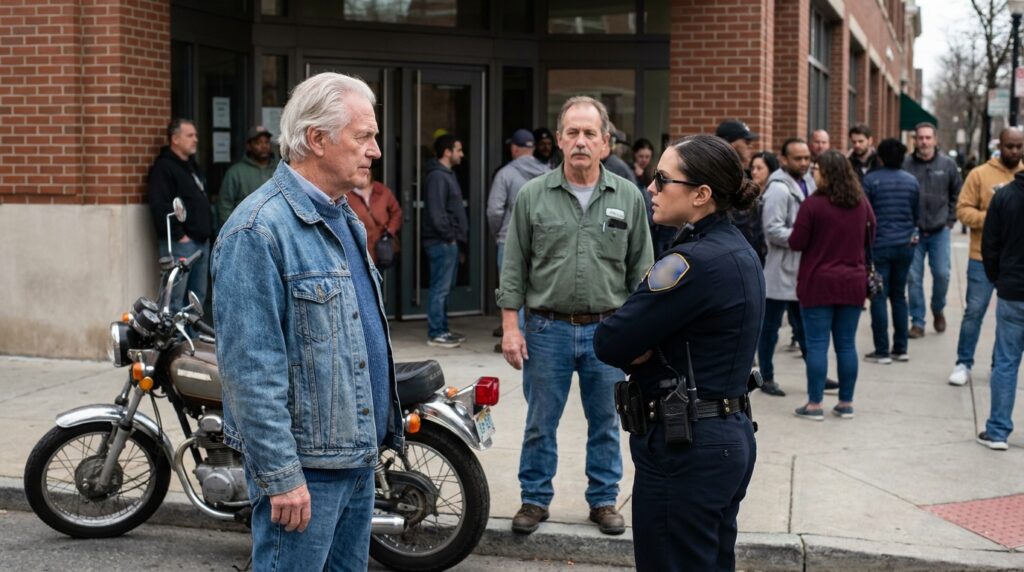
The choke knob was pitted with salt from an Atlantic crossing fifty years ago, its brass tarnished down to the color of wet river silt. Marcus Vance didn’t clean it. He liked the friction under his thumb. It took three heavy kicks to wake the 1974 Shovelhead, each thrust of his boot sending a dull vibration through the dry timber of the garage floor and up into his knees. The exhaust didn’t roar; it coughed—a wet, metallic bark that smelled of stale leaded fuel and scorched gaskets.
“The city’s got cameras on that whole grid now, Mac,” David said. He was leaning against the rusted frame of an old drill press, his olive work shirt already damp at the armpits from the early July heat. He didn’t look at Marcus; he looked at the floor, watching a thin thread of black oil crawl toward a crack in the foundation. “They aren’t looking for guys who remember where the old armory used to stand. They’re looking for things that don’t look like the brochure.”
Marcus didn’t throttle up. He kept his gloved hand flat against the leather of the seat, feeling the erratic pulse of the old iron between his thighs. His denim jacket was stiff, the cuffs grayed with grease from a dozen roadside top-offs. Beneath the denim, the blue wool of his sweater felt like an extra skin he’d forgotten to shed when the treaty was signed.
“The registry is public,” Marcus said. His voice had the dry, raspy scrape of sand moving through an iron pipe. “The concrete belongs to whoever paid the tax.”
“The tax was fifty years ago,” David muttered, finally looking up. His mustache twitched as he squinted through the bluish haze of the exhaust. “The people inside that building don’t even use paper anymore. You go down there with that leak under your primary drive, and they’re going to treat you like a grease fire.”
Marcus reached down and turned the petcock off, letting the engine die on its own terms. The sudden silence in the garage was heavy, filled only with the ticking of hot metal cooling against the damp morning air. He didn’t answer his brother. He didn’t need to. He reached into his internal breast pocket, his calloused fingers brushing past the cold, heavy edge of a Silver Star challenge coin that stayed tucked away like an old tooth, and pulled out a small, yellowed piece of cardstock—a parking voucher from the county clerk’s office dated three months before the first excavator touched the dirt.
As he went to slide the card back, his finger caught on a jagged split in the interior lining of his jacket. There was something hard taped behind the wool, something small and flat that shouldn’t have been there. It wasn’t the coin. It was too long, too cold. But before his thumb could trace the shape, the distant whine of a municipal siren cut through the valley breeze from the direction of the highway, sharp and clinical.
Marcus pulled his helmet on, the strap snapping against his throat with a dry, leather click. He didn’t look at David as he rolled the heavy machine back into the light.