
The Quiet Resilience of a Forgotten Line Standing Steady in the Gathering Dark

CHAPTER 1: THE WEIGHT OF STONE

The black rubber of the conveyor belt moved in jerky, three-inch increments, carrying a monotonous procession of plastic-wrapped bread, bruised apples, and generic canned soup toward the scanner’s crimson eye. Arthur Vance held his hand flat on the cool, scratched chrome of his shopping cart handle, feeling the low-frequency vibration of the store’s compressor through his palms. The air in Lane Four smelled faintly of damp cardboard, floor wax, and the cold rain leaking off the jackets of forty people trapped in the pre-weekend rush. Nobody was talking. In an American suburban grocery store at six on a rainy Thursday, silence was the currency of survival. You kept your eyes on the back of the neck of the person in front of you, and you didn’t ask for more than your allotted square foot of linoleum.

Arthur adjusted his navy blue cap, the fabric slightly stiff against his temple where the silver hair grew thin. His spine felt like a column of dried pine—brittle, unyielding, but upright. He had stood in lines that stretched across muddy fields in places people back home couldn’t pronounce, lines where the prize at the end was a dry pair of socks or a cold cup of chicory. This line was just for bread and milk, but the rules were exactly the same. You waited your turn because the person ahead of you had paid for their place with time.

Then the perimeter broke.

A sharp, rhythmic clicking of leather-soled shoes cut through the soft, muddy shuffle of sneakers and rubber boots. It was too fast, too loud, a deliberate violation of the room’s exhausted rhythm. Arthur didn’t turn his head—he didn’t need to—but his eyes shifted toward the left periphery.

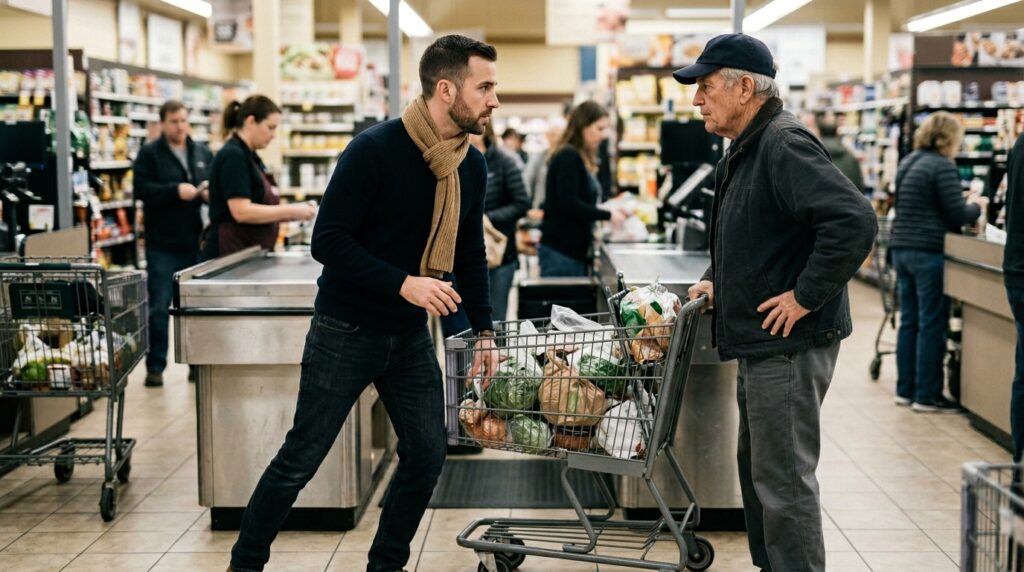
A man in his early thirties, smelling of expensive cedar cologne and cold rain, was cutting hard through the narrow gap between the magazine racks and the active queue. His dark sweater was immaculate; his tan scarf was looped with a casual precision that felt offensive in an aisle where people were counting pennies for laundry detergent. His face was glued to a glowing phone screen, his thumb flying across the glass with a twitchy, manic energy. He wasn’t looking at the people; he was looking at the spaces between the people, treating the human beings in his path like a series of slow-moving pylons on a closed course.

Arthur watched the younger man’s shoulder dip as he prepared to slide into the narrow eighteen-inch gap beside Arthur’s cart. The cart was packed tight—the heavy cans at the bottom, the fragile eggs balanced on top—acting as a visual anchor for Arthur’s entire baseline position. The young man didn’t slow down. He simply raised his left hand, palm outward, a cutting gesture designed to dismiss an obstacle before he even arrived at it.

The edge of the younger man’s dark sweater brushed the wire mesh of Arthur’s cart, the metal groaning softly as the wheels shifted an inch. A small, brass key ring attached to Arthur’s jacket zipper caught the harsh fluorescent glare above, spinning once before falling dead still.

Arthur didn’t flinch. He didn’t step back toward the candy displays to grant the requested detour. Instead, his fingers closed around the chrome handle with a slow, deliberate pressure that locked his forearms into rigid status. He widened his stance by two inches, his worn boots gripping the linoleum like stone anchors.

The younger man stopped. His chest was less than six inches from the side of Arthur’s shoulder, his forward momentum dying against an invisible wall of pure physical placement. He blinked, his eyes tearing away from the phone screen for the first time, a sharp crease forming between his trimmed eyebrows as he looked down at the old man blocking his path.


CHAPTER 2: THE PERIMETER DECREE

The world flattened into the space of three inches. The younger man’s chest hovered right at the edge of Arthur’s shoulder, a rigid plane of dark wool that smelled of expensive citrus oil and cold, high-altitude office buildings. Up close, the pristine quality of the tan scarf began to break down under the harsh, unforgiving flare of the supermarket fluorescents; there were tiny, frayed fibers lifting from the weave, damp from the storm outside, vibrating slightly with every short, shallow breath the young man took.

Arthur held his position. He could feel the cold, pitted iron of the shopping cart handle biting deep into the calluses of his palm. His knuckles were the color of salt pork, the skin stretched thin over knuckles that had seen the salt-crusted decks of ships forty years out of port. He didn’t drop his chin. He kept his gaze level, targeting the small, tense junction where the younger man’s jawline met the collar of his sweater. A tiny pulse was leaping there, frantic and erratic, like a trapped bird behind a screen door.

“Excuse me,” the younger man said again. The voice was sharper now, the polite cadence fracturing around the edges. He shifted his weight from one leather sole to the other, the sound a distinct, dry slap against the damp linoleum. “I need to get through here quickly. I’m in a rush.”

He raised his hand a fraction higher, the fingers slightly spread as if he could simply wave Arthur into a different state of matter. The gesture was clean, efficient, the move of a man used to signed contracts and compliant subordinates.

Arthur let the silence stretch. It was a heavy, deliberate thing, the kind of quiet that accumulates in a squad bay before the lights are cut. He let it fill the narrow corridor between the row of Hershey bars and the stack of current-events magazines. Behind them, the slow thump-beep of Lane Three’s register continued, but in Lane Four, the air felt thick, almost greasy with the sudden suspension of movement. The woman with the screaming toddler three carts back had stopped rocking her heels. The cashier’s hand remained hover-locked over a cardboard container of half-and-half, her silver rings catching the pale light.

“The line moves forward,” Arthur said. His voice didn’t have the volume of a shout; it carried the low, flat resonance of an old diesel engine idling in a closed garage. It was a tone that didn’t ask for permission to occupy the air. “It doesn’t move sideways.”

The younger man’s eyes widened slightly, the dark pupils contracting under the direct glare of the tubes above. He looked down at the cart, then back up at Arthur’s face, his gaze snagging on the faded navy blue cap pulled low over the veteran’s forehead. For a second, a flicker of something old and half-buried crossed his features—a sudden, sharp squint of recognition that vanished as quickly as it had arrived, replaced by the red flush of public frustration climbing up from his collar.

“Look, man,” the youth muttered, his tone dropping an octave as he tried to regain the high ground of the interaction. He leaned into the narrow passage, his shoulder pressing directly against the wire frame of the basket. “I don’t have time for a lesson in grocery store manners. I’ve got things to do. Move the cart.”

The wire frame groaned under the pressure. Arthur felt the movement travel through the metal, up his arms, and into his sternum. Inside his dark jacket pocket, a crumpled piece of paper rustled—the stiff, coarse edge of a hospital discharge sheet he’d stuffed away three hours ago, its ink still fresh, detailing the exact dosage of the medication currently making his thighs feel like bags of wet sand. The physical weakness was there, a dull, throbbing ache behind his kneecaps, but he didn’t let it touch his posture.

Instead, he reached down with his left hand, his fingers catching a loose, frayed silver thread that hung from his own hem, twisting it once around his index finger until the skin turned white. He used the small, sharp pain to focus his center. He didn’t shift his boots. He let his body become part of the building’s foundation, an extension of the heavy concrete pillars holding up the roof against the storm.

“You’ve got the same twenty-four hours everyone else has,” Arthur said softly, his eyes never leaving the younger man’s face. “No more, no less. You wait like the rest of the block.”

The younger man’s hand froze mid-air, his fingers curling into a loose, frustrated fist. He didn’t back off, but his shoulder stopped pushing against the wire. The crowd behind them had gone completely still now; the only sound was the rhythmic, metallic dripping of rain from the outdoor awning onto the heavy rubber mat by the automatic doors. The space had become a cage, and neither of them was looking at the exit anymore.

CHAPTER 3: THE CHROME BOTTLENECK

The cuff of Brandon’s sweater pulled taut over a heavy stainless-steel watch face as his hand stayed suspended near the wire frame. The damp scent of his coat deepened under the dry warmth of the checkout heater, mixing with the sharp, faint odor of ozone rising from the old register belt. He didn’t drop his hand. Instead, his knuckles twitched, the leather strap of his briefcase groaning softly as his grip tightened.

“You don’t know what kind of night I’m having,” Brandon muttered, his voice dropping into a flat, raspy register that barely carried past the tabloid rack. His jaw was locked so hard the muscles beneath his trimmed beard formed a hard, white knot. “You’re just standing here. You have all the time in the world to be a monument. Some of us actually have a destination.”

Arthur did not lean away from the heat of the younger man’s proximity. His own shoulder felt heavy, the dull ache from the three-hour clinic wait now settling into the lower curve of his ribs like cold grease. Through the thin canvas of his dark jacket pocket, his knuckle brushed the folded corner of the clinic sheet. The paper was rough, water-spotted from the walk across the asphalt parking lot, its top margin stamped with a fading purple emblem from the county oncology ward. The ink was still fresh enough to leave a small, dark smudge on his thumb if he touched it directly. It was a physical anchor—a reminder that his body was currently failing him, even as his posture refused to give notice.

He looked down at the gap between his cart and the rack of single-serve mints. It was tight. A standard-sized man would have to turn his hips sideways to clear it, scraping his coat against either the metal basket or the cheap cardboard dividers of the display. Brandon was already angled, his lean frame leaning over the lane like a sail catching a bad wind.

“Everyone’s got a destination,” Arthur said, his voice flat, rhythmic, matching the slow, mechanical clunk-shove of the cashier behind him. He didn’t shift his fingers on the handle. “The road doesn’t get wider just because you’re running out of it.”

A faint, high-frequency whistle cut through the lane—the sound of an old, overtaxed fluorescent tube near the ceiling beginning to die. It cast a flickering, greenish-yellow tint across Brandon’s pale face, emphasizing the dark, hollow shadows beneath his eyes. He didn’t look back at his phone. His focus remained pinned to Arthur’s navy blue cap, his eyes squinting again as if trying to parse a line of text written in a language he used to speak. There was an edge of exhaustion in his anger now, a ragged quality that didn’t belong to a man who was simply trying to save three minutes on his commute. It was the frantic, messy energy of someone fleeing a fire.

Behind them, a low murmur rippled through the line. A woman in a yellow raincoat shifted two heavy plastic jugs of milk from her arms to the bottom shelf of her cart, the plastic crunching loudly against the wire. The cashier didn’t look up, but her scanning hand slowed down, her fingers lingering on a bar code as she listened to the silence in Lane Four. The space between the two men had become a small, isolated pocket of gravity, drawing the attention of the room without a single word being shouted.

Brandon took half a step closer, his knee almost touching the lower tray of Arthur’s cart, where two heavy cans of split pea soup sat wedged against the wheels. “Move the basket,” he whispered. The words were thin, scraped dry of any polite pretense. “Just an inch. That’s all it takes. One inch and I’m gone.”

Arthur looked at the younger man’s raised hand. The skin across the knuckles was white, trembling slightly from the sheer force of a pressure that had nothing to do with the supermarket queue. He could see the small, rhythmic pulse in the man’s throat jumping faster now, a frantic little engine driving a machine that was about to break down. Arthur knew that pulse. He had seen it in the necks of kids forty years younger than him, sitting in the dust of a ditch with their gear scattered around them, waiting for a command they didn’t want to hear.

Instead of answering, Arthur slowly let his weight sink back onto his heels, using the heavy frame of the grocery cart to stabilize the sudden, sharp tremor that had just started in his own left thigh. The white slip of the discharge paper shifted inside his pocket, the blurred clinic emblem sliding upwards until a single, torn corner of the document showed through the open top of the pocket, pale against the dark blue canvas.

“An inch is a lot of ground,” Arthur said softly. “Depending on who’s holding it.”

CHAPTER 4: THE ANCHOR ANATOMY

The front wheels of the grocery cart buckled sideways with a dry, metallic rattle as Brandon plunged his forearm against the upper chrome rim. He didn’t use his open palm; he used the flat of his bone, forcing his weight into the metal with the raw, clumsy momentum of someone whose mind has already left his limbs. The impact traveled up through the cart’s frame, vibrating through the heavy glass milk bottles and jars of pinto beans before striking Arthur flat in the center of his palms.

Arthur did not lean back. He took the shock through his elbows, his shoulder blades pinning against his spine with the dry, deliberate crack of an old latch-lock. Under his boots, the damp linoleum slicked with oil and tracked-in stormwater offered no traction, but his hips stayed fixed, his core drop-locked into the lane. The physical strain sent a hot, white line of fire straight down his left thigh, right where the surgical scar from his winter treatment remained tight and angry under his trousers. His breath came shallow, carrying the sour smell of cold hospital corridors and the metallic tang of the noon medication that was still wearing off.

“I said,” Brandon rasped, his face so close Arthur could see the tiny white flecks of dried salt on his lips, “get out of my way.”

He shifted his upper torso, his leather briefcase swinging out like a pendulum, striking the tabloid rack with a loud, hollow slap that sent several weekly papers sliding down onto the floor. Brandon didn’t look down at them. His fingers hooked into the steel lattice of the cart basket, his nails clawing for leverage to pull the barricade out of the bottleneck. In his frantic heave, his elbow caught the top of Arthur’s dark jacket pocket.

The thick, coarse corner of the hospital sheet tore.

The white slip didn’t just slide; it burst outward under the pressure of Brandon’s sleeve, the crisp paper unfolding along its crisp lines until it fluttered down against the conveyor belt, landing face-up right between a box of generic crackers and a jar of apple butter. The purple clinic emblem—the sharp, unmistakable cross of the county oncology annex—sat exposed under the unshielded glare of the ceiling tube. Below the stamp, the bold, typed lines of the discharge summary were instantly legible: Patient Arthur Vance. Outpatient Session 4. Restricted physical exertion for 72 hours.

Brandon’s fingers stayed frozen in the wire grid. His breath hitched, his chest remaining uncomfortably close to Arthur’s shoulder, but the forward drive vanished from his shoulders like air escaping a punctured tire. His eyes dropped to the paper on the black rubber belt, tracking the name printed in fading gray ink. He blinked once, twice, his head twisting slightly to the side as if trying to clear a thick fog from his vision.

“Arthur…?” Brandon whispered. The tone was completely different now—scraped of the corporate edge, thin, child-like, and hollow. He didn’t pull his hand back from the basket, but his grip went entirely limp.

Behind them, the cashier stopped mid-motion, an un-scanned bag of frozen corn clutched in her right hand as she stared at the paper on her belt. The silence in Lane Four grew so dense that the low, wet thud of a car door closing in the parking lot outside sounded like an explosion through the plate glass window. Nobody spoke. The row of bystanders in the next lane turned their heads slowly, their eyes locking onto the small, white document that had just redrawn the boundaries of the room.

Arthur kept his hands flat on the chrome handle, his knuckles burning from the strain of the block. He looked at the younger man’s profile, tracking the sharp, defensive set of the jaw that looked so much like his brother’s—the same brother who had stopped calling fifteen years ago after the farm probate collapsed. The family line was right there, written in the shape of the nose and the nervous twitch of the left eyelid, but it was buried under ten layers of expensive wool and thirty years of accumulated distance.

“The name is on the ticket,” Arthur said, his voice dropping into a deeper, gravel-rough crawl. “But the spot belongs to the line.”

He reached out with one stiff finger, his thumb pressing down on the edge of the torn paper to slide it back toward his pocket. His hand was shaking—a fine, involuntary tremor that he couldn’t suppress no matter how hard he locked his wrist. The physical failure was total now; his knees were beginning to give, the weight of the three-hour treatment finally dropping through his legs like lead weights. But he didn’t pull his boots from the floorboards. He stood in the narrow gap, his navy cap tilted forward, a solitary old man holding an inch of ground against a ghost who didn’t even know his own blood.

CHAPTER 5: THE SHATTERED SILENCE

“Don’t look at it like it’s a ghost,” Arthur said. His voice was barely a whisper, a dry rasp that sounded like coarse sandpaper sliding over cedar. He didn’t lift his fingers from the shopping cart handle, though the chrome felt ice-cold against his splitting skin. “It’s just paper. It goes in the trash when the week’s done.”

Brandon didn’t look up at Arthur’s face right away. His gaze remained pinned to the black conveyor belt, tracking the single drop of rainwater that slid off his own tan scarf and landed with a tiny tap directly onto the bold purple stamp of the county oncology annex. The moisture began to blur the outer edge of the cross, the ink bleeding into the cheap, high-acid paper fibers until the clean margins looked like an old bruise.

“Uncle Arthur,” Brandon said. The name came out fractured, a low rattle behind his teeth that didn’t match the crisp efficiency of his leather shoes or his stainless-steel watch. He pulled his hand out of the wire lattice of the grocery basket, but his fingers remained curled, hovering in the open air like five dead matches. “You… we thought you were still out west. Dad said you didn’t leave the ranch after the probate closed.”

“Your father says a lot of things to clear his conscience,” Arthur said. He adjusted his stance, his worn boot heel squeaking against a patch of dried salt on the floorboards. The white-hot line of fire in his left thigh had gone numb, replaced by a heavy, leaden cold that made his knee feel like it belonged to someone else’s skeleton. He didn’t allow his weight to drop into a slump. He kept his shoulders squared against the narrow passage, his chest anchoring the lane. “He tells them to you so you can run his errands without looking behind you.”

A sudden, sharp chime shattered the quiet—not the mechanical chirp of the cash register, but the high, urgent vibration of Brandon’s phone held loose in his left hand. The screen lit up against the dull gray background of the tabloid racks, casting a cold blue flare across his face.

Arthur’s eyes shifted down to the glass. A black text banner was pinned across the lockscreen, the preview text readable under the bright ceiling tubes: ICU ADMISSION NOTICE: HOLLIS VANCE. STABLE BUT FAILING. CONTACT ARRIVAL IMMEDIATELY.

The younger man didn’t grab the phone to answer it. He looked at the message, then back at the torn sheet on the belt, his jaw working silently as if he were trying to compile two completely separate languages into a single sentence. The frantic, cutting urgency that had driven him into the narrow gap three minutes ago was suddenly naked; it wasn’t the rush of a man trying to catch a corporate train, but the blind, desperate panic of a son racing toward a room where the machines were slowing down. The shared burden was right there on the black belt—one man leaving the ward, another man fighting to reach it before the doors closed for good.

Behind them, the cashier let out a soft, shaky breath, her knuckles white around the container of half-and-half she’d been holding mid-air since the confrontation peaked. She reached down, her silver rings clinking against the plastic edge, and gently pushed Arthur’s items an inch down the belt, clearing a small space around the discharge papers without touching the ink. The other shoppers in the active queue didn’t move. They stood like fence posts in a winter field, their heads lowered but their ears tuned to every breath passing between the two men.

“I have to get to the county annex,” Brandon whispered. He didn’t demand the ground anymore. He looked at the loaded grocery cart, then at Arthur’s steady, unblinking eyes under the navy cap. The modern, sharp edges of his posture had vanished; his shoulders were hunched forward, his coat hanging loose from his frame like a wet sack. “They called from the second floor twenty minutes ago. I can’t… I can’t wait behind thirty people, Arthur. He’s not going to make the night.”

Arthur looked at the young man’s trembling fingers. He saw the family trait—the narrow nail beds, the slight crook in the index joint—the exact markers his brother Hollis had carried when they were thirty years younger, sorting fence wire in the dry dust before the lawyers came between them. The anger in Arthur’s chest didn’t flare; it settled into a cold, flat stone, heavy and durable.

“Hollis always was a poor hand with a clock,” Arthur said softly. He didn’t take his left hand off the cart handle, but he shifted his forearm, his elbow clearing the six inches of passage space Brandon had tried to steal. “He never could figure out how much time a mile took.”

He looked back toward the cashier, his voice rising just enough to reach the register. “Put the milk and the bread on my tab. The boy is in the wrong lane, but he’s on the right road.”

The younger man didn’t move forward into the clearance. He stayed pinned by the sheer weight of the room’s silence, his eyes fixed on the old man’s weathered profile as the real context of the bottleneck finally settled into the floor. The decoy secret of Arthur’s stubbornness was gone, broken by the white paper on the belt, but the deeper reality—the dying brother on the second floor and the old man who had just spent three hours in the same concrete building without telling a soul—stayed strictly locked, an unexploded shell buried three feet beneath the linoleum.

CHAPTER 6: THE HARVEST LINE

The register belt didn’t move. It sat flat under the heavy, oil-stained rubber casing, holding the bread, the milk, and the torn purple cross of the county oncology summary like an offering on a stone slab. Time dilated, expanding until the rhythmic dripping of water off Brandon’s tan scarf sounded like the slow, measured ticking of a grandfather clock in an empty hallway. Every breath in Lane Four carried the dull, chalky scent of bleached grocery dividers and old floor wax.

Brandon didn’t leap forward into the clearance Arthur had granted. His leather-clad arm remained halfway between his chest and the chrome cart, his fingers uncurling with an agonizingly slow friction. He looked at the edge of the metal basket, where his own hand hovered less than an inch away from Arthur’s weathered, salt-pork knuckles. In the bright, unshielded wash of the fluorescent tubes, the line of their hands became a single mirror; both carried the identical, slightly crooked index joint and the distinctively narrow nail beds inherited from three generations of Vances who had worked the dry clay of the west pasture.

“Uncle Arthur,” Brandon whispered again, his throat clicking on the vowels as if the name were too large for his mouth. His jawline, once tight with corporate assurance, had slackened into an unmoored tremble. He looked from the shared shape of their fingers to the pale, rain-streaked ink on the discharge sheet. “You… you were at the clinic today. While I was waiting in the hospital lounge down the block. All afternoon.”

“I was there,” Arthur said. The words came out slow, heavy with the weight of old iron, but they didn’t shake. He allowed his boots to remain anchored to the floorboards, though the leaden numbness in his left thigh was climbing past his hip now, threatening to drop his balance into a total collapse if he shifted a fraction of an inch. He kept his spine straight under the dark blue canvas jacket, his old navy cap tilted just far enough to shield his eyes from the raw light. “I saw your car in the lot. The one with the clean tires. I didn’t see a reason to disturb your father’s peace before his time.”

Brandon’s head dropped. The immaculate tan scarf slid forward, the frayed wool edge trailing across the wet rubber of the belt, catching a smear of grey, greasy dust from the scanner track. He didn’t pull it away. The frantic blue chime of his phone vibrated against the tabloid rack once more—ICU FLOOR ARRIVAL CONFIRMATION—but the sound didn’t make him jump. The emergency hadn’t changed, but the world had grown too narrow for him to run through it blindly.

“He… he asked for you on Tuesday,” Brandon said into the space between them. His shoulders had lost all their sharp posture, the expensive dark sweater bunching around his collar like an oversized coat. “Before the tubes went in. He told me he’d spent forty years trying to keep people behind his fences, and now he couldn’t find the gate.”

Arthur looked at the young man’s bowed head. He didn’t feel the sting of the old probate court or the bitter winter of fifteen years ago when the family trucks had driven away from the shared barn for the last time. Those grievances had been washed clean by three hours of clear fluid dripping into his arm from a plastic bag in Room 4B. The world wasn’t a checklist of debts to be collected anymore; it was just a line of tired people waiting for their names to be called.

“The gate’s where it always was, Brandon,” Arthur said, his voice dropping into a low, warm hum that matched the steady hum of the dairy coolers across the aisle. He slowly lifted his left hand off the cart handle, his joints cracking loudly in the dead silence of the store. He reached down and picked up the water-spotted clinical summary, folding it into a tight, neat square before sliding it back into his pocket, out of sight. “It’s just that some people think they have to tear down the fence to find it.”

He nodded toward the open bottleneck beside the register. The path was clear now. The woman in the yellow raincoat behind them had pulled her hands away from her milk jugs, her head lowered in a quiet, respectful stillness that had spread through the entire front end of the market. The cashier stood with her mouth closed, her hand finally releasing the package of half-and-half, leaving the transaction open, waiting for the elder’s signal.

“Go on,” Arthur said softly, his palm resting flat against the wire grid of his cart, his body remaining perfectly still to hide the tremor in his legs. “The lane is open. Don’t let your father wait on a clock he can’t read.”

Brandon looked up, his dark eyes wet under the harsh light, tracking the white-knuckled grip Arthur maintained on the chrome to stay upright. He didn’t speak. He couldn’t. He simply reached out, his hand matching the old man’s angle for a fraction of a second, his fingers brushing the rough canvas of Arthur’s sleeve in a brief, silent weight of recognition. Then, he turned his hips sideways, clearing the narrow passage without scraping a single chocolate bar from the display, and moved toward the automatic glass doors with a long, steady stride that had no more hurry left in it—only a quiet, disciplined necessity.

Arthur watched the glass doors slide shut against the cold rain, the reflection of the store’s bright neon interior swallowing the young man’s dark shape as he stepped into the parking lot. He waited until the taillights of Brandon’s car flashed once through the storm and vanished into the gray dark of the avenue.

Then, and only then, Arthur let his weight ease back against the front bar of his shopping cart, his shoulders relaxing by a fraction of an inch as he looked at the cashier.

“Some lines,” Arthur said into the quiet room, his hand reaching for his wallet, “aren’t meant to be crossed. But they’re meant to be shared.”

Similar Posts

Leave a Reply

Your email address will not be published. Required fields are marked *






