
The Fraying Edge of Honor and the Quiet Reverberations of a Forgotten Soldier’s Earned Grace

CHAPTER 1: THE WEIGHT OF THE RIBBON

The metallic rattle of the subway car pulsed upward through the rubber-scuffed floorboards, vibrating into the worn brass collar of Arthur’s wooden cane. He didn’t look up. At eighty-one, you learned to read the world through its structural frictions—the screech of steel flange against a curved track, the dry chemical scent of aged air conditioning, the subtle shifts in human weight filling the blue plastic benches around you. On his lap rested the yellowed, corner-bent manila folder from the downtown VA hospital, its metal prongs slightly oxidized. It was thick with printouts detailing things that were slowly giving out inside him, a quiet bureaucratic ledger of a body paying its final interest on a decades-old debt.

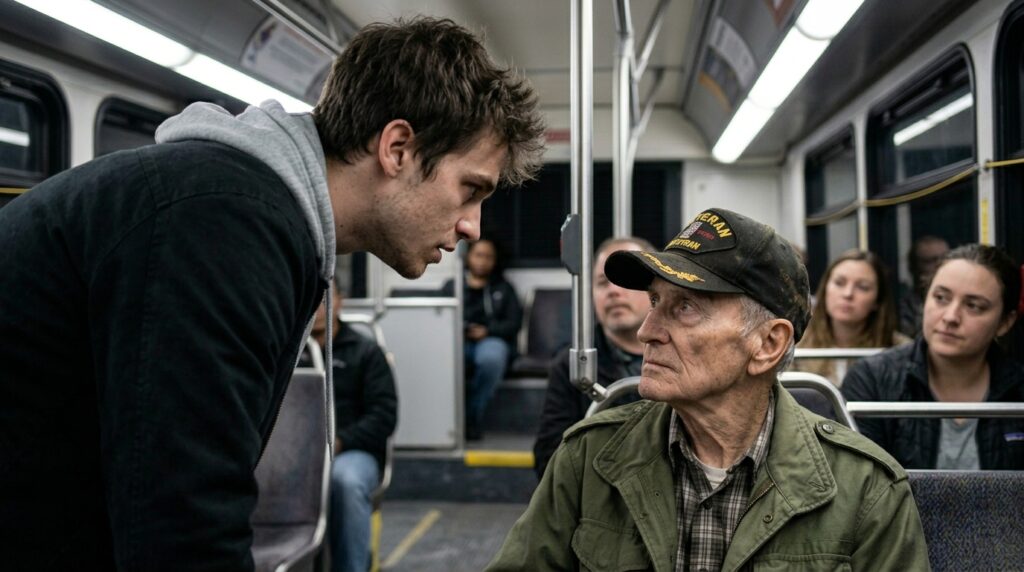
Overhead, the fluorescent tubes flickered, casting a pale, desaturated wash over the passengers packed into the evening rush. Arthur kept his fingers looped loosely around the cap resting near his chest. The black cotton was faded to a soft, charcoal gray along the crown, its edges tattered into fine, wispy threads that caught the light like spiderwebs. Pinned to the center was a small, tarnished piece of metal—a Silver Star citation pin, its enamel long since chipped away by time, leaving only the raw, dull silhouette of an anchor and a star. To anyone else, it was a relic of an obsolete geography. To Arthur, it was simply the weight he carried.

The train slammed through the switchyard near 4th Street, throwing the standees into a brief, synchronized lurch. When the car stabilized, the air changed. A cold draft spilled from the vestibule doors, accompanied by the sharp, rhythmic slap of a heavy nylon zipper.

“Mind if I take a closer look at that hat?”

The voice was young, reeking of cheap synthetic cologne and the hollow bravado of someone who needed an audience to feel anchored.

Arthur didn’t blink. He kept his gaze fixed on the scuffed linoleum between his boots, but his peripheral vision locked onto the gray hoodie and the dark, messy hair leaning into his space. The young man had stepped deep into the interaction lane, his thighs crowding Arthur’s knees, forcing the passengers on either side to shrink back into the plastic molding.

“Relax, it’s just a hat,” the youth sneered, his hand rising from his pocket, fingers hovering inches from the frayed brim. “What’s the big deal?”

The hand moved—a casual, predatory swipe meant to snatch the cloth and see if the old man would weep or beg.

But Arthur’s right arm didn’t rise in panic. It moved with the ancient, unthinking economy of a muscle memory that had survived the Ia Drang Valley. A micro-shift of his shoulder, a clean rotation of the wrist, and his forearm intercepted the young man’s sleeve with a dull, flesh-on-fabric thud. It wasn’t a strike; it was a wall. The sheer placement of Arthur’s skeletal frame stopped the momentum cold, the brass collar of his cane clicking once against the floor as his steady blue eyes locked directly onto the young man’s face.

The car went dead silent. The young passenger froze, his arm suspended in the air, his fingers twitching against the invisible barrier of an old man’s absolute composure.

Arthur cleared his throat, his voice low, gravelly, and entirely devoid of anger. “That hat was earned, son.”

As the words left his mouth, Arthur’s thumb accidentally brushed the underside of his VA folder, his skin catching on a piece of paper tucked behind his medical charts—a faded, photocopied enlistment record bearing a name that didn’t belong to him, but to the young man’s family.


CHAPTER 2: THE AMBIENT SILENCE OF THE CAR

The word hung in the humid air of the transit car, dense and unyielding, like the sulfurous smoke that used to pool in the low draws of the central highlands after the mortars fell. The young man’s arm remained locked in Arthur’s grip, the fabric of his cheap black jacket bunching beneath Arthur’s liver-spotted fingers. For three full oscillations of the train, neither of them moved. The smugness on the youth’s face didn’t vanish so much as it curdled, his eyes darting from Arthur’s steady, blue gaze down to the ancient, liver-spotted hand that held his wrist with the precise, structural leverage of a brass clamp.

Arthur felt the subtle tremor in the boy’s sleeve. It wasn’t the shaking of fear yet; it was the vibration of a sudden, deep confusion. The boy had expected a soft target—an old man whose joints were brittle and whose spirit had been ironed flat by decades of waiting in the fluorescent purgatory of federal clinics. Instead, he had hit something dense. The bone beneath Arthur’s thin skin was still heavy, seasoned by the weight of things the boy had only ever seen digitized on a screen.

Slowly, Arthur released his grip. He didn’t pull his hand back in a defensive jerk; he simply opened his fingers and let his arm drop back onto the yellowed surface of the manila VA folder resting on his lap. As his hand settled, his thumb brushed the rough edge of the tucked-away slip of paper. The typed surname on that scrap—Miller—seemed to hum against his skin through the thin cardstock. It was a common name, an ordinary American name, but the registry number beside it matched the designation of a platoon sergeant who had gone into the high tall grass near the Cambodian border and never walked out.

The youth pulled his arm back, his mouth twisting into a hard, defensive line to cover the embarrassment blooming across his cheeks. He looked around the carriage, his eyes searching the faces of the midground riders for a shared smirk, a nod of agreement, some sign that the collective environment was still on his side. But the room had changed its texture. The passive detachment that usually governed the evening rush had dissolved into a tight, observant stillness.

“Yeah, whatever,” the boy muttered, his voice dropping an octave as he tried to regain his footing. He didn’t step back out of the interaction lane, but his shoulders slouched slightly, his forward lean losing its predatory edge. “A hat’s a hat, old man. You don’t gotta make it weird.”

“It isn’t weird,” a voice cut in from three seats down.

Arthur didn’t turn his head, keeping his eyes fixed on the boy’s chest, watching the rapid, shallow rise and fall of the dark nylon jacket. The voice belonged to a woman in her mid-forties, her fingers tightly coiled around the brushed steel of a vertical stanchion. She had lowered her white earbuds, letting them dangle against her coat like twin pendulums. “He told you to leave it alone. So leave it alone.”

A low murmur of agreement passed through the rear depth of the carriage—a collective shifting of boots on scuffed linoleum, the rustle of grocery bags, the soft click of a tongue against teeth. The public witness layer, which had been a collection of isolated strangers moments before, was beginning to crystallize into a single, defensive wall. The unwritten social contract of the transit line had been breached, and the weight of the car was beginning to lean toward the corner where Arthur sat with his oak cane.

The boy’s friends—two other youths in oversized athletic gear who had stayed near the center doors—didn’t move forward to support him. They remained back, their eyes fixed on their own shoes, subtly untangling their bodies from his proximity. They were reading the environment with the quick, sharp instinct of the young; they knew when the floor was dropping out from under a friend, and they knew how to let him fall alone.

Arthur let the silence do the heavy lifting. He reached down, his fingers moving with deliberate slowness, and adjusted the placement of his wooden cane, letting the brass collar rest more firmly against his knee. The wood was old, smoothed by twenty years of skin oils until it felt like silk, but the core of it was solid American ash.

“You got the next stop, son,” Arthur said softly. It wasn’t a threat. It was a diagnostic observation, delivered with the same flat cadence he used when telling a junior corpsman which tourniquet to tighten first.

The boy looked at the flickering digital map above the emergency exit. The indicator for 8th Street was pulsing in red intervals, the train’s brakes beginning to hum as the undercarriage took the friction of the descent. The youth’s jaw worked silently, his fingers curling into loose fists inside his pockets, but the kinetic energy had drained completely out of his frame. He was no longer the author of the scene; he was merely an occupant waiting for a door to open.

Beneath Arthur’s hand, the manila folder shifted slightly as the train slurred to the left. The loose registry slip inside peeked out by a fraction of an inch, revealing the date October 1969 typed in a faint, manual ribbon ink. Arthur’s thumb covered it again, his internal monologue silent, calculating the distance between the boy’s messy dark hair and the facial structure of the man he had left behind in the mud fifty-seven years ago. The resemblance was there, buried under the soft fat of a comfortable life, but the eyes were the same—furious, untethered, and looking for something to break.

The brakes gave a final, metallic shriek, and the carriage came to a halt. The pneumatic doors slid open with a heavy huff of stale tunnel air, revealing the dirty white tiles of the 8th Street platform. The boy didn’t move immediately, waiting for a second of delayed pride, but his friends had already stepped out onto the concrete, leaving him alone in the threshold.

“My granddad had one of those,” the boy said suddenly, his voice tight, his hand pointing quickly at the tattered black cap on Arthur’s head before he turned toward the exit. “He died in a state house with nothing but his name. The ribbons didn’t buy him a damn thing.”

Before Arthur could answer, the boy stepped through the threshold, his black jacket disappearing into the gray current of the platform crowd. But as the doors began to slide shut, Arthur noticed a small, black leather card holder lying on the blue plastic seat directly opposite him—dropped from the boy’s pocket during the brief physical interception.

CHAPTER 3: THE REMAINS OF THE STRANGE LANE

The heavy rubber edges of the pneumatic doors sealed with a pressurized hiss, locking out the damp chill of the 8th Street station. As the train gathered its slow, groaning momentum toward the next transit block, the space across from Arthur seemed to widen. The blue plastic bench, still retaining a faint residue of corporate warmth from the young man’s presence, sat vacant. At the center of that plastic mold lay the black leather card holder. It was small, scuffed along the seams where the cheap imitation thread had begun to unravel, mimicking the fraying edge of the world Arthur had traveled through all afternoon.

Arthur didn’t reach for it immediately. He let his eyes trace the contours of the cracked vinyl. In his line of work, decades ago, you never touched an unchecked object in a cleared zone until the dirt settled. He looked around the perimeter of the carriage. The midground riders had already begun their retreat into the safety of their small, isolated lives; headphones were being tugged back over ears, and eyes were dropping down toward glowing screens. The brief crystallization of public witness energy had broken. They had stood as a wall when the intrusion was active, but now that the threat had slipped into the gray tunnels, they wanted their silence back. Only the mid-30s transit employee several seats down kept a lingering, protective gaze fixed on Arthur’s position before shifting to look out into the dark windowpane.

Slowly, using the crook of his wooden walking cane, Arthur hooked the small strap of the card holder and slid it across the linoleum floor until it rested against his own boot. The friction made a faint scratching sound against the rumble of the undercarriage. He leaned forward, his spine offering a familiar, dull ache that registered through the olive fabric of his jacket, and picked it up.

The weight of it was negligible. Inside the transparent plastic window where a driver’s license usually rested, there was no identification card. Instead, Arthur’s thumb brushed against a hard, metallic ridge. He slid his fingers into the tight pocket, pulling out a small, uniquely notched brass key. It wasn’t a standard house key; the teeth were square, cut with the industrial precision of a government-issued padlock or a military locker anchor. Tucked right behind it was a folded square of paper, yellowed at the crease line and matching the exact, distinctive tint of the platoon registry sheets resting inside his own VA hospital folder.

He didn’t unfold the paper yet. He held it between his fingers, tracking the texture. The boy’s final words echoed beneath the steady rhythm of the wheels below: He died in a state house with nothing but his name.

Arthur’s internal landscape shifted, the quiet tactical calculation of his training taking over the emotional weight of the encounter. The boy hadn’t chosen this specific transit car by pure coincidence. The target wasn’t random underestimation; it was a tracking lane. The surname Miller typed on the loose slip within Arthur’s own document file began to feel less like a ghost from an old ledger and more like a live coordinate. The sergeant he had left behind in the tall grass had a son who died broken, and now a grandson was riding the cross-city loops with an institutional key and a tattered piece of history in his jacket.

“You dropped this,” Arthur muttered to the empty air across from him, his voice absorbed by the heavy acoustic isolation of the moving car.

He looked down at the veteran cap in his lap. The tarnished Silver Star citation pin caught the yellow cast of the overhead bulb. The boy thought the ribbon hadn’t bought his grandfather a damn thing. He thought the system had simply chewed through a name and left a family to rot in a state facility. It was a familiar harshness, a shared burden that Arthur understood better than anyone else in this carriage. But the boy didn’t know about the physical secret locked inside the VA folder—he didn’t know that Arthur carried the very registry that proved his grandfather’s platoon had been officially scrubbed from the active operational logs during the final withdrawal across the border.

The train slowed again, entering a long, sweeping curve where the lights flickered twice, plunging the interior into a brief, shadow-filled twilight. In that darkness, Arthur felt the notched key slip into his palm, cold and real. The decoy secret was already taking shape in his mind—the boy was hunting for the platoon registry to prove a case of systemic neglect, to demand a retroactive settlement for a grandfather who died in poverty. It was a logical, desperate pursuit. But it wasn’t the ultimate final reality. The boy didn’t know what that key actually opened, or what Arthur had truly done in the field hospital to keep that specific registry from being burned.

Arthur slid the black card holder deep into the inner pocket of his olive jacket, right beside the manila folder. He gripped the polished wood of his cane, his knuckles turning a dry, pale white. The next stop was his own, but the path was no longer leading toward his quiet apartment.

“Eighth Street was just the entry point,” he murmured, his thumb checking the placement of the cap on his head, ensuring the frayed edge was straight before the doors opened.

CHAPTER 4: THE THRESHOLD OF EYELEVEL TENSION

The mechanical brakes of the carriage ground to an uneven, high-pitched halt, sending a shudder straight through the iron core of Arthur’s cane. He stood up slowly, allowing his joints to absorb the momentum of the train’s final registration against the concrete platform. The manila folder was tucked securely under his left armpit, his jacket pinning the paper thinness against his ribs like a protective shield. With his right hand, he kept his fingers pressed over the cold outline of the notched key in his lower pocket.

The sliding doors parted with a pressurized gasp, admitting the stale, exhaust-laden atmosphere of the terminal. Arthur stepped over the iron gap between the train and the platform, his heavy leather-soled boots making a dull, flat thud as they found solid ground. The midground riders spilled out around him, a silent, hurried tide of shoulders and lowered heads, eager to shake off the lingering residue of the confrontation that had just played out on the blue plastic benches. None of them looked back at him. The protective wall they had formed during the intrusion had completely atomized into individual urgency.

Arthur didn’t follow the main artery toward the exit turnstiles. Instead, he pulled back against the tiled structural pillars, letting his back find the cold, glazed masonry. He drew the folded square of paper from the dropped vinyl pouch, his calloused thumb unfolding the stiff, coarse fibers. In the dim light of the station, the text became readable. It wasn’t a standard document; it was a single carbon-copy voucher bearing the official ink stamp of the United States Army Support Command, dated November 1969. Stamped diagonally across the upper margin were the letters PROP-REC-8, followed by a handwritten ledger location that corresponded precisely with the old storage basement beneath the transit authority’s central hub three blocks north.

The boy’s earlier taunt seemed to vibrate through the paper: The ribbons didn’t buy him a damn thing.

Arthur understood the specific architecture of that anger. The decoy layout was completely visible now. The boy had been hunting for his grandfather’s missing service record, tracking Arthur through the VA administration logs because he believed Arthur was the last surviving officer who could verify a claim for corporate or state reparations. The key in Arthur’s pocket was the physical link—the anchor meant to unlock an unvouched locker of unit files left behind during the bureaucratic confusion of the late sixties. It was a clean, logical motivation born from generations of neglect.

But Arthur’s internal calculation went deeper, tracking a far more fragile truth. The boy believed he was uncovering a simple story of bureaucratic theft, a narrative where a heartless system had denied an old soldier his pension. He didn’t know about the deeper layers of the registry Arthur guarded. He didn’t know that the platoon hadn’t been forgotten by an administrative error; they had been deliberately deleted to protect the names of three wounded men who had been quietly moved out of a field hospital under false identifiers to escape a targeted retaliatory sweep.

“Looking for a ghost in the ledger,” Arthur murmured, his thumb smoothing the crease of the voucher before sliding it back into his pocket.

He looked down the length of the platform. The shadows between the steel support columns were long, cast by low-wattage safety bulbs that hadn’t been cleared of dust in a decade. Fifty yards away, near the base of the concrete stairs leading up to the street level, a dark shape shifted. A young man in a black nylon jacket over a gray hoodie was standing under an unlit transit map, his hands buried deep in his pockets, his posture tense and unyielding. He wasn’t running. He was waiting, his eyes tracking the thinning crowd, searching for the distinctive silhouette of a worn veteran cap and a polished oak cane.

The antagonist had realized what he’d dropped during the physical interception. He hadn’t left the station because the key in Arthur’s pocket was the only instrument that could open the door to his family’s lost history. The environment had narrowed down to an intentional lane between the two men, a physical corridor of tile and shadow where status and leverage were about to be re-tested.

Arthur tightened his grip on the handle of his ash cane, feeling the solid wood anchor him against the low hum of the station. He didn’t turn back toward the safety of the train. He adjusted his cap, pulling the frayed brim down just enough to shield his eyes from the harsh glare of the upcoming stairs, and began to walk forward, his cane rhythmically marking the distance on the concrete floor.

CHAPTER 5: THE AMBIENT SILENCE OF THE REVERBERATION

The steady tip-tap of Arthur’s ash cane echoed against the glazed masonry of the station walls, each strike a distinct, rhythmic marker counting down the cold space remaining between him and the base of the stairs. The air down here felt static, thick with grease and old brake shoe dust, vibrating every few seconds as a local train rumbled through an adjacent tube. Fifty yards away, the youth remained stationary. His hands stayed buried in the black nylon pockets of his jacket, but his shoulders had squared beneath the hood, his gaze locking onto the approaching silhouette of Arthur’s frayed cap.

Arthur tracked the boy’s chest. The shallow, rapid rise and fall had returned. The young man was trying to project an aura of unyielding placement, but his weight kept shifting back and forth between his sneakers—a classic structural tell of an inexperienced defender whose nerves were beginning to fray. As Arthur drew within ten paces, the low-wattage station bulb overhead caught the boy’s face, revealing a tense line of sweat trickling down past his dark sideburns.

“You have something that belongs to me,” the boy said, his voice bouncing off the grimy white tiling with a hard, hollow edge. He didn’t yell, but the words carried a transactional sharpness designed to regain the leverage he had dropped back on the train car.

Arthur stopped, resting both hands on the smooth, polished handle of his walking cane. His fingers felt the small, jagged hairline crack running down the back of the ash wood—a physical stress fracture from an old winter fall he’d never bothered to repair, choosing instead to let the split remain as part of the tool’s history. “I have a lot of things that belong to people who aren’t around to collect them, son. You’ll need to be specific.”

“The card holder,” the boy snapped, taking half a step forward into the interaction lane, his sneakers squeaking against the scuffed linoleum floor. “And whatever was left inside the transparent sleeve. Don’t play the old-man memory card with me. I saw you look at it before the doors shut.”

Arthur let his gaze drop to the boy’s collarbone, deliberately refusing to match his hostile eye-contact to suppress the escalation before it turned kinetic. He reached into the deep pocket of his olive jacket, his fingertips tracing the stiff, coarse fiber of the Army Support Command voucher before bypassing it to pull out the cracked vinyl pouch. He held it out between them, suspended in the pale light of the platform.

The boy reached for it with a quick, predatory jerk—but Arthur didn’t let go. His grip remained tight on the lower seam, his fingers anchoring the material with an absolute composure that forced the young man to stop, his hand frozen mid-air, clutching only the top edge.

“Your grandfather was Sergeant Thomas Miller,” Arthur said softly, his gravelly voice cutting through the sudden hiss of an automated drainage pump down the track. “Third Battalion. Sixty-nine.”

The boy’s hand flinched against the vinyl. The smugness vanished completely from his mouth, replaced by a sudden, protective shadow of old grief. “How do you know that name? The clinic folder on your lap—you’ve been tracking us. The VA office said his records were destroyed in the fire at St. Louis, but you have them. You have the original platoon registry sheet.”

“I have the ledger that states who went in,” Arthur corrected, his voice flat, retaining its command authority. “And I have the voucher for what was left behind. You think if you find the original logs, you can force the state to pay out the back-dated benefits they denied him when he was in that facility. That’s why you stole the locker key from the district archive.”

The boy didn’t deny it. His jaw worked silently, his fingers tightening on the leather holder until the cheap thread began to pop under the strain. “He spent thirty years staring at a blank wall, waking up screaming in the middle of the night because nobody would admit he was even there. They scrubbed the unit. They treated him like a liar until the day he stopped breathing. If I get those files out of the hub basement, the lawyers have to look at the paperwork. They have to admit his name mattered.”

Arthur felt the heavy weight of the shared burden pressing into the space between them. The boy’s logic was flawless, a perfectly justified pursuit born from decades of watching a family member dissolve into the gray bureaucracy of public state housing. It was a beautiful, desperate attempt to fix a broken legacy.

But as Arthur looked at the young man’s furious, untethered eyes, the devastating setback of the decoy secret began to manifest. The boy was hunting a false flag. He believed the registry would bring validation and legal vindication, but Arthur knew what was actually written in those files locked beneath the transit hub. The platoon hadn’t been deleted by a cold administrative error or state neglect; they had been officially erased because Sergeant Miller himself had requested the scrub to mask an unauthorized mercy-evacuation of three wounded Vietnamese children from an active free-fire zone. If those documents were made public in a court of law, it wouldn’t trigger a pension payout—it would retroactively expose his grandfather’s estate to an old, unresolved military tribunal inquiry that would strip what little honor remained to his name.

“You can’t open that locker, son,” Arthur said, his hand releasing the card holder suddenly, letting the boy stumble back with the prize. “The truth isn’t what you think it is.”

Before the boy could answer, a heavy, measured step sounded behind Arthur. The mid-30s transit employee who had been watching them from the train car stepped out from the shadow of the structural pillar, his blue uniform jacket unbuttoned, revealing a silver badge gleaming against his shirt. His hand was resting casually on his utility belt as his eyes shifted between the old man and the youth.

“Is there a problem here, sir?” the employee asked, his eyes locking onto the boy with a hard, unyielding authority that completely broke the young man’s physical posture.

The boy took two rapid steps backward toward the concrete stairs, clutching the vinyl pouch against his chest like a shield. He looked at the transit worker, then back at Arthur’s frayed cap, his face a mixture of deep frustration and unspent rage. “This isn’t over,” he whispered, his voice shaking as he turned and disappeared up the concrete steps into the noisy current of the street-level traffic above.

Arthur watched the empty stairwell for a long moment, the notch of the brass key still pressing into his palm through his lower jacket pocket. He had kept the core reality locked, but the failure to make the boy understand had left a bitter, metallic taste in his mouth.

CHAPTER 6: THE VOICE OF THE RECORD

“You look like you’ve walked enough miles for one night, chief,” the transit employee said, his voice dropping from its formal, security-coded edge into a softer, gravelly resonance that sounded like old tobacco and long shifts. He didn’t step out of Arthur’s personal space immediately. Instead, he reached up with a slow, deliberate movement, his fingers brushing against his unbuttoned collar where a faint blue ink smudge—an inspection marker from the central hub depot—shadowed the gray fabric. His silver badge settled against his chest with a soft metallic click as he shifted his weight.

Arthur didn’t lower his guard. He kept his right hand anchored to the cracked handle of his ash cane, feeling the vibration of another north-bound local train throbbing through the concrete under his boots. “The miles don’t change much down here, son. They just get louder.”

The employee looked down at the yellowed manila folder pinned tightly against Arthur’s ribs, then his gaze moved upward, pausing on the frayed crown of the black cotton cap and the tarnished star silhouette pinned to its center. A slow, quiet recognition settled into the lines around the worker’s eyes—not the superficial pity of a bystander, but the specific, heavy understanding of a man who knew exactly how much paperwork it took to bury a name.

“Third Battalion,” the worker murmured, his eyes locking back onto the insignia. “My old man was with the First Group out of Da Nang. He had a footlocker full of those carbon vouchers before the state facility cleared out his room. I know the stamp on that paper you’re holding. PROP-REC-8. That’s the old regional property reclamation locker under the north hub platform.”

Arthur felt his chest tighten by a fraction of an inch, the physical cardstock of his VA folder flexing against his thumb. The environment had narrowed again, the cold tile corridor turning into a repository of shared burdens. “Your father knew Thomas Miller?”

“Everyone who survived the draws knew Miller,” the worker said, leaning back against the structural pillar, his leather belt creaking against the masonry. “But the boy doesn’t know what he’s digging up. He thinks if he pulls those old crates out of the hub basement, he’s going to find a clean line of text that says the government owes his family fifty years of back-pay. He’s going to use that notched key to open a box of ashes.”

The devastating setback of the decoy secret crystallized fully in the dim light of the platform. The boy’s entire pursuit was built on a false flag—a beautiful, desperate belief that the system had simply made an error, that a legal correction could mend the fraying edges of his grandfather’s broken life. But the transit worker’s words confirmed the deeper, locked truth that Arthur had carried alone for over half a century. The files weren’t mislaid. They had been hidden by the men who lived through that valley to bury the evidence of an unauthorized mercy-action that saved civilians but technically violated the strict rules of engagement of the late sixties. If the boy brought those records into the light of a modern courtroom, it wouldn’t bring healing; it would dismantle the one thing Sergeant Miller had died protecting: the absolute anonymity of the survivors.

“The boy has the voucher now,” Arthur said, his voice dropping into a dry, flat rasp. “He’s heading toward the north hub. He’s going to force the lock.”

“He won’t get past the gate supervisor on a Friday night without an administrative pass,” the employee said, but his eyes drifted toward the exit stairs where the boy’s black jacket had vanished. “Unless he knows the service tunnels. The Miller family always knew the tunnels. His dad used to work the track maintenance lines before the facility took him.”

Arthur didn’t wait for the worker to finish the calculation. He adjusted his veteran cap, his fingers sweeping over the coarse fabric of the brim to ensure it sat straight, and turned toward the north-bound platform edge. The failure to stop the boy at the stairs had created a direct, unyielding consequence loop. If Arthur remained passive, the boy would break the lock, destroy the secrecy of the platoon registry, and unwittingly expose an entire generation of old men to a retroactive tribunal inquiry that would strip away their remaining dignity. The agency had to be his own; he had to be the one to intercept the boy before the brass key found its target.

“The north loop train is coming in on track two,” the employee noted quietly, not moving to block Arthur’s path. Instead, he stood straight, his arm rising in a small, unprompted gesture—not a formal military salute yet, but a respectful, disciplined nod of acknowledgment as the headlights of the approaching train cut through the platform darkness, washing the grimy tiles in a blinding, electric white.

Arthur stepped toward the yellow safety line, his cane marking the floor with a heavy, persistent strike that drowned out the squeal of the incoming brakes.

CHAPTER 7: THE REVERBERATION ON THE SEAMS

The north-bound local train emptied Arthur into the vast, echoing cavern of the central hub depot, a subterranean junction where the city’s old brick foundations met modern structural steel. The atmosphere down here was colder, heavy with the smell of wet gravel, ozone, and old grease trapped behind the station panels. Arthur didn’t follow the thinning crowd toward the escalator. He kept his arm pressed firmly against the yellowed manila folder beneath his jacket, his hand checking the lower pocket to confirm the heavy, notched brass key was still cradled in his palm.

He moved along the maintenance corridor behind track four, the steady tip-tap of his walking cane muffled by the damp film of soot coating the concrete floor. The light fixtures were sparser here, caged bulbs casting long, trembling shadows across the masonry. At the end of the maintenance lane, an industrial chain-link gate leading down into the deeper utility levels sat unlatched. Arthur stopped, using the brass-collared tip of his cane to nudge the heavy mesh. It swung inward with a dry, ungreased groan, revealing a heavy iron padlock hanging completely open from the latch. The metal loop was scratched, showing bright silver scoring where the boy had forced the mechanism with the district archive pass-key.

Arthur stepped into the dark stairwell, his leather-soled boots finding the wet stone treads. Groundwater dripped somewhere in the vertical depth, a slow, rhythmic ticking that sounded like an old field watch winding down in a quiet tent. He descended into the reclamation vault corridor, his joints aching against the raw humidity of the lower system.

“You shouldn’t have followed me down here, old man,” a voice called out from the dark, forty feet down the passage.

The boy was standing before a heavy, olive-drab iron locker built directly into the foundational masonry. A single grimy bulb dangled between them on a frayed cloth cord, illuminating the black nylon surface of his jacket and the tattered vinyl voucher clutched in his trembling fingers. He had the card holder wedged into the lock cylinder of the iron cabinet, but the pins wouldn’t turn; the pass-key could clear the gate, but the specific locker required Arthur’s notched brass key.

Arthur slowed his pace, the tip of his ash cane finding a dry patch of concrete to steady his weight. He didn’t lift his hands from the handle, letting his posture settle into the familiar composure of a commander who had negotiated with desperate men in far worse terrain. “Your grandfather didn’t want these doors opened, son. If he wanted this box on a courtroom table, he wouldn’t have spent thirty years keeping his mouth shut in that state facility.”

“He was protecting himself because he was scared!” the boy shouted, his voice cracking as it slammed into the wet masonry walls. He spun around, his back to the locker, his fingers digging into the rusted handles. “The VA said he didn’t qualify for the medical extension because there was no record of his platoon being exposed in the valley. They treated his sickness like an ordinary breakdown. If I pull the original log out of this box, the registry proves his unit was active on those coordinates for three straight weeks before the withdrawal.”

The devastating failure of the boy’s pursuit lay entirely exposed between them, a false flag that was about to shatter under its own weight. He believed he was an active driver of justice, a grandson mending a broken family legacy with legal paperwork. He didn’t know that Arthur carried the true, unredacted field copy within the faded cardstock folder on his lap. He didn’t know that the original platoon log inside that iron cabinet didn’t contain an administrative error; it contained a direct, signed order from Sergeant Miller himself, authorizing the falsification of the unit’s coordinates to shield three orphaned children they had smuggled across the border from an incoming tactical strike.

“If you turn that cylinder, you don’t get a pension, son,” Arthur said softly, his voice a gravelly, resonant anchor in the damp space. “You get an official investigation into an unauthorized transport of foreign nationals under false military manifests. You turn that lock, and the state doesn’t give you a check—they take the one thing your grandfather died keeping clean. His name.”

The boy froze, his fingers losing their grip on the vinyl pouch. He stared at Arthur’s frayed veteran cap, then down at the yellowing edges of the manila file peeking from the old man’s jacket. The psychological blow hit his frame like a physical shock, his shoulders collapsing as the structural reality of his grandfather’s sacrifice finally broke through the armor of his anger. The shared burden wasn’t a systemic mistake to be fixed; it was a profound, intentional silence paid for in blood and discipline.

“Then why did he leave the key?” the boy whispered, his voice shrinking into the hollow rumble of a train passing overhead. “Why keep the voucher if it was all a lie?”

Arthur reached into his lower pocket, his thumb brushing the cool, square teeth of the brass key as he prepared to offer the final paradigm shift of the valley.

CHAPTER 8: THE ECHO OF THE GRACE RESTORED

“He kept it,” Arthur said, his voice dropping into a soft, textured rasp that seemed to absorb the wet drip of the subterranean brickwork, “because a piece of brass doesn’t remember a regulation. It only remembers the lives.”

The boy’s hand remained suspended near the rusted keyway of the olive-drab iron cabinet. His fingers had stopped trembling, his shoulders slumping under the immense, crushing weight of an emotional reality he had never been trained to calculate. The old man reached into his jacket pocket one final time. His fingers bypassed the manila folder, bypassing the paper registries, and pulled out the small, notched brass key. He didn’t drop it into the boy’s hand. Instead, he leaned forward, his slender frame holding its position with the quiet grace of a structural anchor, and slid the square-toothed metal straight into the keyway himself.

The mechanism didn’t turn with a clean, industrial click. It resisted, clogged by decades of oxidized scale and dust, requiring Arthur to apply the firm, steady leverage of his thumb against the head of the key until the internal pins gave way with a heavy, metallic crunch. The heavy iron door swung outward by three inches, its hinges screaming against the static dampness of the room.

Inside the small, dark recess, there were no bundles of corporate passing documents. There were no typed administrative logs detailing millions of dollars in back-dated federal pensions. There was only a single, heavy canvas ditty bag, its fiber faded to a dull, washed-out sage green, secured at the throat by a length of frayed parachute cord. Resting on top of the canvas was a single, fired thirty-millimeter brass casing, its cylindrical body tarnished to a deep, dark amber.

The boy stepped closer, his sneakers scraping against the linoleum film of the floor. He didn’t reach for the bag; his eyes were fixed on the brass shell. Etched into the metal with the rough, uneven point of a combat knife was a single name in Vietnamese characters, followed by a handwritten date: November 14, 1969.

“That’s not a pension file,” the youth whispered, the word coming out flat, his entire focus dilating into the sensory slow-motion of the reveal.

“No,” Arthur murmured, his hand settling over the tattered crown of his black veteran cap, adjusting the brim against the pale glare of the dangling bulb. “That’s the medical manifest for a girl named Linh. Your grandfather carried her four miles through a burning bamboo draw after the rest of the sector had been cleared by the tactical logs. He didn’t ask for a record because if the command knew she was on that evacuation chopper, they would have court-martialed the entire flight crew for breaking the border quarantine.”

The boy reached out, his calloused fingertips finally brushing the cold, oxidized ridge of the brass casing. The internal shock was visible in the way his jaw went completely still, the thin line of sweat along his temple catching the yellow light. The grand narrative of his anger—the beautiful, desperate belief that his family had been broken by an unthinking administrative oversight—shattered completely, leaving behind the raw, golden kintsugi of a profound sacrifice. His grandfather hadn’t been forgotten by the world; he had chosen to be invisible so that someone else could live.

“The state house,” the boy said, his voice cracking against the stone masonry. “He never told my dad. He never told anyone.”

“Because the silence was the only thing keeping the girl safe,” Arthur said softly. He reached into the ditty bag, pulling out a small, yellowed piece of cardstock—not a platoon ledger, but a civilian citation from a provincial field hospital, signed by a doctor whose name had long since faded into the grain of the paper. It was a document tracking a quiet, painful mercy-action that had cost his grandfather his physical health, but it carried an unassailable moral weight that no federal court could ever evaluate or match. “He didn’t leave you a fortune, son. He left you an unpardoned grace.”

The rumble of a train passing overhead grew louder, vibrating through the structural steel pillars, but inside the small vault corridor, the air remained completely static, held in a long, respectful dilation of time. The boy’s hand wrapped around the brass shell, lifting it from the iron shelf. He didn’t look for more papers. He held the metal against his chest, his posture losing its defensive, confrontational edge, his frame aligning with the same quiet dignity that Arthur had carried into the car two hours ago.

Slowly, Arthur turned back toward the concrete stairwell, the tip of his ash cane marking the wet stone with a deliberate, unhurried stroke. He had delivered the core truth; the ledger was clear, and the horizon was finally open.

As he reached the base of the platform stairs, the mid-30s transit employee who had followed them down stepped out from the shadow of the pillar. He didn’t speak. He stood perfectly straight under the flickering station lights, his unbuttoned jacket revealing the silver badge, his right arm rising into a slow, formal, and unprompted military salute that held until Arthur’s frayed cap cleared the threshold into the evening air above.

Similar Posts

Leave a Reply

Your email address will not be published. Required fields are marked *






