Chapter 1: Two Swings That Shook the Ballpark
The first blow sounded like a gunshot.
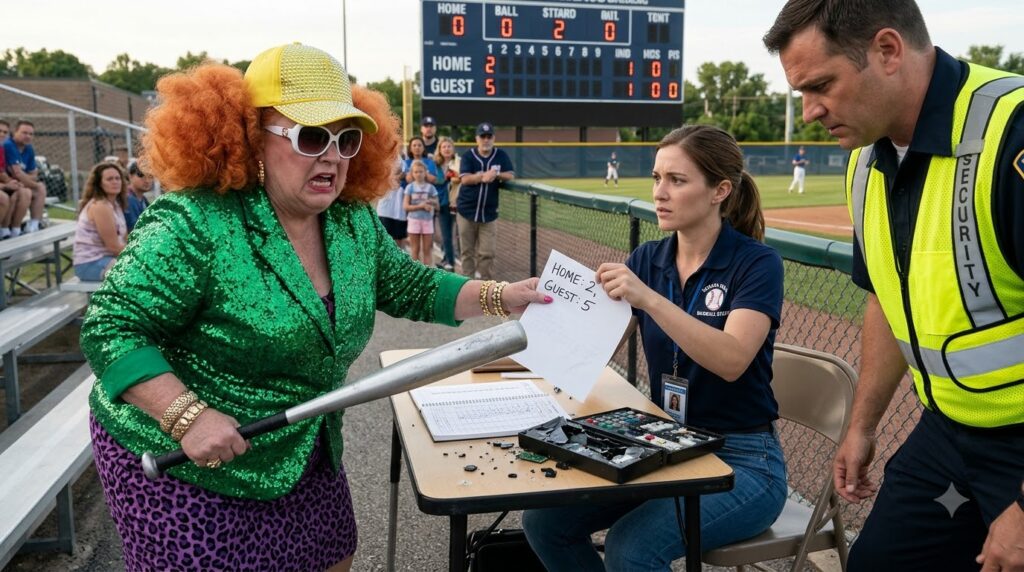
An aluminum baseball bat slammed into the electronic scoreboard controller, sending black plastic fragments skittering across a folding table. Several spectators in the nearby bleachers ducked instinctively. A little boy dropped his bag of popcorn. On the baseball field, the third baseman turned toward the noise.
Before anyone could react, the woman holding the bat raised it again.
CRACK!
The second strike split the controller’s casing wide open. Buttons bounced across the tabletop, and a piece of the shattered display landed beside the official scorebook.
“Try fixing the score now!”
The woman shouting was sixty-three-year-old Patricia Whitmore, although nearly everyone in the small Ohio community of Fairhaven knew her simply as Karen.
She was impossible to overlook.
Her enormous figure filled the narrow space beside the scorekeeping station. Her bright orange-red hair was arranged in two enormous curly puffs, and her sparkling emerald-green blazer flashed in the late-afternoon sunlight. A purple leopard-print skirt stretched around her broad hips, while a yellow rhinestone baseball cap sat crookedly above oversized white sunglasses.
Gold bracelets rattled against the aluminum bat as she lowered it.
Patricia was breathing heavily, but her expression was triumphant.
Across the folding table, twenty-nine-year-old scorekeeper Emily Carter stood frozen.
Emily had been recording baseball games for the Fairhaven school district for seven years. She had seen angry parents, disputed calls, and coaches who needed several minutes to remember that high school baseball was supposed to be about teenagers.
She had never seen a parent destroy official equipment with a baseball bat.
And she had certainly never seen someone do it while smiling.
Behind Patricia, the large digital scoreboard displayed:
HOME: 2
GUEST: 0
That was not the real score.
Fairhaven High School, the home team, had scored two runs. Their championship opponents, the Westbrook Eagles, had scored five.
The actual score was 5–2 in Westbrook’s favor.
Patricia’s seventeen-year-old son, Tyler Whitmore, was Fairhaven’s starting shortstop. His team was losing in the bottom of the sixth inning, and Patricia had decided that the scoreboard was the problem.
A few minutes earlier, while Emily was briefly helping an assistant coach clarify a substitution, Patricia had slipped behind the scorekeeping desk and manipulated the controller.
When Emily returned, the scoreboard showed Westbrook’s five runs had vanished.
Patricia insisted that the display was correct.
Emily refused to accept it.
And when Emily reached for the controller to restore the official score, Patricia grabbed a bat leaning against the fence.
Now the controller lay in pieces.
Emily stared at the destruction for one heartbeat before recovering herself.
She carefully picked up the damaged unit, avoiding its sharp plastic edges, and pressed the remaining buttons.
Nothing happened.
The scoreboard remained frozen at 2–0.
Patricia pointed toward the enormous numbers.
“There. That’s the score everybody can see.”
Emily looked at her, then at the scoreboard, then at the official paper scorebook.
The numbers on the electronic display were wrong, but the recorded game had not changed.
She set the broken controller down and reached beneath the scorebook.
Patricia’s smile faded when Emily pulled out a separate sheet of paper.
It was the backup scoring record, maintained inning by inning.
Emily lifted it high enough for the nearby coaches and spectators to see.
“The official score is still five!”
A ripple of confusion moved through the bleachers.
Patricia’s expression changed.
For the first time, she seemed to understand that destroying a machine had not destroyed the facts.
She lunged toward the paper with her free hand.
Emily pulled it away.
At that exact moment, a man in a navy uniform and yellow SECURITY vest stepped around the end of the bleachers.
His name was Daniel Brooks. At forty-two, he had worked stadium security for almost a decade and had learned to recognize trouble before it became dangerous.
He stopped when he saw the bat.
Then he noticed the shattered controller.
Then he looked at Patricia.
Her outstretched hand slowly dropped.
For several seconds, nobody spoke.
Daniel calmly instructed her to place the bat on the ground.
Patricia hesitated.
Then she lowered it beside the table.
The metal struck the gravel with a hollow clink.
In the stands, an elderly man wearing a faded Fairhaven baseball cap stood up.
His name was Walter Bennett, and he had coached youth baseball in the county for thirty-four years.
He had watched the entire incident.
More importantly, he had recorded the last few seconds on his phone.
Walter looked from Patricia to the teenagers standing motionless on the field.
He felt something deeper than anger.
He felt shame for what the adults had allowed to happen to a children’s game.
And as Daniel moved between Patricia and Emily, Walter realized the worst part might still be ahead.
Because the scoreboard was broken, the championship was in jeopardy.
And Patricia Whitmore was already preparing to blame someone else.