
The Weight of Dry Timber and the Thin Line Between Order and Intimidation
CHAPTER 1: THE LEDGER AT THE EDGE OF THE CONCRETE
The heat coming off the asphalt at four in the afternoon smelled like scorched lime and dust.
From the shadows of the hallway, the world outside was framed by three inches of reinforced oak and a five-inch wide-angle lens. On the smartphone screen resting in my palm, the glowing blue ring of the doorbell camera cast a pale halo over Evelyn Krauss’s face. She didn’t knock. She never knocked first.
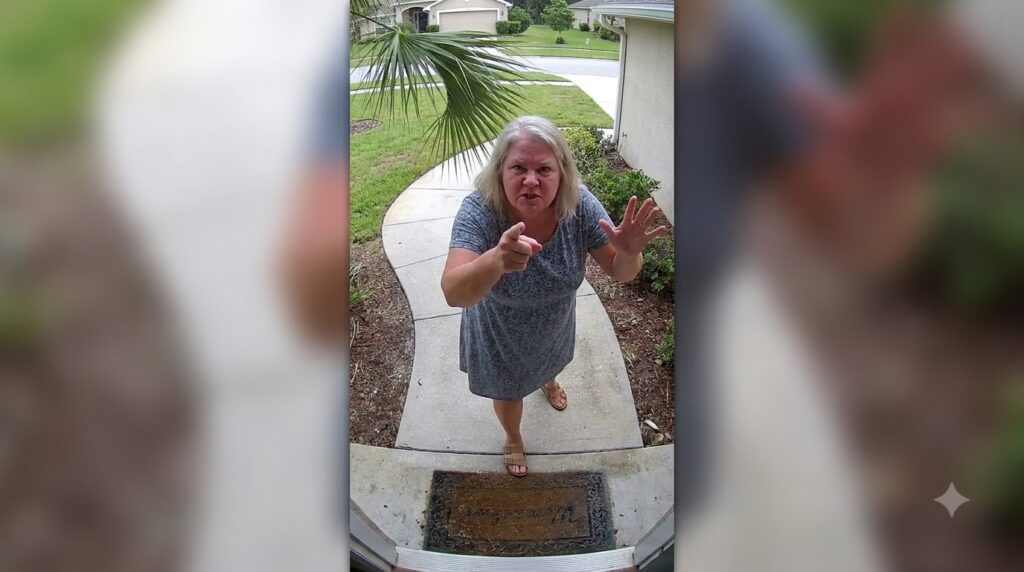
Evelyn stood on the second step of the curved concrete walkway, her tan sandals planted wide, her gray-blue patterned dress stiffened by sweat and conviction. In her left hand, she clutched a worn vinyl ledger, its edges frayed from years of being pressed against iron gates and wooden fence lines. Her short gray-blonde hair caught the harsh glare of the sun, highlighting the hard line of her jaw as her eyes swept across the front porch—measuring the clearance of the gutter, the angle of the porch light, the slight overhang of the untrimmed palm frond above the entry lane.
Behind her, across the asphalt of the cul-de-sac, Miller’s lawnmower sputtered to a stop. Miller stayed on the tractor seat, wiping his neck with a blue rag, his eyes fixed on my porch. Two houses down, Sarah Henderson paused with her gardening shears raised against a hedge. Nobody spoke on pristine suburban streets when Evelyn was on the pavement; you simply watched to see where the light landed.
Evelyn took one step forward. The heavy rubber of her sandal slapped against the clean concrete—a deliberate, rhythmic sound designed to trigger a latch inside the house.
She leaned toward the camera. Her face filled the frame, distorted by the wide-angle fisheye lens until her features looked heavy, almost subterranean. Her right hand came up, index finger extended until the tip sat less than two inches from the glass lens.
“You think you can ignore me,” she said. Her voice didn’t carry the high pitch of an argument; it had the dry, flat scrape of iron dragging across stone. “Come out here and explain yourself right now!”
Inside the hallway, the air conditioning unit kicked on with a soft mechanical whine, circulating the smell of fresh spackle and dried timber. I didn’t reach for the brass deadbolt. My thumb stayed hovered over the glass screen, resting on the small white microphone icon. On the camera feed, a dark hairline fracture along the main branch of the palm frond directly above Evelyn’s head shifted a fraction of an inch, releasing a faint dusting of dry pollen into the stagnant air.
Evelyn threw her left hand wide, the vinyl ledger fanning out like a deck of dark cards. She opened her mouth to double down, her chest expanding against the gray-blue pattern of her dress.
Before the next word cleared her lips, a deep, fibrous crack echoed from the roofline.

CHAPTER 2: THE LAWS OF GRAVITY AND HEDGEROWS
“–explain yourself right now!”
The word now was still vibrating against the glass of the door when the fibrous stem of the thirty-pound palm frond parted from the trunk.
It didn’t drop like a stone. It came down with a heavy, dry crack-whip—a sound like a sail snapping flat in a sudden gale. The fan of yellowed, razor-edged fronds swept through the still air of the porch, cutting through the space where Evelyn Krauss’s pointed finger hung suspended.
Evelyn didn’t have time to duck. She had time to gasp, her mouth opening into a wide, pale ‘O,’ before the thick, serrated base of the stalk clipped the edge of her shoulder.
The blow didn’t shatter bone, but it carried the dead weight of five years of unpruned growth. It threw her off balance. Her tan sandals lost their grip on the sun-baked concrete. Her arms flailed out—the leather ledger flying from her left hand, its pages fanning wide in the air like panicked birds—and then she hit the walkway hard on her backside.
The sound of her landing was a dull, fleshy thud that echoed off the stucco walls of the entryway. The frond settled over her lap like a heavy, bristling fan, pinning her knees to the concrete.
Outside, Miller’s lawnmower didn’t just idle; he cut the ignition entirely. The sudden silence across the cul-de-sac was absolute. Down the street, the metallic snip-snip of Sarah Henderson’s gardening shears stopped mid-stroke. The entire neighborhood seemed to hold its breath, suspended in the humid, four-o’clock glare.
On my phone screen, the fisheye distortion made Evelyn look small, tangled in dry brown leaves, her stocky frame pinned against the concrete walkway she had spent forty-five minutes trying to cite me for. Her gray-blonde hair was disheveled, a thin coating of dry palm dust settled across the front of her patterned dress.
She sat there for three full seconds, her chest heaving, staring up at the empty sky above the porch threshold.
“What the hell…” her voice was no longer iron on stone; it was a thin, wheezing rasp. “What the hell just fell on me?”
I pressed my thumb against the glowing blue microphone icon on the phone interface. The small speaker built into the doorbell chime hummed, then clicked open with a burst of static that made Evelyn flinch.
“You’re on private property, Evelyn,” my voice came through the small speaker, flat, digitized, and amplified just enough to carry across the front lawn toward the street. “And the camera’s been running since you stepped off the sidewalk.”
Evelyn’s head snapped toward the small black dome of the lens. For a fraction of a second, the old, habitual fury flared in her pale eyes—the reflexive urge to cite section numbers, to demand compliance, to reach for the ledger that now lay face-down in the Bermuda grass three feet away. But as she tried to shift her legs, the dry frond rustled loudly against her knees, reminding her precisely where she was: sitting on the ground, trapped under yard waste, in full view of three neighboring houses.
“This tree…” she sputtered, her hands clawing at the serrated edge of the frond to push it off her lap. “This tree is a hazard! It’s an unmaintained nuisance! It’s… it’s a violation of Section 4!”
“The tree is on my side of the property line,” I said through the speaker, keeping my tone deliberately measured. “Which means you’re currently trespassing beneath it.”
She scrambled backward, her hands scraping against the rough concrete as she unthreaded her legs from the heavy frond. She didn’t use the wrought-iron porch railing to pull herself up; she pushed directly off the dusty walkway, her tan sandals skittering until she found her footing. Her gray-blue dress was smeared with dry dirt across the hem, and a long gray streak marked her right elbow.
She didn’t grab her ledger. She didn’t look back toward the door.
“This isn’t over,” she hissed, though she kept her eyes fixed on the pavement as she retreated down the curved walkway toward the driveway. “You think a piece of dead wood changes the codes? I have documents coming from the county!”
She reached the edge of the asphalt, snatched her fallen ledger out of the grass without breaking stride, and marched down the center of the cul-de-sac, her sandals slapping the hot pavement in an uneven, hasty rhythm.
Through the window pane beside the door, I watched Miller slowly turn his head as she passed his driveway. He didn’t say a word, but he didn’t restart his mower either. He just watched her go, his blue rag dangling from his hand.
I unlocked the heavy oak door and stepped out onto the porch. The heat hit my face like a damp towel.
The air smelled of crushed vegetation and warm dust. The palm frond lay across the concrete threshold—six feet of coarse, fibrous wood, its base thick as a fence post. I bent down to drag it off the walkway, my fingers catching on the rough, splintered edge where it had torn free from the trunk.
As I shifted the weight of the branch toward the side yard, something caught the light near the base of the wrought-iron porch railing.
It wasn’t a leaf. It was a thick, yellowed manila envelope, folded lengthwise and shoved deep into the gap between the iron scrollwork and the brick foundation. It had been placed there before Evelyn’s march up the steps—hidden far enough under the overhang that the rain couldn’t reach it, but wedged tightly enough that a casual glance wouldn’t spot it from the driveway.
I set the frond down in the grass and reached into the shadow of the railing. The paper felt brittle under my thumbs, stiff with age and stained with old dampness along the seams.
There was no address on the front. No stamp. Just a single word written in faded black ink across the center:
EASEMENT.
CHAPTER 3: THE PAPER ARCHIVE IN THE HALLWAY
The paper felt brittle enough to snap.
I didn’t open the envelope out on the porch. The sun was too sharp, and across the cul-de-sac, Miller was still sitting motionless on his tractor seat, watching the empty space where Evelyn Krauss had stood moments before. I carried the envelope inside, using my boot to nudge the oak door shut until the heavy deadbolt clicked into its brass strike plate.
The hallway was quiet, cooled to sixty-eight degrees by the window unit humming in the back room. The air carried the flat, chalky tang of fresh joint compound and the damp scent of unpainted drywall.
I laid the manila envelope on the improvised workbench—a pair of folding steel sawhorses supporting a door slab I’d pulled out of the garage three weeks ago. My fingers left dark smudges of dry palm dust on the yellowed paper.
Whoever had shoved the envelope into the iron scrollwork hadn’t sealed it. The flap was tucked neatly inside the pocket. When I tilted the envelope, two folded sheets slid out onto the raw wood grain.
The first was a carbon copy of an official municipal notice, dated eight years prior. The ink had faded from navy to a dull plum color, but the typewriter impressions were deep enough to leave ridges on the back of the page. It was addressed to the property’s previous owner—an elderly electrician named Vance who had lived here thirty years before his heart gave out in the back garden.
The text was brief, written in the stiff, combative legalese of county zoning boards:
NOTICE OF NON-CONFORMING USE / INGRESS EASEMENT C-14.
Be advised that the concrete slab serving as the primary vehicular driveway for Lot 112 extends beyond the platted private boundary line by approximately six (6) inches along the eastern border…
I shifted my gaze to the second page. It was a hand-drawn site map, rendered in faded India ink on translucent vellum. The lines were precise—drawn with a draftsman’s t-square and hatching pens—showing the boundary line between Lot 112 (my property) and Lot 113 (Evelyn Krauss’s pristine, manicured parcel next door).
A thick red grease-pencil line cut through the eastern edge of my driveway, right where the concrete met the narrow strip of crushed granite and azalea bushes Evelyn spent every Tuesday morning weeding.
I leaned closer, tracing the red line with a thumbnail. According to the drawing, the entire six-inch concrete curb—the structural lip that kept my driveway from slumping into her flowerbed—wasn’t mine. It belonged to Lot 113.
And according to the date stamp at the bottom, the county had flagged it nearly a decade ago, long before I ever signed a deed or picked up a paintbrush.
A low horn sounded out on the street.
I walked over to the front window, drawing back the corner of the canvas drop-cloth covering the glass. A yellow panel truck with MUNICIPAL UTILITY COMMISSION painted on the side was idling at the curb near my mailbox.
The driver didn’t get out right away. He sat in the cab with the window rolled down, his arm resting on the door frame, a clipboard cradled against his steering wheel. He wasn’t looking at my house. He was looking at his side mirror, watching Evelyn Krauss as she stood at the head of her own driveway fifty yards away.
Evelyn had changed her clothes. The dirt-smeared gray-blue dress was gone. She was now wearing a crisp white polo shirt tucked into stiff khaki slacks, her gray-blonde hair brushed flat against her skull. She stood beside her mailbox, her arms crossed tight over her chest, whispering fiercely into a cordless landline phone pressed to her ear.
Every few seconds, her eyes flicked toward my front window.
The driver of the utility truck finally opened his door, his heavy steel-toed boots striking the asphalt with a metallic clatter. He reached into the bed of the truck and hauled out a pair of tall orange traffic cones and a heavy, wooden-handled sledgehammer.
I let the canvas drop-cloth fall back into place, the room darkening instantly.
I picked up the vellum site map again, holding it up against the ambient light filtering through the hallway doorway. The ink was old, but the red grease-pencil line looked fresher—the wax smooth, unblemished by dust, laid down with the steady pressure of someone who knew exactly where to draw the line to make it hurt.
Someone had tucked that envelope behind my porch railing before Evelyn ever marched up the walkway. It hadn’t been left as a warning to me; it was a blueprint.
I turned the page over. On the back, in faint pencil that had almost been erased, were three sets of GPS coordinates and a handwritten note in precise, cramped cursive:
Check the survey pin under the second palm root. She knows.
Outside, the heavy, rhythmic thud of a sledgehammer hitting iron echoed off the concrete driveway as the utility worker drove a steel marking stake directly into the curb.
CHAPTER 4: THE IRON PIN IN THE BASEMENT ARCHIVE
The vibration ran up through the soles of my work boots before the sound reached my ears.
Clang.
It was the heavy, flat sound of steel striking steel—the county worker driving a half-inch rebar rod straight through the edge of my driveway asphalt.
I stepped onto the porch without grabbing a shirt or wiping the plaster dust from my forearms. The afternoon air was thick as warm grease, carrying the smell of exhaust and crushed granite from where the utility truck sat idling at the curb.
The worker was leaning over the head of the sledgehammer, his neon-yellow vest stiff with salt rings across the shoulder blades. He didn’t look up when the screen door slammed shut behind me. His name tag read D. VANCE in faded black marker—a young guy, mid-twenties, with dust caked in the creases of his neck.
“You’re driving steel into private concrete, son,” I said, my voice staying low, carrying just enough edge to cut through the idle rumble of the V8 engine.
The kid paused, his calloused hands resting on the hickory handle of the hammer. He wiped his forehead with the back of his leather glove, leaving a dark streak of grease across his brow. He didn’t look angry; he looked exhausted.
“County work order, sir,” he said, tapping a plastic clipboard resting on the hood of the truck. “Boundary verification request filed three hours ago at the municipal clerk’s office. Emergency priority.”
“Filed by who?”
“Evelyn Krauss,” a voice called out from fifty feet away.
Evelyn was standing right at the edge of her property line, her feet planted precisely on her side of the narrow strip of crushed white gravel separating our yards. She wasn’t holding her ledger anymore. In her hands was a pristine, blue-backed document bound with silver staples—a certified plat copy fresh from the county printer. Her white polo shirt was spotless, her gray-blonde hair slicked back tighter than before.
“Section 12-B of the municipal code permits immediate marking upon submission of a certified survey discrepancy,” she said, her voice dry, precise, completely free of the panic that had sent her scrambling backward through the dirt an hour ago. She didn’t mention the palm frond. She didn’t look at the porch threshold where the dead branch still rested in the grass. “You have six inches of illegal concrete resting on easements deeded to the utility district in 1994.”
I walked down the three concrete steps, my boots crunching softly on the driveway sand. I stopped three feet from the kid with the hammer, looking down at the steel rod he’d driven four inches into the edge of my driveway.
“You checked the origin pin?” I asked the kid.
- Vance blinked, shifting his grip on the hammer handle. “Sir?”
“The origin pin,” I repeated, my eyes turning slowly toward Evelyn. “The iron monument set by the county surveyor back in ninety-four when they laid out Lot 112 and Lot 113. Before you cut concrete or flag a line, you’re supposed to pull reference from the origin pin under the south palm root.”
Evelyn’s hands tightened around the blue folder. For a fraction of a second, the paper creased under her thumbs, the clean white margin folding under the sudden pressure of her grip.
“The county records are unambiguous,” Evelyn declared, stepping two inches closer to the gravel line, though her tan sandals stayed strictly on her side of the boundary. “The plat map on file in Book 42, Page 118 clearly demonstrates that your driveway encroaches on the district right-of-way.”
“Book 42 was superseded by the ninety-eight resurvey,” I said, holding her gaze. I drew the folded piece of vellum out of my back pocket—the thin, translucent sheet with the hand-drawn India ink lines I’d just pulled from the envelope behind the iron railing. “The map you pulled at the clerk’s office was the preliminary draft. Someone left the actual deeded easement map right on my porch.”
The kid, Vance, looked between the two of us, his gaze lingering on the yellowed, brittle paper in my hand.
“Let me see that,” Vance said, reaching out a gloved hand.
“Don’t touch that document,” Evelyn snapped, her voice cracking slightly before she caught herself, smoothing her tone back into the flat, authoritative drone of an official. “He’s presenting unverified, uncertified papers. I have a stamped injunction order from the city code enforcement division pending approval tomorrow morning.”
Vance didn’t take the paper, but he didn’t raise the sledgehammer again either. He set the head of the hammer down on the pavement, wiping his mouth again.
“Look, folks,” Vance muttered, looking down at his clipboard. “I just drive the pins where the work order tells me to drive ’em. If there’s an origin pin under the tree root that contradicts the current map, I can’t touch the driveway until a certified county surveyor clears the line. That’s policy.”
“There is no pin under that tree!” Evelyn’s voice rose, sharp and thin against the afternoon heat. “That tree was planted twenty years ago! Any historical markers were destroyed when the previous owner poured that unauthorized slab!”
I didn’t answer her. I turned my back on her and walked toward the base of the massive trunk near the corner of the porch.
The soil at the foot of the palm tree was dark, packed hard by decades of rain runoff from the eaves. A thick network of fibrous roots jutted out from the base, weaving over and around a rusted iron casing that sat flush with the earth.
I knelt down in the dirt, my knee pressing into the dry grass. I reached into the gap between two thick, woody roots, my fingers digging through years of decayed palm fronds, soil, and coarse builder’s sand until my knuckles struck something hard, cold, and square.
It wasn’t a standard half-inch rebar pin.
My fingers brushed against a heavy brass cap set into a cast-iron collar—a municipal benchmark, green with copper oxidation, buried six inches deeper than any standard residential boundary marker ever should have been.
And cut straight across the tarnished brass surface was a deeply grooved arrow, pointing not toward my house, but directly across the gravel strip toward the corner of Evelyn Krauss’s pristine, brick-faced garage.
CHAPTER 5: THE THRESHOLD AND THE EYE OF THE CAMERA
The brass cap felt like ice against my fingertips, cold despite four decades under the sun-baked soil.
I didn’t scrape away the remaining dirt with my boots. I stayed on one knee, using my index finger to trace the deep, chiselled groove of the directional arrow stamped into the brass plate. The copper oxidation left a bitter, sour film on my skin. The arrow didn’t point down the property line toward the curb; it pointed at a precise thirty-five-degree angle directly across the strip of crushed white gravel, aiming straight at the southwest corner of Evelyn Krauss’s brick garage.
Behind me, the sound of D. Vance’s steel-toed boots shifted on the asphalt. He stepped over the low curb, his heavy shadow falling across my back as he leaned down to look into the hollow between the palm roots.
“What is that?” Vance asked, his voice losing its flat, bureaucratic drone. He dropped to a crouch beside me, the leather of his tool belt creaking under his weight. “That’s not a standard property pin. Property pins are rebar with plastic caps.”
“It’s a brass benchmark,” I said, wiping the green residue against the thigh of my jeans. “Set by the county public works department during the original subdivision grade.”
Evelyn didn’t move from her gravel border, but her posture went rigid as a fence post. The blue-backed certified plat copy in her hands rustled softly in the faint breeze coming off the asphalt.
“That is an abandoned benchmark,” she said, her voice rising half an octave, sharp and thin. “It has no legal standing in a residential property dispute! The updated survey from the county clerk—”
“The clerk’s office doesn’t supersede a primary survey monument, ma’am,” Vance interrupted, reaching into his vest pocket to pull out a small brass-bristled wire brush. He didn’t ask my permission; he leaned in and scrubbed the dirt out of the stamped lettering surrounding the arrow.
The brass gleamed dull yellow under the afternoon sun as the lettering emerged through the grime: MUNICIPAL EASEMENT CONTROL MARKER – SUBDIVISION 112-114.
“That marker sets the baseline for the entire block,” I said, standing up and dusting the damp soil off my knee. I looked past Vance, straight into Evelyn’s pale, wide eyes. “Which means the six-inch offset isn’t an encroachment by my driveway into your yard. The original road easement was cut six inches further east than the current fence lines.”
I pulled the folded sheet of vellum out of my back pocket again—the hand-drawn site map from the yellowed envelope—and unfolded it against the hood of Vance’s utility truck.
“Look at the red line,” I said, pointing to the grease-pencil mark that cut across the driveway margin. “The line wasn’t drawn to show where my concrete ends. It was drawn to show where the county’s public right-of-way actually sits.”
Vance leaned over the hood, tapping his pencil against the translucent paper. His eyes tracked the coordinates written in cramped, faded pencil on the reverse side. He looked at the vellum, then looked up at the corner of Evelyn’s brick garage, then back down at the brass cap gleaming in the dirt at the foot of the palm tree.
“If this benchmark is active,” Vance said slowly, calculating the angles in his head, “and your driveway follows the vector from this pin… then the six-inch discrepancy isn’t on your lot.” He turned his head toward Evelyn. “It means your garage wall is sitting six inches inside the county easement line.”
The silence that settled over the front porch was heavier than the humid heat.
Across the street, Miller had stepped off his tractor entirely, leaning his elbows against the chain-link fence bordering his yard. Down the cul-de-sac, two more neighbors had walked out onto their front porches, their eyes locked on the yellow utility truck, the orange cones, and Evelyn standing motionless at the edge of her lawn.
Evelyn’s face didn’t flush red. It went a dull, chalky white, the skin around her nostrils pinching tight.
“That’s absurd,” she whispered, though her voice carried across the driveway with terrifying clarity. “That garage was inspected and approved thirty years ago. My husband built that structure in full compliance with town ordinances!”
“He built it using the preliminary plat draft from Book 42,” I said softly, stepping closer to the driveway edge until I was standing just five feet from where she stood on her gravel border. “The same draft you tried to use to cite me this morning. The builder used the wrong boundary marker, didn’t he, Evelyn? And when the county resurveyed the block in ninety-eight, someone found the mistake and buried the notice.”
Evelyn’s chest heaved once, a short, ragged breath. Her eyes flicked toward the front door of my house—toward the small black dome of the doorbell camera mounted beside the threshold, its blue LED ring glowing steadily, recording every word, every shift in her posture, every line written on the paper spread across the truck hood.
She didn’t look at Vance. She didn’t look at the map. She stepped backward, her tan sandals crunching loudly in the white gravel.
“You think you’re clever,” she spat, her voice dropping into that harsh, iron-on-stone rasp, though her hand trembled as she clutched the blue folder against her waist. “You think finding a piece of buried brass absolves you of your obligations to this community. This street has standards, and a misaligned monument doesn’t change the fact that your property is an unmaintained disgrace!”
She turned on her heel and marched up her concrete walkway toward her front door, her head held unnaturally high, her shoulders squared against the gaze of the four neighbors watching from their driveways.
Vance watched her front door slam shut with a sharp, echoing bang. He let out a long, low whistle, picking up his sledgehammer from the pavement.
“Well,” Vance said, pulling the steel marking stake out of my driveway asphalt with a single firm yank. “I can tell you one thing for sure, boss. I ain’t driving another pin on this block until the County Engineer comes out here with a transit level.”
He tossed the steel rod into the back of his panel truck and began loading his orange cones, leaving a clean, round hole in the asphalt where the stake had been driven.
I stood alone on the driveway, the hot sun beating down on my neck. The immediate threat to my concrete was gone, the six-inch citation shattered by the old map and the buried brass marker.
But as I looked down at the vellum map resting on my workbench inside the open door, my thumb brushed the cramped pencil handwriting on the back once more: Check the survey pin under the second palm root. She knows.
I hadn’t written those coordinates. Vance’s father hadn’t written them. And as I looked across the gravel line at the blank, windowless brick wall of Evelyn’s garage, I realized the decoy secret—the six-inch driveway dispute—was only the surface of a much older, deeper fracture built into the very foundation of the block.
CHAPTER 6: THE CRASH AND THE SHATTERED FRAME
The rumble of D. Vance’s panel truck faded as it turned out of the cul-de-sac, leaving behind a blue haze of diesel exhaust that hung motionless in the heavy afternoon air.
I stood at the edge of my driveway, looking down at the round hole left in the asphalt. The steel stake was gone, but the impression remained—a four-inch puncture through three decades of sun-baked tar. The small brass cap buried at the root of the palm tree stayed gleam-bright where Vance’s wire brush had scrubbed away the dirt, its directional arrow pointing like a loaded barrel straight at Evelyn Krauss’s garage foundation.
Across the gravel line, Evelyn’s house was dark. The thick fabric blinds covering her front windows didn’t twitch. But the silence didn’t feel like surrender; it felt like the quiet inside a pressure tank right before a seam splits.
I walked back up the walkway, my boots crunching softly on the sand that had blown across the concrete. I picked up the six-foot palm frond that had dropped during Evelyn’s initial walk-up. The fibrous stem was dry, jagged at the point of fracture, its fan of serrated leaves stiffened by months of sun and neglect.
Before I could drag it toward the side gate, the high-pitched chime of my smartphone rang from my back pocket.
I pulled out the phone. It wasn’t a call. It was a push notification from the doorbell security application: MOTION DETECTED – PORCH CAMERA.
I frowned, tapping the screen. The live feed loaded instantly in a wide-angle fisheye frame.
The porch was empty. My own legs and the tip of the palm frond were visible at the bottom edge of the view. But across the top of the feed, where the camera captured the curved concrete walkway leading down toward the street, a figure was walking up from the sidewalk.
It wasn’t Evelyn.
It was Miller from across the street. He was still wearing his grease-stained blue work shirt, his cloth rag tucked into his rear pocket, his face weathered and dark from forty years under the Florida sun. He walked slowly, his heavy work boots dragging across the concrete, his hands buried deep in his pockets.
I set the frond down and turned around just as he reached the bottom step of the porch.
“You ought to leave that brass cap covered up, son,” Miller said. His voice was a low, gravelly rasp, shaped by decades of tobacco and engine exhaust. He didn’t look at my face; his eyes stayed locked on the green-tinted brass marker gleaming between the roots of the palm tree.
“You knew it was there,” I said, stepping down to the second stair so I was eye-level with him.
Miller took a slow breath, pulling a crumpled pack of cigarettes from his chest pocket. He didn’t light one; he just rolled the paper cylinder between his thumb and index finger.
“Vance—the old man, the electrician who built this place before you—he dug that pin out twenty years ago,” Miller said softly. “When Evelyn and her husband started putting up that brick garage. Old Vance came out here with a spade and a transit, found the benchmark, and realized the developer’s crew had laid out the lot lines six inches wide all the way down the block.”
“Why didn’t he file it with the county?” I asked.
Miller let out a dry, humorless chuckle that sounded like stones grinding together in a bucket.
“Because filing it meant pulling the permits for every house on this side of the street,” Miller said, pointing the cigarette toward his own driveway across the asphalt. “If Evelyn’s garage is sitting six inches inside the public right-of-way, my front porch is sitting eight inches over mine. The whole damn subdivision was poured off a crooked baseline back in nineteen-ninety-four. The developer went bankrupt two weeks after the last roof went on. Nobody wanted to dig it up.”
He stepped closer, his boots crunching on the gravel. He pointed a gnarled, calloused finger at the yellowed vellum map I still held folded in my hand.
“Evelyn’s husband knew,” Miller continued, his eyes darkening. “He knew before he died five years ago. That’s why she keeps that ledger. That’s why she walks this street every afternoon citing people for three-inch grass and unpainted shutters. It ain’t about the rules, son. It’s about keeping everybody so busy defending their own little yards that nobody ever looks down at the ground to see whose foundation is sitting on stolen dirt.”
Before I could answer, a loud, metallic pop echoed from the far side of my porch—the sharp, unmistakable sound of high-tension wire snapping under extreme stress.
I spun around.
The black dome of the doorbell camera mounted beside the front door was dangling from its mounting plate by a single thin copper wire. The plastic housing had been shattered, a heavy iron bolt—thrown or launched from the dense line of hibiscus bushes bordering Evelyn’s driveway—embedded two inches into the wooden doorframe right where the lens had been pointed.
The blue LED ring flickered twice, then went completely dark.
Miller didn’t jump. He just looked up at the dangling camera, then turned his gaze toward the dark, quiet windows of Evelyn’s house. He placed a heavy, calloused hand on my shoulder, his grip tightening just enough to pull my attention back to his face.
“She ain’t going to the city council tomorrow,” Miller murmured, his voice dropping into a harsh whisper. “She’s going to the county courthouse. And when she comes back, she won’t be bringing a utility kid with a hammer. She’ll be bringing a sheriff with a demolition order for that tree—and anything else sitting on that line.”
CHAPTER 7: THE WIRE AND THE DIGITAL AUDIT
The broken copper wire swung in a slow, silent arc, its exposed core ticking softly against the painted oak doorframe.
I didn’t reach for the dangling housing. I reached for the heavy iron bolt embedded in the wood beside the jamb. It was three inches long, rusted red at the threads, the head squatted flat like an old rail spike. Someone had driven it through the pine trim with enough velocity to split the grain straight down to the deadbolt plate.
Behind me, Miller spat into the Bermuda grass at the edge of the porch, his eyes glued to the dark hedge line separating my yard from Evelyn’s.
“That wasn’t a sling,” Miller muttered, his fingers twitching against the unlit cigarette in his hand. “That was a spring-loaded line driver. Her late husband used them to run pull-string through three-inch conduit when they were setting up the workshop behind her garage.”
“She just destroyed a digital recording system,” I said. My voice sounded flat, almost hollow in the stagnant porch shade, but my thumb was already tapping the screen of my smartphone. “Which means she thinks the footage died with the lens.”
I wiped a fleck of shattered plastic off my knuckle and opened the local backup directory stored on my phone’s internal memory. The cloud sync had severed the moment the wire snapped, but the edge-node router mounted inside the hallway closet recorded directly to a solid-state drive every three seconds.
I pulled up the last complete frame before the impact.
The fisheye lens showed Miller standing on the bottom step, his face turned toward the sidewalk. But in the extreme upper-right quadrant—in the narrow, distorted gap between Evelyn’s hibiscus hedge and her brick garage wall—a white polo sleeve was visible. Not holding a telephone. Not holding a certified folder. A hand was resting against the steel frame of a heavy pneumatic tensioner mounted behind her side gate.
And right beneath her arm, tucked into the shadow of the garage eaves, was a secondary junction box—grey PVC, sealed with a municipal lead stamp, wired straight into the underground utility conduit that ran beneath our shared gravel strip.
“Miller,” I said, stepping off the porch stair and holding the screen out so he could see the frozen, pixelated frame. “Where does that grey conduit go?”
Miller leaned in, his weathered face screwing up as he squinted at the screen. He reached into his pocket for a pair of scratched reading glasses, balancing them on the bridge of his nose. He stared at the grey box for five seconds, then six. The color drained out of his tanned cheeks, leaving the skin around his cheekbones looking grey and waxy.
“That ain’t electric,” Miller breathed, his voice dropping so low the hum of a passing car on the main road nearly swallowed it. “That’s the main feeder trunk for the cul-de-sac’s municipal water valve. The town installed it back in ninety-five when they pressurized the line.”
I looked up from the screen toward the blank brick side of Evelyn’s garage.
“She didn’t just know about the six-inch offset,” I said, the pieces locking together with a cold, metallic click. “She’s been sitting on the main utility bypass for thirty years. If a surveyor comes out here with a transit and pulls a trench across that gravel line to verify the baseline, they don’t just find a crooked driveway.”
“They find her garage is built over the town’s primary shut-off,” Miller finished, his hand dropping from my arm. He looked toward his own house across the asphalt, his jaw working silently. “If code enforcement sees that junction box, they don’t issue a fine. They declare the building an illegal encumbrance on critical infrastructure and condemn the whole structure.”
A car door slammed out on the street.
It wasn’t a utility truck. It was a dark blue sedan with county government plates, pulling up to the curb right behind Miller’s idle lawnmower. A tall man in a grey suit stepped out onto the asphalt, carrying a leather briefcase in one hand and a surveyor’s folding tripod in the other. Behind him, stepping out of the passenger side, was Evelyn Krauss.
She wasn’t holding her ledger, and she wasn’t holding the blue plat folder. Her face was set in a tight, victorious mask as she gestured toward my front porch.
“That’s the residence, Inspector,” Evelyn’s voice carried clearly across the quiet cul-de-sac. “He’s currently tampering with the primary boundary markers and operating an unpermitted security apparatus on an disputed easement.”
The inspector didn’t look at her. He set the tripod down on the hot pavement, his eyes tracking the fresh hole in my driveway, the green-capped brass marker at the root of the palm tree, and the dangling, shattered wire hanging beside my front door.
I backed up one step onto the concrete threshold, my thumb resting on the microphone icon of my phone, holding the raw video file that proved who had fired the iron bolt through my doorframe sixty seconds ago.
The inspector reached into his suit jacket and pulled out an official white envelope bearing the red wax seal of the Circuit Court.
“Sir,” the inspector said, his tone dry as bone as he walked up the walkway. “I have a temporary restraining order and an emergency site freeze issued by Judge Vance. No digging, no construction, and no alteration of this property until a formal hearing on Monday morning.”
Evelyn stood at the edge of the street, her arms crossed tight over her chest, a thin, ruthless smile cutting across her pale face.
She thought she had locked the narrative in place. She thought the court order bought her seventy-two hours to cover the grey box behind her garage before anyone dug deeper into the dirt.
I looked down at my phone screen, then up at the inspector, my boot resting right over the buried brass marker.
“You’re too late for a freeze, Inspector,” I said softly, holding out the phone. “Because the crime scene didn’t happen thirty years ago. It happened one minute ago—and it’s all on the server.”
CHAPTER 8: THE SHIFT ON THE ASPHALT
The inspector stopped two paces short of the porch steps, his leather briefcase swinging once before settling against his thigh.
His eyes didn’t fixate on the smartphone held out in my palm. They drifted past my elbow, taking in the jagged splinter of oak where the doorframe had split, the dangling black plastic of the camera housing, and the rusted iron bolt still driven deep into the pine trim.
“What caused that damage, sir?” the inspector asked. His voice remained measured, professional, but the sharp legal edge in his posture softened into something far more cautious.
“A three-inch iron bolt,” I said, my thumb swiping across the glass screen to play the high-definition backup video recorded sixty seconds prior. “Fired from a tensioner behind the hedge line of Lot 113. The camera caught the trajectory, the operator, and the grey PVC junction box mounted inside the utility easement.”
Evelyn Krauss stepped off the curb, her tan sandals striking the asphalt with a sharp, frantic slap.
“Inspector, this is a stall tactic!” Evelyn’s voice cut through the afternoon heat, shrill and unravelling at the edges. “He’s attempting to distract you from the property boundary violation! That camera was illegally positioned to spy on my private driveway!”
The inspector didn’t turn around to look at her. He took one step up the walkway, his polished dress shoes crunching against the fine sand on the concrete. He leaned over my shoulder, staring at the lit screen.
On the high-resolution recording, the wide-angle frame showed the entire porch threshold. It captured Miller standing near the steps, the green-tinted brass benchmark gleaming at the foot of the palm tree, and the clear line of sight straight through the hibiscus hedge to Evelyn’s white polo sleeve resting on the pneumatic lever. The video captured the distinct, metallic pop, the spray of splintered wood, and the camera housing shattering as the iron bolt struck the frame.
“That’s a pneumatic wire driver,” the inspector noted, his brow furrowing as he zoomed in on the grey PVC box mounted behind the hedge. “And that box… that’s not a residential circuit.”
“It’s the master bypass valve for the municipal water trunk,” Miller called out from the bottom step, stepping forward until he was standing beside the inspector. “Installed thirty years ago when the developer laid out the block. Evelyn’s garage was built six inches over the easement line to cover the access hatch.”
Evelyn reached the edge of my lawn, her face devoid of color, the white polo shirt sticking to her chest in the humid glare.
“Miller, you keep your mouth shut!” she shouted, her hands clenching into tight fists at her sides. “You have no standing here! You’re an accomplice to his non-compliant modifications!”
“I’m a homeowner on this street, Evelyn,” Miller said, his voice quiet, flat, carrying the weight of forty years of silent observation. “And every house on this side of the road was built off that same crooked baseline. You didn’t keep that ledger to protect our property values. You kept it so nobody would ever measure your garage.”
The inspector looked down at the white envelope in his hand—the red wax seal of the Circuit Court glistening under the harsh midday sun. He didn’t hand it to me. Slowly, deliberately, he folded the document in half and slid it back into his internal jacket pocket.
“A temporary restraining order applies to property disputes, Mrs. Krauss,” the inspector said, turning around to face her. “It does not apply to the intentional destruction of evidence or the unlawful obstruction of a municipal utility bypass.”
“I… I was protecting my boundary!” Evelyn stammered, stepping backward onto the white gravel strip. Her posture, usually so rigid and unyielding, seemed to collapse inward, her shoulders hunching as if the heat itself had grown too heavy to bear. “The code… the town ordinances require strict enforcement!”
“The County Engineer will be here in twenty minutes,” the inspector replied, reaching into his pocket for his radio. “Along with a full survey crew and a representative from the water authority. We’re going to pull the baseline from that brass benchmark under the tree.”
Evelyn stood motionless at the edge of the gravel, her eyes fixed on the green-capped brass marker at the foot of the palm tree. The small arrow, chiselled deep into the oxidized metal, pointed inexorably toward her garage wall.
Down the cul-de-sac, two more front doors opened. Neighbors stepped out onto their lawns, standing silently along the curb, watching the self-appointed authority of the neighborhood stand exposed in the glare of the four-o’clock sun.
She didn’t speak again. She turned away from the porch, her head bowed, her tan sandals dragging through the white gravel as she walked back toward her dark, silent house.
I looked down at the iron bolt embedded in my doorframe, then at the glowing screen in my hand. The initial dispute—the six inches of concrete, the unpruned palm frond, the endless stream of paper notices—had burned away like morning mist, revealing the true, unyielding bedrock of the land beneath our feet.
CHAPTER 9: THE UNBROKEN GROUND AND THE DUSTY GRAY
The sound of her front door closing wasn’t a slam. It was a soft, dull latching of deadbolt against strike plate—a quiet, final sealing off of Lot 113.
The cul-de-sac didn’t erupt into noise. The air remained heavy, thick with the smell of sun-cured asphalt, dry pine needles, and the faint, bitter tang of copper oxidation lingering on my thumb. Across the road, Miller didn’t cheer, and he didn’t restart his tractor. He walked slowly back to his porch, sat down on the top stair, and finally struck a match to light the crumpled cigarette he’d been holding all afternoon. The small plume of blue smoke rose straight up into the windless glare.
Beside my porch, the county inspector stood on the lawn with his radio pressed to his ear, his voice quiet as he confirmed the coordinates with the district dispatch.
“Target marker identified,” the inspector murmured into the receiver. “Section baseline C-14 verified at benchmark plate. Requesting municipal survey crew for Monday morning to adjust district easement boundaries. Cancel enforcement warrant.”
He lowered the radio, looking over at me. He didn’t offer a handshake or a formal apology. He picked up his folding tripod from the street, loaded it into the back seat of his blue sedan, and pulled away from the curb without another word.
I walked down the three concrete steps to the edge of the lawn.
The brass benchmark sat in the shade at the base of the palm tree, the green oxidation gleaming dully where Vance’s wire brush had exposed the stamped lettering. The chiselled arrow still pointed across the white gravel, locked onto the foundation of Evelyn’s brick garage. Thirty years of manufactured authority, written down in leather ledgers and shoved into mailboxes as anonymous warnings, had all been built to keep anyone from placing a transit level over this single, six-inch cap of buried iron.
I bent down and scooped a handful of dry, sandy soil from the edge of the root collar. I let the dirt trickle slowly through my fingers, covering the bright brass plate once more, burying the chiselled arrow beneath a soft layer of earth until only the faint curve of the green rim showed against the dark bark.
Behind me, the front door of my house stood open. Inside, the hallway was cool, smelled of fresh spackle and unpainted drywall, waiting for the work that should have been done weeks ago. On the doorframe beside the jamb, the iron rail spike remained driven deep into the wood, a permanent scar through the pine grain where the camera had hung.
I didn’t pull the spike out. I left it embedded in the frame—a dark, rough anchor marking the exact line where the boundary had been held.
Down the street, the sun dipped below the tree line, casting long, cool shadows across the concrete driveways of the cul-de-sac. The heat began to ease off the asphalt, replaced by the quiet, steady breath of the evening wind rustling through the unpruned fronds above.
I walked back up the porch steps, picked up the six-foot palm frond lying across the threshold, and carried it around to the side yard to toss it onto the pile. The land was clear, the baseline was set, and the boundary belonged to the concrete.







