The Weight of the Ridge: How One Man’s Quiet Resistance Dismantled an Empire of Paper and Bluff
CHAPTER 1: The Yellow Placard
The cold bit through the double-layer flannel of Julian’s sleeves as he tightened the final hinge bolt on the north post. Five hundred acres of rolling timber and jagged granite did not ask for much maintenance, only respect for gravity and the seasonal push of the creek. For two months, the silence had been absolute—the kind of dense, uncrowded quiet that settles over high-altitude meadows when a man stops answering emails and starts measuring his days by the sun.
Then came the snap of gravel under wide tires.
Julian didn’t turn around immediately. He finished seating the lock washer, gave the socket wrench a final half-turn, and wiped his palms on a rag before looking up.
The vehicle was an obsidian SUV, idling with the quiet arrogance of a machine built for city pavement rather than mountain grades. It had drifted a full four feet past the property boundary marker, its front bumper resting squarely on the edge of the access clearing Julian had cleared three weeks prior with county approval.
Through the tinted glass, the silhouette of a woman sat motionless, watching him with the steady, practiced fixation of someone accustomed to inspecting subordinates rather than scenery. When the door swung open, the scent of expensive leather and sharp citrus cut cleanly through the smell of damp pine needles and cedar shavings.
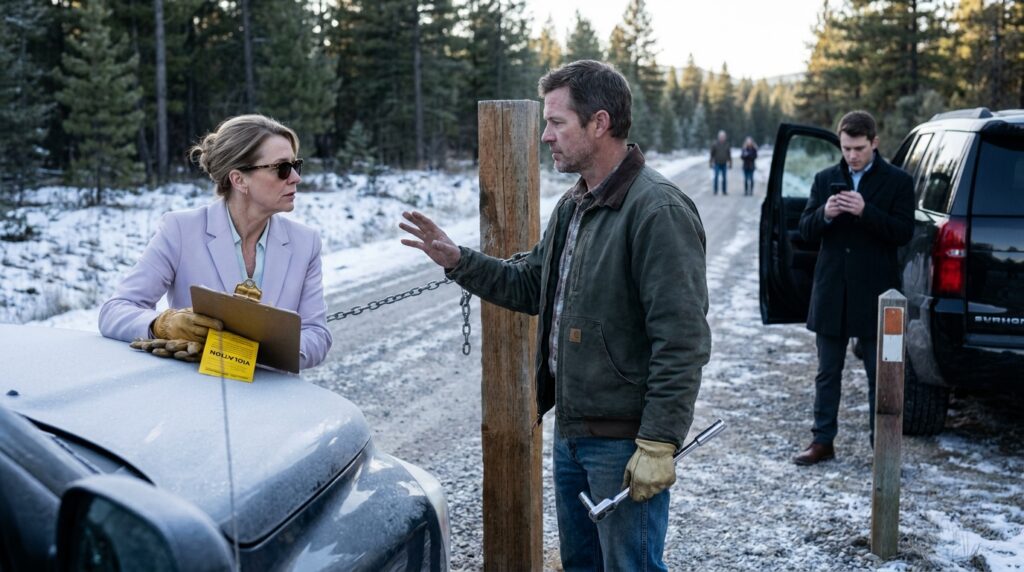
Eleanor Vance did not look like an invader. She looked like a neighborhood audit committee incarnate: a tailored pastel blazer that defied the altitude, silver-rimmed sunglasses perched on a sharply angled nose, and a heavy brass-clipped folder clutched against her chest like a shield.
“Mr. Cole, I presume,” she said, her voice carrying the smooth, flat cadence of an attorney who had never had to raise her tone to win an argument.
Julian picked up his socket set, sliding the steel pieces into their molded tray with a series of dull metallic clicks. “You’re past the marker, Ms. Vance. The turnoff is another fifty yards down the county road.”
“I am exactly where I need to be,” Eleanor replied, stepping past the mud flap with a pair of low-heeled loafers that were entirely unsuited for crushed granite. She didn’t look at the timberline or the peaks catching the first hard orange light of dawn. Her eyes were fixed entirely on the cedar gateposts, appraising their spacing with cold geometry. “The Crestwood architectural review board has logged three separate complaints regarding the unauthorized construction along our western buffer. That fence line violates our sightline easement by precisely four feet.”
Julian leaned against the fender of his truck, his expression flat, his hands shoved deep into his pockets to keep the cold from stiffening his fingers. “There is no Crestwood easement on this parcel. The county deeds were recorded clean thirty days before I moved the first shovel of dirt.”
Eleanor offered a thin, tight smile that did not reach her lenses. She reached into her brass-clipped folder, extracted a heavy sheet of cardstock covered in sharp, authoritative typography, and held it out. When Julian made no move to take it, she let it flutter down to rest on the hood of his truck, right beside his leather work gloves.
“You can dispute the jurisdiction all you care to, Mr. Cole. The association has governed this ridge for eleven years. We establish the standards, and we enforce the boundaries. Remove that gate within fourteen days, or the daily assessment fees will begin accumulating against your title.”
She turned on her heel, the loafers grinding sharply against the gravel, and pulled open the SUV door.
Julian picked up the paper, his thumb brushing the embossed seal. He didn’t unfold it. Instead, he watched the brake lights flare red as the vehicle backed down the narrow track, kicking up a spray of dust that settled slowly over the frost.
He walked over to the post where the bright yellow placard still hung by its severed zip-tie, lifted it free, and slid it into the side pocket of his jacket. The paper was stiff, the ink fresh, and the wording designed to provoke a hot, immediate response. But Julian wasn’t angry. He felt only the sudden, sharp clarity of a gear dropping securely into place. He pulled out his phone, dialed a seven-digit number from memory, and listened to the phone ring into the empty morning air.
“Tom,” Julian said when the line clicked. “She just dropped the first notice.”
A heavy sigh crackled through the speaker. “Bring your coffee down to my porch, Ethan. We’ve got a lot of history to unpack before that fourteen-day clock runs out.”

CHAPTER 2: The Kitchen Table Ledger
The cabin smelled of damp wool and roasted chicory. Tom Briggs had lived on the western edge of the valley long enough to remember when the ridge was just timber and wind, before the asphalt lanes and ornamental streetlights of Crestwood crawled up the grade like manicured ivy. He pushed a chipped ceramic mug across the laminate table, the dark liquid sloshing against the rim.
“She doesn’t lose, Ethan,” Tom said, his voice grating like dry sandpaper over pine. He lowered himself into a wooden Windsor chair that groaned under his weight. “That’s the part people don’t understand until they’re already half out of their homes. Eleanor Vance didn’t build an association; she built a tollbooth. You cross her ridge, you pay her price.”
Julian wrapped his hands around the mug, feeling the steady heat soak into his cold skin. He didn’t touch the coffee yet. His gaze drifted past Tom’s shoulder to the cluttered drafting table by the window, where stacks of yellowed aerial photographs and county tax rolls sat pinned beneath brass paperweights.
“She called it an architectural violation,” Julian said, his tone flat and level. “A sightline breach on a fence line that sits four hundred yards outside her recorded boundary.”
“Of course she did,” Tom snorted, reaching for a tin of mints. “She’s an attorney who treats bylaws like a loaded revolver. Eleven years ago, when the first phase of Crestwood went up, she drafted the covenants herself. Left the definitions vague enough around the western drainage so she could claim whatever acreage she looked at. Tried it twice with the old man who owned your parcel before you. Both times he threatened to run her off with a salt shaker, and she backed down because he had deep roots. But you’re new. You’re an engineer from the city who bought five thousand acres of quiet. To her, you’re just an empty lot waiting to be annexed.”
Julian picked up his spoon, turning it slowly between his fingers. The chrome caught the weak light filtering through the frost-rimmed windowpane. “An annexation needs a paper trail. Counties don’t just hand over title because an HOA president writes a stern letter on cardstock.”
“She doesn’t want the title yet,” Tom said, leaning forward, his blue eyes sharp beneath gray, unkempt brows. “She wants compliance. She wants you to sign a ‘co-management’ agreement. Once you sign away oversight of that western access road, you’ve legally recognized her authority over your property line. Give her an inch of paper, and she’ll pave a highway across your pasture by next spring.”
Julian’s thumb traced the edge of his mug. He remembered the specific, practiced arrogance in Eleanor’s posture, the way she hadn’t looked at the land at all—only at the structures. Her eyes hadn’t appraised the timber or the grade; they had measured utility.
“She had a young man with her,” Julian recalled, his mind locking onto the detail. “Carrying a folio, typing into his phone the second she turned her back.”
“That’s Dale Marsh,” Tom muttered, shaking his head. “Junior partner from her firm, or whatever’s left of it. He does the legwork—serves the notices, files the faux liens with the county clerk before anyone checks the plat maps. Most folks just pay the twenty-five hundred dollar fine to make the noise stop. It’s cheaper than a lawyer.”
“I don’t pay for noise,” Julian said quietly.
Tom let out a dry, rattling laugh, finally taking a sip of his coffee. “Good. Because she’s already scheduled a special board meeting for Thursday night. She’s going to present your refusal to the residents as a direct threat to community safety. Says your fencing obstructs emergency fire access along the ridge. She’s got thirty homeowners wrapped around her finger who’ll vote to authorize a formal injunction by voice vote alone.”
Julian set his mug down with a soft, deliberate thud that didn’t spill a drop. He reached into his coat pocket and slid the yellow violation placard across the table, smoothing the creases flat against the wood.
“Let her hold her meeting,” Julian said, his eyes meeting Tom’s with a cold, absolute steadiness. “Let her put it on record. Every paper she files is just another coordinate for us to map.”
Tom stared at the placard, then slowly looked up, a faint, grim smile touching the corners of his mouth. “You really think you can beat an eleven-year machine with a clean title and a stubborn streak?”
Julian didn’t answer immediately. He stood up, buttoned his field jacket, and reached for the door latch. The wind outside was picking up, rattling the loose tin roofing against the rafters—a sharp, kinetic reminder of the weather rolling in from the peaks.
“The title doesn’t lie, Tom,” Julian said, pulling the door open to the crisp mountain air. “And neither do the survey stakes. I’ll see you Thursday.”
CHAPTER 3: The CoManagement Offer
The sound reached Julian before the vehicle did—the distinct, heavy crunch of low-profile tires grinding over sharp granite gravel. He didn’t drop his shovel, nor did he alter his rhythm. He drove the blade deep into the damp earth of the eastern rise, cleared the clinging loam with a sharp scrape of his boot, and waited.
The obsidian SUV came to a halt ten feet from the fresh foundation trench, its engine cutting off with a soft electronic sigh. The driver’s side door clicked open, and Eleanor Vance stepped out into the raw mountain air. She wore the same immaculate pastel blazer as before, though today it was buttoned tight against the wind. Her low-heeled loafers picked their way across the loose dirt with practiced disdain, avoiding the dark streaks of clay that marked the wet path. Behind her wheel, young Dale Marsh remained seated, his fingers clacking a frantic, rhythmic tattoo against his smartphone screen.
“You’re making a considerable amount of noise for a man operating without a variance, Mr. Cole,” Eleanor said, stopping at the edge of the excavation. Her gaze swept over the exposed footings of the cabin framework, her eyes narrowing as she measured the square footage with cold, professional appraisal.
Julian leaned lightly against the ash handle of his shovel, keeping his voice low and level. “This ground is zoned agricultural and conservation, Ms. Vance. The county gave me the green light three weeks ago. No variance required.”
“The county administrative office is staffed by people who haven’t walked this ridge in a decade,” she countered smoothly, stepping closer to the trench. She reached into her leather folio and pulled out a fresh set of papers—not a yellow violation notice this time, but a thick, stapled booklet bound with a dark blue cover. “Crestwood manages the ecological integrity of this entire watershed. Your clearing disrupts the natural drainage contour along the western boundary.”
“My western boundary sits four hundred yards away from this trench,” Julian replied, his eyes locked on hers.
Eleanor didn’t blink. She extended the blue booklet, letting it rest a few inches above the freshly dug earth like an offering. “Boundaries are porous things when they intersect with community safety. The board has reviewed your situation. We are prepared to offer an equitable solution. A co-management framework. You surrender formal oversight of the western access road and the eighty-foot buffer strip to the Crestwood association, and we will quietly rescind the violation fees, withdraw the pending notices, and allow you to proceed with your modest little homestead unhindered.”
Julian didn’t reach for the booklet. He let the wind rustle the heavy paper between them. “You want an easement over my access road.”
“We want administrative partnership,” Eleanor corrected, her smile tightening into a thin, bloodless line. “To protect mutual interests. It saves you months of legal friction and board opposition.”
Julian let out a quiet, measured breath that misted in the cold air. “Let’s talk about the specific provisions. Show me the exact clause in your recorded subdivision plat from nineteen-eighty-four that grants Crestwood jurisdiction over acreage outside its designated perimeter.”
The silence that followed was instant and absolute, broken only by the distant caw of a crow in the canopy. Eleanor’s hand remained extended, but her fingers twitched slightly against the blue cover. The smooth, practiced cadence of her speech faltered for a fraction of a second—just long enough for a shadow of genuine irritation to cross her features.
“Our legal counsel will provide the formal citations in writing, Mr. Cole,” she said, her voice dropping a register into something colder. “You are playing a very small game with very large consequences.”
She turned sharply on her heel, her loafers crunching back across the gravel toward the SUV. As she pulled the door open, Dale Marsh glanced up from his screen, his eyes darting nervously toward Julian before he ducked his head back down, his thumbs flying across the glass keyboard. The vehicle reversed in a tight, aggressive arc, tires throwing loose stone against the side of Julian’s truck, before disappearing down the winding timber track.
Julian watched the dust settle over the fresh tire ruts. He reached into his coat pocket, pulled out his field notebook, and jotted down a single line of time and coordinates. The pressure was shifting from paper threats to direct negotiation attempts, which meant the board meeting on Thursday was going to push things past the breaking point. He picked up his shovel, turned the earth, and went back to work.
CHAPTER 4: The Writ of Inscription
The heavy linen envelope hit the passenger seat of Julian’s truck with a dry, authoritative slap.
The process server—a man whose face looked like it had been carved from weather-beaten pine—did not wait for Julian to speak. He simply tucked his clipboard under his arm, shifted his weight on the muddy tire tracks, and offered a nod of professional dismissal before turning back toward his white sedan.
Julian didn’t chase him, and he didn’t shout. He picked up the heavy packet, broke the thermal seal with the edge of his thumb, and spread the documents out across the steering wheel. The caption glared back in bold, clean type: Crestwood Community Association versus Julian Vance, Complaint for Prescriptive Easement, Injunctive Relief, and Statutory Damages.
The figure listed at the bottom was four hundred and fifty thousand dollars—a sum calculated entirely to crush an independent consultant before he even reached a courtroom. They weren’t asking the court to resolve a boundary line; they were attempting to penalize him out of existence.
Forty minutes later, Julian’s truck cut the ignition in front of a modest brick building off County Road 4. The brass plate beside the heavy oak door read Margaret Foss, Attorney at Law. There were no polished marble pillars or gleaming brass plaques listing corporate clients, only three tall windows stacked edge-to-edge with floor-to-ceiling metal shelving packed tight with case binders from forty years of Montana land litigation.
Margaret did not look up when the bell above the door chimed. She was bent over an oversized drafting table, running the tip of a red grease pencil down the margin of an orthophotoset map. Her hair was iron-gray, pulled back into a severe knot, and she wore a heavy wool cardigan that had seen better decades.
“Put the papers on the table, Mr. Cole,” she said without raising her head. “And don’t fold them. I already know what they contain. Eleanor’s office uses the same filing template for every trespass suit she drafts. She thinks volume replaces legal standing.”
Julian laid the thick civil complaint flat across the center of the table, weighting the corners down with a brass paperweight. “Four hundred and fifty thousand in damages. They’re claiming a prescriptive easement over the western access road based on continuous community utility use since twenty-nineteen.”
Margaret finally straightened, peeling off a pair of half-moon reading glasses and setting them beside a yellow legal pad. Her eyes were sharp, pale blue, and entirely unimpressed by large numbers. She didn’t touch the complaint right away. Instead, she reached into the deep well of her desk and pulled out a rolled sheet of heavy parchment, yellowed at the edges and smelling faintly of a damp archive vault.
“A prescriptive easement requires open, notorious, and hostile use for the statutory period,” Margaret said quietly, unrolling the sheet and pinning its corners with heavy lead weights. “It also requires that the underlying use be lawful at its inception. If the initial act of construction violated a superior legal interest, the use never ripens into a right. It simply compounds into liability.”
She traced her finger down to the lower right corner of the old parchment—an original zoning overlay map dated 1984. Beneath layers of faded ink and regional notations was a small, almost invisible stamp: Carver County Watershed Protection Trust, Conservation Easement Overlay, Book 12, Page 447.
“Your neighbors built a drainage channel along that western boundary back in twenty-nineteen,” Margaret continued, her voice dropping into a rhythmic, methodical cadence. “They assumed nobody was looking at the historical overlays because nobody ever does. They treated protected trust property as their personal backyard drainage ditch.”
Julian leaned in closer, the scent of old paper and ink filling his senses. “Are you saying they built on protected land without clearance?”
“I’m saying they created an illegal installation on a federally recognized conservation corridor,” Margaret said, a dry, humorless smile touching her lips. “And when you file a lawsuit asking a judge to protect a right derived from an illegal act, you hand the court a shovel to dig your own grave.”
She pulled her keyboard toward her, the plastic keys clacking rhythmically in the quiet office. “We aren’t going to panic, and we aren’t going to negotiate down their nuisance fee. We are going to file an answer denying every material allegation, serve comprehensive discovery requests that force them to produce every construction permit and board minute from the last six years, and let them walk themselves right into a corner.”
Julian looked from the faded 1984 survey map up to the attorney’s steady, unyielding gaze. The weight of the four-hundred-thousand-dollar claim didn’t feel heavy anymore; it felt like a door swinging slowly open.
“Draft the response,” Julian said. “And tell me what records you need from the county archives.”
CHAPTER 5: The Digital Paper Trail
The screen of Julian’s laptop cast a pale, steady blue across the dark timber walls of the front room. Outside, the night wind drove dry pine needles against the glass in sharp, rattling bursts, but inside, the only sound was the rhythmic click of a mouse and the soft hum of the hard drive processing data.
He didn’t need to scroll down to recognize the pattern. Within forty-eight hours of filing the court response, the local online boards had flooded with a coordinated wave of indignation. A freshly created user handle, bearing a generic silhouette avatar, had published an inflammatory post claiming that the new timberland owner on the eastern ridge was preparing to construct an industrial livestock processing facility and an open-air chemical waste staging yard directly upstream from the community water shed.
Attached to the post were three photographs. None of them showed Julian’s land. They were stock images of rusted corrugated steel and toxic sludge lagoons pulled from an industrial site three states away, framed with high-contrast filters to make them look local, menacing, and immediate.
The comment section beneath the thread was already burning through public outrage. Neighbors Julian had nodded to at the post office were typing in capital letters, demanding emergency town council interventions, county planning board investigations, and immediate code enforcement sweeps.
Julian didn’t reach for his keyboard to reply. He didn’t post a frantic correction or write an open letter defending his reputation. Instead, his expression remained flat and analytical as he opened a dedicated folder on his desktop, neatly labeled Crestwood Ongoing.
Using a custom timestamp tool, he captured each post individually. He saved the image metadata, recorded the precise URL string, logged the exact minute of publication, and cross-referenced the posting accounts. He noted how three separate anonymous handles shared the identical press-release phrasing within a twelve-minute window—a mathematical footprint of coordinated manipulation that screamed of professional PR management rather than grassroots neighborhood panic.
His phone buzzed against the wood grain. A text message from Tom Briggs flashed across the display: Have you seen the community board page? They’re calling an emergency public assembly for Friday night. Eleanor is positioning herself as the neighborhood savior against your “industrial project.” Want me to go down there and shout them down?
Julian picked up the phone, his thumbs moving with slow, deliberate precision. No shouting, Tom. Let them build the record. Every false claim they publish under a traceable digital signature is just another exhibit for Margaret’s desk.
He locked the phone screen and set it face down beside a heavy brass stapler. The public smear campaign was designed to provoke a defensive, emotional reaction—to push him into making a public spectacle that the association’s legal team could twist into proof of hostility. Eleanor wanted a shouting match because she operated best in the chaos of public theater.
Julian closed the browser tab, opened his secure mail client, and attached the compiled digital archive—along with three FOIA request confirmation receipts from the state natural resources department—into a single encrypted transmission directed to Margaret Foss’s office. He added a two-line note: Additional context for the public relations timeline. The paper trail is wide enough to walk through now.
He hit send, leaned back in his wooden chair, and listened to the timbers of the cabin settle against the rising mountain draft. The noise outside was loud, but inside, the workspace was cold, methodical, and entirely clean.
CHAPTER 6: The Paper Archive
The heavy oak door of the county record vault clicked shut behind Julian with a dry, permanent sound. It was past midnight, and the only illumination came from a single green-shaded brass lamp suspended over an industrial stainless-steel sorting table. Margaret Foss sat across from him, her sleeves rolled to the elbows, her fingers tracing the edge of a faded blue file folder labeled Crestwood Utility Expansion – 2019.
The box of public records they had triggered through the state Freedom of Information Act had arrived two hours earlier—four linear pounds of stapled plat sheets, municipal variance applications, and board voting rolls.
“They thought they could bury it under sheer volume,” Margaret murmured, her voice steady and devoid of triumph. She slid two separate documents side by side beneath the light. “Look at the execution dates, Ethan. Not the summaries. The fine print at the bottom of page seven.”
Julian leaned over the steel table, his eyes narrowing. On the left lay the sanitized copy produced by the Crestwood legal team during the early phases of discovery—a document bearing a clean execution date of March 14, 2019. On the right lay the raw, unedited duplicate retrieved directly from the state natural resources archive in Helena, stamped and sworn by a county clerk who had retired five years ago.
The date on the archive copy read February 3, 2019. A discrepancy of forty days, untethered to any subsequent variance request or municipal correction on file.
“Forty days,” Julian said softly. “And look at page twelve.”
Margaret flipped the sheet. On the association’s produced copy, the signature block for the regional water board director was entirely blank space. On the original archive version, the signature was crisp, but stamped with a bold red marginal note: Application Denied – Incomplete Environmental Impact Review.
“They didn’t just misplace a permit,” Margaret said, her pen tapping a quiet, metallic rhythm against the table edge. “They extracted a rejected application, altered the execution date by six weeks to pre-date a zoning freeze, scrubbed the denial stamp, and handed it to the court as a legitimate compliance record. That isn’t sloppy paperwork. That is deliberate fabrication of evidence submitted in a judicial proceeding.”
Julian felt a cold, clear edge settle into his chest. The legal strategy had shifted from a defensive boundary dispute into something far more dangerous for the opposition. Eleanor had operated for eleven years inside a closed loop where her word was treated as institutional law. She had never expected anyone to pull the original state archive records because nobody before him had ever cared enough to spend forty hours cross-referencing metadata against paper files.
“Does Adler have these yet?” Julian asked, his hand resting on the edge of the cold steel table.
“Not yet,” Margaret replied, closing the folder with a quiet snap. “We hold them until we are standing in front of the bench. If you show your hand too early in a game like this, the opposition finds a way to spin it as a clerical oversight. We let them walk into the courtroom tomorrow morning entirely confident in their forged paperwork. We let lead counsel read their own fabricated clauses into the record. And then we lay the original archive copies right beside them.”
She stood up, gathering her coat and scarf from the back of the metal chair. The yellow light caught the sharp lines of her face, reflecting a lifetime of watching institutional bluffs collapse under the weight of unvarnished truth.
“Get some sleep, Ethan,” Margaret said, walking toward the heavy vault door. “Tomorrow, the courtroom is going to get very quiet, very quickly.”
CHAPTER 7: The Courtroom Confrontation
The air in the Carver County District courtroom was thick with the scent of floor wax and stale radiator heat. Judge James Adler sat behind the heavy oak bench, his expression flat and unreadable as he turned a page on his legal pad with a dry, mechanical rustle.
At the plaintiff’s table, Eleanor Vance sat with absolute, immaculate composure. Her pastel blazer caught the pale morning light streaming through the high windows, and she leaned over occasionally to murmur a quiet, self-assured instruction to lead counsel Garrett Paulson. Paulson had spent twenty minutes delivering a polished, systematic argument, projecting digital slide overlays that mapped out the association’s continuous, open use of the western corridor. He spoke with the unhurried cadence of a man who believed the outcome had been written years before he stepped into the room.
Julian sat motionless at the opposite table, his hands resting flat against the dark wood. He didn’t look back toward the public gallery where Tom Briggs sat among a handful of quiet observers, and he didn’t look at Eleanor. His focus was fixed entirely on Margaret Foss’s yellow-tabbed binder and the sealed manila envelope resting beside it.
“We conclude our opening presentation, Your Honor,” Paulson said, stepping back with a smooth, professional bow toward the bench. “The physical evidence of continuous infrastructure installation and community reliance is absolute. The defendant’s resistance is merely an attempt to rewrite established property norms.”
Judge Adler looked up, his gaze shifting across the room to the defense table. “Counsel for the defendant, you may proceed.”
Margaret Foss did not use slides. She did not stand up immediately. She took her time sliding her glasses into her breast pocket, gathered a single sheaf of heavy paper, and walked slowly to the podium.
“The plaintiff’s theory depends entirely upon the premise that their use of the western corridor beginning in twenty-nineteen was lawful from its inception,” Margaret began, her voice quiet, conversational, and carrying effortlessly through the hushed room. “We do not dispute that concrete was poured. We dispute the legal character of that construction.”
She placed an original, notarized county document on the overhead projector. The sharp, blue-lined details of the 1984 zoning overlay flashed onto the large screen behind the bench.
“This is an active, recorded conservation easement granted to the Carver County Watershed Protection Trust,” Margaret continued, her finger tapping the glass surface. “It encompasses precisely the corridor where the association’s drainage channel was installed. Construction within this zone required written trust clearance and a state-mandated environmental review. Neither was requested. Neither was granted. An unlawful encroachment does not mature into a legal right simply because time passes.”
Judge Adler leaned forward, his eyes narrowing as he studied the projected map. He looked down at Paulson. “Counsel, did the association obtain clearance from the Watershed Protection Trust prior to breaking ground in twenty-nineteen?”
Paulson blinked, turning to consult in a sharp, hurried whisper with Eleanor. After a tense moment, Paulson stood up, clearing his throat. “Our understanding, Your Honor, is that the easement status was fully accounted for during the preliminary project planning phase.”
“Do you have documentation of that review?” Adler asked, his tone dropping a fraction of an octave.
“We… we would require a brief recess to verify the precise exhibit, Your Honor,” Paulson stammered, the first crack showing in his professional polish.
Adler made a sharp note on his pad. “Proceed, Ms. Foss.”
Margaret didn’t pause. She reached into her yellow-tabbed binder and placed two separate sheets side by side on the projector tray. On the left was the construction authorization document produced by the association’s legal team during discovery; on the right was the raw, unedited duplicate retrieved directly from the state archives.
“We invite the court to examine page seven of the plaintiff’s produced record,” Margaret said evenly. “The execution date reads March fourteenth, twenty-nineteen. The county archived original reads February third, twenty-nineteen—a forty-day variance that corresponds to no recorded board amendment.” She pointed to page twelve. “Furthermore, the signature block present on the original archive copy is entirely absent from the version handed to this court.”
The courtroom went dead silent. It wasn’t the quiet of polite attention; it was the suffocating stillness of a room holding its breath. Eleanor turned her head sharply, her eyes locking onto the screen, the cool composure fracturing instantly as she stared at the side-by-side discrepancy.
“We are not merely presenting a procedural defense,” Margaret added, placing two final letters on the edge of the judge’s bench. “This is formal written confirmation from EPA Region 8 that a compliance investigation has been opened into unpermitted wetland disturbances at these exact coordinates. And this is a notice from the Montana Department of Justice opening an inquiry into association financial expenditures.”
Eleanor rose abruptly from her seat, her chair legs scraping sharply against the linoleum floor. “Your Honor, these documents are entirely speculative—”
“Sit down, Ms. Vance,” Judge Adler said. His voice wasn’t loud, but it carried the absolute weight of a hammer striking iron. He didn’t look at Eleanor; his eyes remained fixed on the two conflicting documents glowing on the screen.
Adler looked slowly from the bench across the silent room. He picked up the federal letters, read them methodically line by line, and then set them down.
“Counsel for plaintiff,” Adler said, his tone cold enough to frost glass. “I am going to need you to explain how the association intended to establish lawful prescriptive use through infrastructure that federal agencies are now investigating as an illegal installation. Furthermore, I am appointing an independent forensic document examiner from the court’s approved list to evaluate the structural alterations on these exhibits.”
He banged his gavel once—a sharp, final crack that echoed off the high ceiling.
“Court is recessed for two weeks. I remind all parties present that the submission of altered records to a judicial proceeding is not a civil dispute.”
As the judge stood and stepped back through the heavy wooden door behind the bench, Julian leaned back in his chair. Across the aisle, Eleanor stood frozen beside her counsel table, her phone clutched in her hand, her fingers trembling against the glass as the gallery behind her dissolved into a low, stunned murmur.
CHAPTER 8: The Boundary Line
The morning frost clung heavy to the raw cedar of the eastern gateposts, turning the pale wood a brittle, sparkling silver under the early mountain sun. There was no sound of idling engines, no crunch of city tires on the crushed granite, and no bright yellow placards zip-tied to the latch. For the first time in nine months, the air over the ridge belonged entirely to the wind moving through the Ponderosa pines and the steady, unhurried rush of the creek cutting across the lower pasture.
Julian stood on the wooden threshold of the completed homestead foundation, his boots resting against the cured concrete. The legal files were closed. The forensic report from the independent document examiner had arrived on Judge Adler’s desk two weeks after the hearing, confirming with absolute technical precision that the execution dates on the association’s 2019 drainage permits had been digitally altered fourteen months after the fact.
The consequences had cascaded through Eleanor Vance’s meticulously constructed empire with the cold inevitability of an avalanche. The prescriptive easement claims had been dismissed with prejudice, accompanied by a crushing twelve-thousand-dollar assessment for legal fees and court costs. More critically, the federal EPA notice of violation had triggered a multi-million-dollar remediation liability for unpermitted wetland disturbance along the protected corridor, and the Montana Attorney General’s office had formally accepted the court record for criminal review regarding the falsification of judicial evidence.
The silent engine behind the entire harassment campaign—the commercial resort consortium—had reacted to the collapse of the access negotiations by instantly activating a severe default penalty clause against Eleanor’s private practice LLC. Stripped of active clients, facing personal liability for self-dealing transactions under the state nonprofit corporation act, and having surrendered her law license pending criminal resolution, Eleanor was no longer an institutional power on the ridge. At an emergency session called three days after the ruling, the Crestwood board had voted unanimously to strip her of the presidency, replacing her with a reconstituted administration committed to complete financial transparency.
Julian pulled his worn leather field notebook from the inside pocket of his canvas jacket. The pages were dog-eared, filled with coordinate notes, timeline entries, and legal citations accumulated during months of methodical defense. He flipped past the digital screenshot logs, past the FOIA confirmation numbers, back to the second-to-last page where he had jotted down a brief note next to a faded 1984 survey map reference: Check this later.
He pulled a graphite pencil from his pocket, pressed the lead firmly against the paper, and drew a single, clean horizontal line straight through the old reminder. The ink didn’t tear the page; it simply anchored it, turning an open question into a closed record.
A soft crunch of footsteps sounded behind him on the gravel path. Tom Briggs walked up, carrying two heavy mugs of chicory coffee, his breath pluming in the crisp mountain air. He didn’t look down toward the valley or toward the manicured lawns of the distant subdivision development. He just stood beside Julian, looking out across five thousand acres of rolling timber and open meadow that stretched toward the horizon.
“The new board president called me this morning,” Tom said, taking a slow sip from his mug. “They want to know if we can sit down next Tuesday to discuss the permanent conservation buffer along the drainage. No lawyers, no corporate brokers. Just property owners figuring out where the fences actually belong.”
Julian took the mug Tom offered, feeling the ceramic warmth soak into his cold fingers. He looked out over the eastern rise, where the first permanent timbers of his home stood square and true against the slope.
“Tell them we’ll meet at the property line,” Julian said quietly. “The stakes are already in the ground.”