
CHAPTER 2: The Kitchen Table Ledger
The cabin smelled of damp wool and roasted chicory. Tom Briggs had lived on the western edge of the valley long enough to remember when the ridge was just timber and wind, before the asphalt lanes and ornamental streetlights of Crestwood crawled up the grade like manicured ivy. He pushed a chipped ceramic mug across the laminate table, the dark liquid sloshing against the rim.
“She doesn’t lose, Ethan,” Tom said, his voice grating like dry sandpaper over pine. He lowered himself into a wooden Windsor chair that groaned under his weight. “That’s the part people don’t understand until they’re already half out of their homes. Eleanor Vance didn’t build an association; she built a tollbooth. You cross her ridge, you pay her price.”
Julian wrapped his hands around the mug, feeling the steady heat soak into his cold skin. He didn’t touch the coffee yet. His gaze drifted past Tom’s shoulder to the cluttered drafting table by the window, where stacks of yellowed aerial photographs and county tax rolls sat pinned beneath brass paperweights.
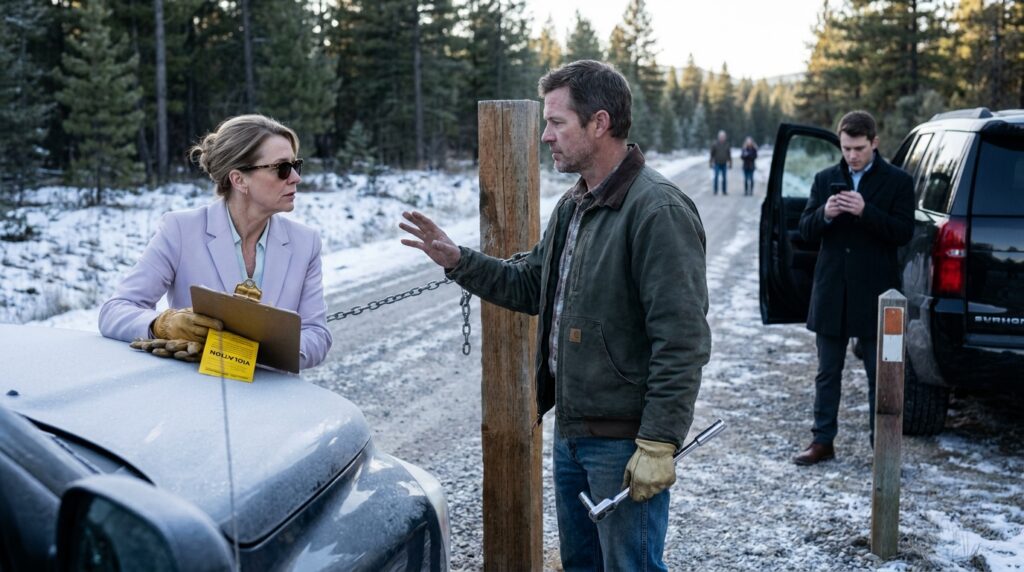
“She called it an architectural violation,” Julian said, his tone flat and level. “A sightline breach on a fence line that sits four hundred yards outside her recorded boundary.”
“Of course she did,” Tom snorted, reaching for a tin of mints. “She’s an attorney who treats bylaws like a loaded revolver. Eleven years ago, when the first phase of Crestwood went up, she drafted the covenants herself. Left the definitions vague enough around the western drainage so she could claim whatever acreage she looked at. Tried it twice with the old man who owned your parcel before you. Both times he threatened to run her off with a salt shaker, and she backed down because he had deep roots. But you’re new. You’re an engineer from the city who bought five thousand acres of quiet. To her, you’re just an empty lot waiting to be annexed.”
Julian picked up his spoon, turning it slowly between his fingers. The chrome caught the weak light filtering through the frost-rimmed windowpane. “An annexation needs a paper trail. Counties don’t just hand over title because an HOA president writes a stern letter on cardstock.”
“She doesn’t want the title yet,” Tom said, leaning forward, his blue eyes sharp beneath gray, unkempt brows. “She wants compliance. She wants you to sign a ‘co-management’ agreement. Once you sign away oversight of that western access road, you’ve legally recognized her authority over your property line. Give her an inch of paper, and she’ll pave a highway across your pasture by next spring.”
Julian’s thumb traced the edge of his mug. He remembered the specific, practiced arrogance in Eleanor’s posture, the way she hadn’t looked at the land at all—only at the structures. Her eyes hadn’t appraised the timber or the grade; they had measured utility.
“She had a young man with her,” Julian recalled, his mind locking onto the detail. “Carrying a folio, typing into his phone the second she turned her back.”
“That’s Dale Marsh,” Tom muttered, shaking his head. “Junior partner from her firm, or whatever’s left of it. He does the legwork—serves the notices, files the faux liens with the county clerk before anyone checks the plat maps. Most folks just pay the twenty-five hundred dollar fine to make the noise stop. It’s cheaper than a lawyer.”
“I don’t pay for noise,” Julian said quietly.
Tom let out a dry, rattling laugh, finally taking a sip of his coffee. “Good. Because she’s already scheduled a special board meeting for Thursday night. She’s going to present your refusal to the residents as a direct threat to community safety. Says your fencing obstructs emergency fire access along the ridge. She’s got thirty homeowners wrapped around her finger who’ll vote to authorize a formal injunction by voice vote alone.”
Julian set his mug down with a soft, deliberate thud that didn’t spill a drop. He reached into his coat pocket and slid the yellow violation placard across the table, smoothing the creases flat against the wood.
“Let her hold her meeting,” Julian said, his eyes meeting Tom’s with a cold, absolute steadiness. “Let her put it on record. Every paper she files is just another coordinate for us to map.”
Tom stared at the placard, then slowly looked up, a faint, grim smile touching the corners of his mouth. “You really think you can beat an eleven-year machine with a clean title and a stubborn streak?”
Julian didn’t answer immediately. He stood up, buttoned his field jacket, and reached for the door latch. The wind outside was picking up, rattling the loose tin roofing against the rafters—a sharp, kinetic reminder of the weather rolling in from the peaks.
“The title doesn’t lie, Tom,” Julian said, pulling the door open to the crisp mountain air. “And neither do the survey stakes. I’ll see you Thursday.”








