
CHAPTER 8: The Boundary Line
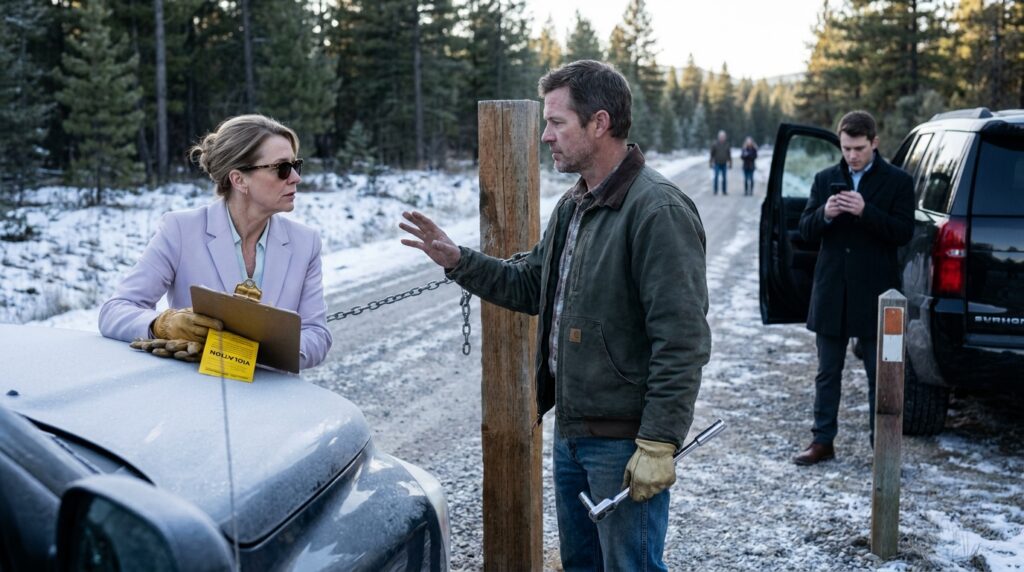
The morning frost clung heavy to the raw cedar of the eastern gateposts, turning the pale wood a brittle, sparkling silver under the early mountain sun. There was no sound of idling engines, no crunch of city tires on the crushed granite, and no bright yellow placards zip-tied to the latch. For the first time in nine months, the air over the ridge belonged entirely to the wind moving through the Ponderosa pines and the steady, unhurried rush of the creek cutting across the lower pasture.
Julian stood on the wooden threshold of the completed homestead foundation, his boots resting against the cured concrete. The legal files were closed. The forensic report from the independent document examiner had arrived on Judge Adler’s desk two weeks after the hearing, confirming with absolute technical precision that the execution dates on the association’s 2019 drainage permits had been digitally altered fourteen months after the fact.
The consequences had cascaded through Eleanor Vance’s meticulously constructed empire with the cold inevitability of an avalanche. The prescriptive easement claims had been dismissed with prejudice, accompanied by a crushing twelve-thousand-dollar assessment for legal fees and court costs. More critically, the federal EPA notice of violation had triggered a multi-million-dollar remediation liability for unpermitted wetland disturbance along the protected corridor, and the Montana Attorney General’s office had formally accepted the court record for criminal review regarding the falsification of judicial evidence.
The silent engine behind the entire harassment campaign—the commercial resort consortium—had reacted to the collapse of the access negotiations by instantly activating a severe default penalty clause against Eleanor’s private practice LLC. Stripped of active clients, facing personal liability for self-dealing transactions under the state nonprofit corporation act, and having surrendered her law license pending criminal resolution, Eleanor was no longer an institutional power on the ridge. At an emergency session called three days after the ruling, the Crestwood board had voted unanimously to strip her of the presidency, replacing her with a reconstituted administration committed to complete financial transparency.
Julian pulled his worn leather field notebook from the inside pocket of his canvas jacket. The pages were dog-eared, filled with coordinate notes, timeline entries, and legal citations accumulated during months of methodical defense. He flipped past the digital screenshot logs, past the FOIA confirmation numbers, back to the second-to-last page where he had jotted down a brief note next to a faded 1984 survey map reference: Check this later.
He pulled a graphite pencil from his pocket, pressed the lead firmly against the paper, and drew a single, clean horizontal line straight through the old reminder. The ink didn’t tear the page; it simply anchored it, turning an open question into a closed record.
A soft crunch of footsteps sounded behind him on the gravel path. Tom Briggs walked up, carrying two heavy mugs of chicory coffee, his breath pluming in the crisp mountain air. He didn’t look down toward the valley or toward the manicured lawns of the distant subdivision development. He just stood beside Julian, looking out across five thousand acres of rolling timber and open meadow that stretched toward the horizon.
“The new board president called me this morning,” Tom said, taking a slow sip from his mug. “They want to know if we can sit down next Tuesday to discuss the permanent conservation buffer along the drainage. No lawyers, no corporate brokers. Just property owners figuring out where the fences actually belong.”
Julian took the mug Tom offered, feeling the ceramic warmth soak into his cold fingers. He looked out over the eastern rise, where the first permanent timbers of his home stood square and true against the slope.
“Tell them we’ll meet at the property line,” Julian said quietly. “The stakes are already in the ground.”








