
CHAPTER 1: The Yellow Placard
The cold bit through the double-layer flannel of Julian’s sleeves as he tightened the final hinge bolt on the north post. Five hundred acres of rolling timber and jagged granite did not ask for much maintenance, only respect for gravity and the seasonal push of the creek. For two months, the silence had been absolute—the kind of dense, uncrowded quiet that settles over high-altitude meadows when a man stops answering emails and starts measuring his days by the sun.
Then came the snap of gravel under wide tires.
Julian didn’t turn around immediately. He finished seating the lock washer, gave the socket wrench a final half-turn, and wiped his palms on a rag before looking up.
The vehicle was an obsidian SUV, idling with the quiet arrogance of a machine built for city pavement rather than mountain grades. It had drifted a full four feet past the property boundary marker, its front bumper resting squarely on the edge of the access clearing Julian had cleared three weeks prior with county approval.
Through the tinted glass, the silhouette of a woman sat motionless, watching him with the steady, practiced fixation of someone accustomed to inspecting subordinates rather than scenery. When the door swung open, the scent of expensive leather and sharp citrus cut cleanly through the smell of damp pine needles and cedar shavings.
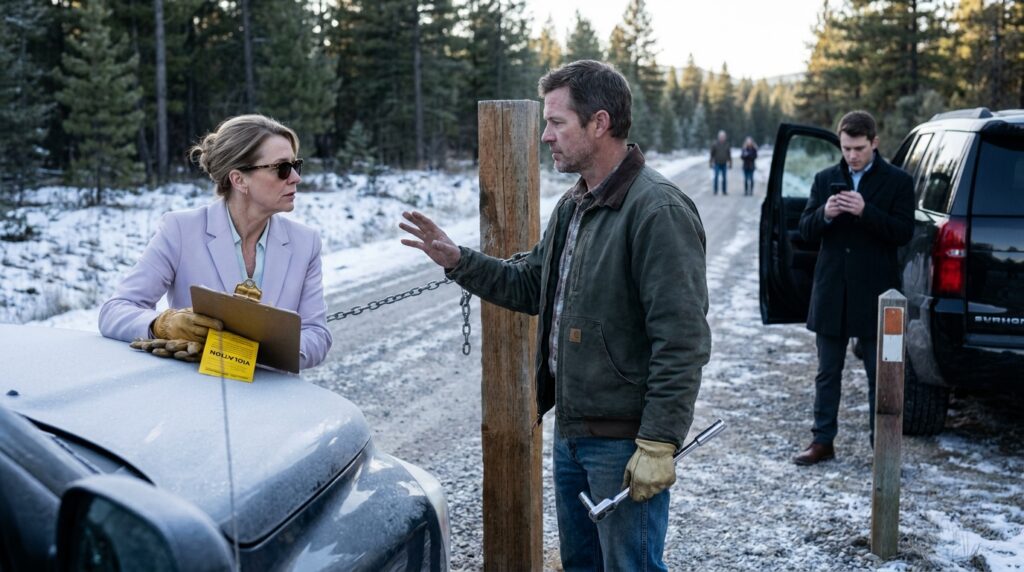
Eleanor Vance did not look like an invader. She looked like a neighborhood audit committee incarnate: a tailored pastel blazer that defied the altitude, silver-rimmed sunglasses perched on a sharply angled nose, and a heavy brass-clipped folder clutched against her chest like a shield.
“Mr. Cole, I presume,” she said, her voice carrying the smooth, flat cadence of an attorney who had never had to raise her tone to win an argument.
Julian picked up his socket set, sliding the steel pieces into their molded tray with a series of dull metallic clicks. “You’re past the marker, Ms. Vance. The turnoff is another fifty yards down the county road.”
“I am exactly where I need to be,” Eleanor replied, stepping past the mud flap with a pair of low-heeled loafers that were entirely unsuited for crushed granite. She didn’t look at the timberline or the peaks catching the first hard orange light of dawn. Her eyes were fixed entirely on the cedar gateposts, appraising their spacing with cold geometry. “The Crestwood architectural review board has logged three separate complaints regarding the unauthorized construction along our western buffer. That fence line violates our sightline easement by precisely four feet.”
Julian leaned against the fender of his truck, his expression flat, his hands shoved deep into his pockets to keep the cold from stiffening his fingers. “There is no Crestwood easement on this parcel. The county deeds were recorded clean thirty days before I moved the first shovel of dirt.”
Eleanor offered a thin, tight smile that did not reach her lenses. She reached into her brass-clipped folder, extracted a heavy sheet of cardstock covered in sharp, authoritative typography, and held it out. When Julian made no move to take it, she let it flutter down to rest on the hood of his truck, right beside his leather work gloves.
“You can dispute the jurisdiction all you care to, Mr. Cole. The association has governed this ridge for eleven years. We establish the standards, and we enforce the boundaries. Remove that gate within fourteen days, or the daily assessment fees will begin accumulating against your title.”
She turned on her heel, the loafers grinding sharply against the gravel, and pulled open the SUV door.
Julian picked up the paper, his thumb brushing the embossed seal. He didn’t unfold it. Instead, he watched the brake lights flare red as the vehicle backed down the narrow track, kicking up a spray of dust that settled slowly over the frost.
He walked over to the post where the bright yellow placard still hung by its severed zip-tie, lifted it free, and slid it into the side pocket of his jacket. The paper was stiff, the ink fresh, and the wording designed to provoke a hot, immediate response. But Julian wasn’t angry. He felt only the sudden, sharp clarity of a gear dropping securely into place. He pulled out his phone, dialed a seven-digit number from memory, and listened to the phone ring into the empty morning air.
“Tom,” Julian said when the line clicked. “She just dropped the first notice.”
A heavy sigh crackled through the speaker. “Bring your coffee down to my porch, Ethan. We’ve got a lot of history to unpack before that fourteen-day clock runs out.”








