The Weight of the Curb: How One Driver’s Ledger Dismantled a Self-Appointed Street Tyrant
CHAPTER 1: The Iron and the Asphalt
The diesel engine of the delivery van ticked as it cooled against the damp morning air of Maple Street. Julian Vance did not rush. After eleven years of urban logistics, his joints had learned the language of cold iron and unyielding concrete, and his mind had been trained to treat friction not as an obstacle, but as a data point. He stood with one hand resting on the cold metal latch of the rear cargo door, watching the reflection of the sunrise distort across a greasy puddle near the curb.
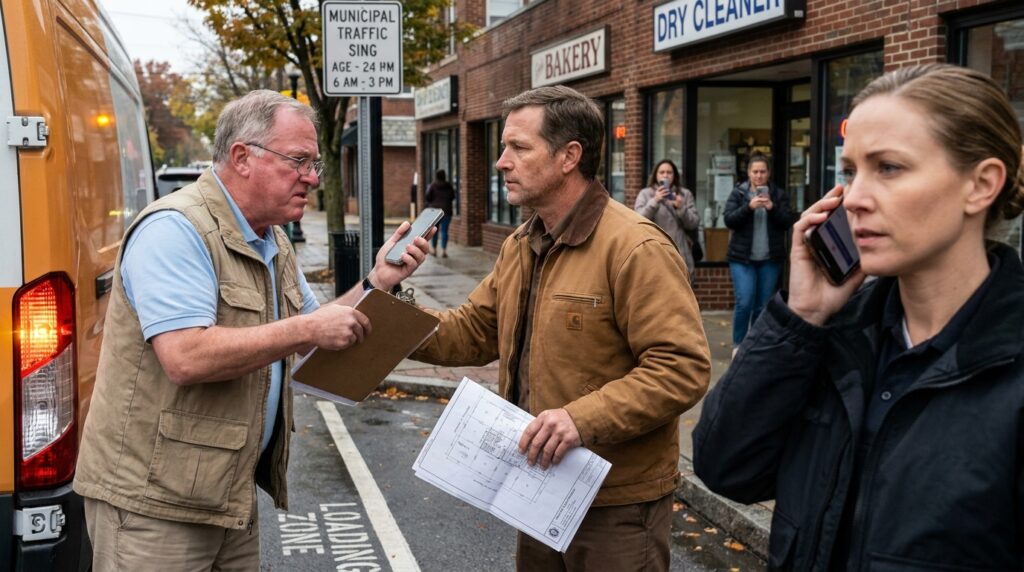
The street smelled of roasted chicory from the corner café and wet exhaust pipe. To anyone else, it was just another Tuesday morning delivery run through a busy commercial strip. But to Julian, the space between the bakery awning and the dry cleaner’s entrance was a narrow corridor of compressed rules. His hazard lights blinked in a steady, amber rhythm, casting a rhythmic pulse over the white-striped loading zone stenciled beneath his tires.
“You delivery drivers think you own every inch of asphalt in this district,” a sharp voice cut through the drone of passing traffic.
Julian did not turn around immediately. He finished sliding his manifest clipboard into the canvas pocket of his jacket, smoothing the edge of the paper with a calloused thumb. Only then did he pivot on his heel.
Arthur Pendelton stood three paces away, his pastel polo shirt stretched tight across a rounded frame, a pristine laminated clipboard clutched in his right hand like a badge of office. Arthur’s silver-rimmed glasses slid halfway down the bridge of his nose as he glared down at the white stripe beneath Julian’s front tire, his lower jaw set in the permanent, humorless rigidity of a man who measured his self-worth by how many people he could inconvenience before noon.
“This is a restricted retail clearance zone,” Arthur announced, pitching his voice deliberately so the pedestrians waiting at the crosswalk could hear every syllable. “Commercial drop-offs concluded at eight o’clock. You are in direct violation of district association bylaws. Move this vehicle right now, or I will call the impound yard before you finish unloading your first crate.”
Julian maintained the steady, unblinking posture of a man who had spent decades reviewing structural blueprints where panic carried a heavy price. He did not raise his voice to match Arthur’s theatrical cadence. Instead, he reached into his breast pocket, drew out a folded municipal placard copy, and pointed quietly to the green-and-white city traffic sign bolted directly to the steel pole beside Arthur’s shoulder.
“The municipal traffic code explicitly designates this specific forty-foot zone for commercial freight handling between eight in the morning and eleven,” Julian said, his tone flat and level. “The district association bylaws do not supersede city ordinance, Mr. Pendelton.”
Arthur’s face flushed a dull, mottled red. He didn’t look up at the sign; he simply slapped an unofficial orange warning sticker onto Julian’s side mirror, muttering something dark about outsiders who refused to respect local order.
Julian watched the sticker settle against the glass. He reached out, peeled the paper backing off with surgical precision, folded it twice, and slid it into his pocket alongside his manifest. But as he turned back toward his cargo bay, his peripheral vision caught something odd reflected in the side mirror—a second set of footsteps lingering by the alley entrance, watching the exchange with an intent, calculating stillness that didn’t belong to a casual bystander.

CHAPTER 2: The Silt and the Warning
The morning air tasted of stale tobacco and iron shavings. Julian Vance shifted his commercial van into low gear, the transmission groaning a dry complaint as he eased the heavy chassis down the alley behind the dry cleaner’s. The dashboard clock glowed a cold amber: 7:42 AM. Twenty minutes before the municipal loading window opened, and already the space was claimed by a shadow that didn’t belong to a customer.
A crisp, neon-orange warning notice fluttered beneath the wiper blade of a delivery pickup two stalls down. Julian didn’t need to step out of his cab to recognize the handwriting. It was penned with the aggressive, straight-edged slant of someone who spent their evenings drafting bylaws they had no legal authority to enact. Arthur Pendelton had been busy before sunrise.
Julian pulled his van into the designated freight bay, killed the ignition, and let the silence rush in. The street outside was quiet, save for the steady drip of a compromised gutter pipe splashing against a rusted corrugated iron wall. His fingers lingered on the steering wheel, tracing the worn patch where the rubber grip had worn down to the smooth wire mesh beneath.
Two days had passed since the first confrontation by the bakery, and the atmosphere along the commercial strip had tightened like a dry winch. Ed Patterson, who managed the hardware depot across the lane, had stopped his morning sweep with his broom when Julian drove past, his eyes sliding away toward the brickwork with studied neutrality. It wasn’t hostility yet; it was the cautious retreat of men who smelled trouble and preferred to stand downwind.
Julian stepped down from the cab, his boots crunching against a scattering of dry gravel. He reached out to lift the orange sticker from his windshield, peeling it off in one unbroken strip. The adhesive left a sticky residue that caught the grit of the morning dust. Beneath the printed text—Unauthorized Commercial Staging Penalty: $50—was a handwritten code in the bottom margin: Ref: M-14.
It wasn’t a city code. The municipality used alphanumeric zoning designations like C-2 and B-F. The ‘M’ prefix belonged exclusively to the Maple Street Business Association’s internal accounting ledgers—a private ledger that Arthur managed out of a spare room in the community clubhouse.
“Working early, are we, courier?”
The voice came from the mouth of the alley, dry and thin like old parchment. Arthur stood beside a rusted utility box, his hands buried deep in the pockets of a slate-grey windbreaker. The pastel polo shirt of two days prior was gone, replaced by a utility vest adorned with various brass-pinned badges that looked suspiciously like security tokens from an industrial park lease that had expired a decade ago.
Julian didn’t turn around immediately. He folded the orange sticker twice, squared the edges against his palm, and slipped it into his canvas jacket pocket alongside yesterday’s harvest.
“The loading zone opens at eight,” Julian said, his voice level as he turned to face the older man. “My manifests are time-stamped by the freight terminal. You’re losing efficiency tracking cars that aren’t breaking ordinance, Mr. Pendelton.”
Arthur took two slow steps forward, his heels clicking against the concrete with a deliberate, metronomic cadence. He stopped four feet away, just outside the perimeter of Julian’s work zone, his chin tilted up with the practiced arrogance of a man who believed a laminated badge could rewrite a deed.
“Efficiency is maintained by order, Mr. Vance,” Arthur replied, his eyes narrowing as he stared at the rear cargo doors of the van. “And this district has enjoyed a very particular kind of order long before independent contractors started cutting corners on our back streets. You think a city permit protects you from local oversight? The board has ways of ensuring that businesses who choose not to cooperate find their operating costs exceeding their profit margins very quickly.”
Julian looked past Arthur’s shoulder, watching a stray cat pick its way across a pile of discarded cardboard boxes near the dumpster. He didn’t rise to the bait. In logistics, an opponent who stated their leverage openly was an opponent who had already revealed the perimeter of their control. Arthur wasn’t protecting the neighborhood; he was protecting a revenue stream that depended entirely on people being too tired to check the county archives.
“The engine’s cold, Arthur,” Julian said quietly, stepping past him toward the rear latch. “Move your clipboard. I’ve got freight to drop before the morning rush locks the street.”
Arthur didn’t move. He stood firm against the damp morning wind, his hand sliding slowly toward the leather folio tucked beneath his arm, his fingers twitching with the urge to write another ticket that would never reach a municipal desk.
CHAPTER 3: The Ledger and the Aisle
The refrigeration units along the back wall of the Maple Street Market hummed with a low, bone-chilling vibration that cut through the humid air of the dairy aisle. Julian Vance stood motionless beside a stack of wire milk crates, his thumb tracing the jagged edge of an inventory manifest. He didn’t look up when the heavy glass door of the dairy case clicked shut, though he felt the shift in air pressure before he heard the familiar squeak of rubber soles against the linoleum.
Arthur Pendelton did not walk alone. Flanked by two members of the district merchant committee—men whose eyes carried the guarded, flat expressions of property owners who had long since traded independence for a quiet life—Arthur stepped into the narrow aisle, deliberately blocking the return path toward the registers.
“It has come to the board’s attention, Mr. Vance, that your service continues to operate under the dangerous assumption that municipal convenience overrides local commercial stability,” Arthur announced, pitching his voice to carry past the stacks of butter and bottled cream, ensuring the cashiers near the front counter could hear every syllable.
Julian lowered his clipboard by an inch. The metal ring binder made a soft, metallic scrape against his canvas jacket. “The loading zone is governed by city traffic ordinance, Mr. Pendelton. Not a committee resolution.”
“A resolution that protects the integrity of our shared streetfront,” interjected one of Arthur’s companions, a man named Henderson whose hardware store sat three doors down from the bakery. Henderson crossed his arms, his flannel sleeves rolled tight against thick forearms. “You’re bringing heavy freight into a retail corridor that wasn’t engineered for continuous axle load. If the pavement fails, the assessment falls on every shop owner on this block. We aren’t going to let an outsider break the paving stones just to save ten minutes on a drop schedule.”
Julian kept his breathing steady, feeling the cold draft from the open freezer case bite through the fabric of his sleeve. He recognized the tactical pattern immediately. This wasn’t about the asphalt or the weight limits; it was an attempt to corner him in a semi-public space where a sharp word could be twisted into a threat, creating the paper trail Arthur needed to justify an emergency ban.
“The axle weight of my vehicle complies with standard urban delivery parameters,” Julian said evenly, his voice refusing to climb to their theatrical pitch. “If you have concerns about structural wear, you can submit an official inquiry to the municipal engineering department. They keep records on file.”
Arthur’s mouth tightened into a thin, bloodless line. He reached into his windbreaker pocket and produced a small, leather-bound receipt book—the private ledger used to track the district’s internal fee collections. He flipped it open with an aggressive snap of the wrist, exposing a page covered in handwritten columns and neat rows of figures.
“Records are maintained right here, courier,” Arthur snapped, stepping closer until the smell of stale pipe tobacco and damp wool washed over Julian. “And right here, your service is listed as delinquent on three separate district maintenance assessments totaling four hundred and fifty dollars. Pay the fee to the committee registry today, or I will personally ensure that every merchant between the square and the railway tracks denies you access to their receiving docks before the week is out.”
Deep inside Julian’s coat pocket, the digital voice recorder application on his phone continued to run its silent, unbroken loop, capturing the explicit demand for unauthorized cash exactions in a public market aisle. Julian looked down at the receipt book, noting the specific bank routing numbers stamped lightly on the stub beneath Arthur’s thumb—a private account held not by the city, but under the corporate title Maple Street Commercial Defense Fund.
The decoy structure of the dispute clicked into place with the cold certainty of a gear locking into a damaged housing. The parking tickets, the manufactured code violations, the public warnings—none of it was about the street or the pavement. It was a toll gate erected across a public right-of-way, designed to bleed independent operators until they paid tribute to a private pocketbook disguised as a civic board.
“Four hundred and fifty dollars,” Julian repeated, his voice dangerously soft. “That’s an interesting line item for a public loading zone, Arthur.”
“It’s the cost of doing business in our district,” Arthur retorted, his eyes flashing with the triumph of a man who believed he had successfully boxed his target into a corner. “Take it or leave your keys.”
Julian did not argue. He did not raise his voice, nor did he reach for the receipt book. He simply pulled a carton of whole milk from the shelf, placed it neatly into his wire handbasket, and turned his back on them, walking slowly toward the checkout counter without another word. Behind him, Arthur’s laughter echoed dryly off the tile walls—a premature victory note that faded the moment Julian stepped past the registers and felt the crisp autumn wind hit his face.
CHAPTER 4: The Archive Dive
The municipal zoning office smelled of damp cellulose and vinegar-based ink. Beneath the fluorescent hum of a single flickering tube in the basement archive, Julian Vance straightened a heavy, unhinged cardboard box across the zinc-topped examination table. The air was thick with the weight of decades past, holding the stagnant heat of a building that had long since forgotten the sound of an open window.
He did not come for opinions. In logistics, opinions were noise; geometry and time were the only data points that mattered.
His fingers slid across the rough edge of a rusted metal filing drawer until they found what he had been tracking since the confrontation in the dairy aisle: the 1992 street dedication plats for the Maple Street commercial corridor. The papers were yellowed at the margins, bound together by a corroded brass staple that had stained the surrounding bond paper a rusty orange.
Julian unclipped his pen light, casting a sharp, clean circle of white illumination across the folio. He traced the heavy black ink lines of the original surveyor’s map, checking parcel numbers, right-of-way boundaries, and dedication stamps. There it was, stamped in the bottom right corner with the seal of the county commissioner: Dedication of Public Access Easement — Fee Simple to Municipality, Unconditional.
The commercial loading zone outside the bakery wasn’t private association property. It never had been. It was public domain, deeded over to the city thirty-four years prior precisely to prevent local merchants from erecting private toll gates across public infrastructure. Arthur Pendelton’s entire regulatory framework—every ticket, every warning sticker, every calculated demand for cash expediting fees routed through the Maple Street Commercial Defense Fund—was built entirely on a foundation of administrative bluffing.
A soft scraping sound echoed from the top of the concrete stairs. Julian looked up, his hand sliding instinctively into his pocket to brush against the smooth metal casing of his digital recorder.
“Looking for historical preservation permits, Mr. Vance?”
The voice belonged to Elena Vance—no relation, though they shared the same sharp, unblinking evaluation style—a senior archivist whose desk sat just outside the caged partition. She peered over the rim of her reading glasses, her expression neutral, holding a fresh batch of property ledgers under one arm. “Most couriers don’t spend their Tuesday afternoons reviewing thirty-year-old right-of-way ordinances.”
“Just verifying boundary limits,” Julian said quietly, lifting the fragile plat sheet with both hands to ensure it lay completely flat under the light. “When a local committee starts charging administrative fees for a public curb, it pays to check who holds the master deed.”
Elena let out a short, dry breath that sounded like rustling paper. She set her ledgers down on the edge of the zinc table, her eyes lingering on the municipal stamp at the bottom of the map. “Arthur Pendelton has been pulling those plats from the public rack for years whenever a new driver tries to push back. Most people don’t look past the first page of the association charter. They assume if someone wears a badge and talks loud enough in a public market, the rules they’re quoting actually exist.”
“They exist until someone reads the secondary clauses,” Julian replied, pulling a portable scanner from his canvas satchel.
The device hummed to life with a soft, electronic whir, its green scanning bar sweeping rhythmically across the face of the 1992 dedication document. Each pass captured the high-resolution vector lines, the commissioner’s seal, and the precise legal language prohibiting any private entity from levying tolls or restricting commercial access within the forty-foot zone.
Yet, as the green light flickered across the final page, a sudden, cold realization settled in Julian’s chest. Having the document in the basement archive was entirely different from forcing a public confrontation on the street. Arthur wasn’t operating alone, and the business association had deep ties to the local magistrate who handled municipal code infractions. If Julian rolled his van into the loading zone tomorrow morning armed only with a paper map, Arthur wouldn’t read the ordinance; he’d double down, call a tow truck under emergency powers, and let the legal fees mount while the truck sat in an impound lot four miles across town.
The paper was a shield, but a shield didn’t stop a spear. To break the blockade permanently, Julian needed more than a quiet archive victory. He needed a live, irreversible public collapse—one where the trap Arthur had laid for others finally snapped shut around his own ankles in front of the entire neighborhood.
Julian carefully unclipped the scanner, folded the original plat back into its rusted folder, and slid the digital memory card into his shirt pocket. The archive was quiet, but outside on Maple Street, the morning sun was climbing toward the peak of another long, calculated day.
CHAPTER 5: The Speakerphone Reversal
The damp asphalt of Maple Street absorbed the morning glare, throwing up a thin, shimmering heat haze that distorted the edges of the storefronts. Julian Vance didn’t rush his movements. He stepped down from the cab of his delivery van, his boots meeting the grey pavement with a dull, heavy thud. The digital scan of the 1992 municipal street dedication plat rested securely inside his leather folio on the passenger seat, paired with Marisol Delgado’s witness statement from the specialty market.
It was 8:14 AM. The municipal loading window had just opened.
Before Julian could unlatch the rear cargo door, Arthur Pendelton materialized from the shadow of the brick dry cleaner. His pastel polo shirt was replaced today by a heavy canvas utility vest, his chest adorned with the same polished metal badge imitation. In his right hand, a laminated clipboard clutched like an officer’s baton; in his left, a smartphone already dialed to the local private impound service.
“I warned you yesterday, courier,” Arthur announced, his voice carrying deliberately across the waking lane to catch the attention of the morning commuters waiting at the corner bus stop. “You choose to ignore district fees, you forfeit commercial staging rights. I am having this vehicle winched off the public lane before you can finish signing your manifest.”
Julian did not blink, nor did he raise his voice to match Arthur’s public theater. He maintained the calm, unyielding posture of a man surveying a load-bearing column under maximum stress. He reached into his canvas jacket, withdrew the folded municipal right-of-way plat, and stepped forward until he stood two feet from the boundary line.
“There are no district fees applicable to public domain, Mr. Pendelton,” Julian said, his voice flat, steady, and loud enough to cut through the street traffic. “This forty-foot corridor was deeded to the municipality in 1992 under an unconditional public access easement. You have no legal standing to issue fines, levy tolls, or order impounds on city property.”
Arthur scoffed, a sharp, dismissive sound that bounced off the bakery windows. He raised his phone higher, pressing it against his ear while tapping the speakerphone icon with an aggressive thumb. “Tell it to the tow operator,” he snapped. “Let’s see how much your paperwork weighs when your van is sitting in a municipal pound four miles away.”
The speakerphone crackled to life, filling the morning air with a harsh electronic hiss as the automated dispatch tree clicked through its routing options. A tired dispatcher’s voice cut through the static on the other end. “Maple Street Towing and Recovery. State your badge or account code.”
“Arthur Pendelton, President of the Maple Street Business Association,” Arthur barked, his chest puffing out as he leveled a triumphant glare at Julian. “I have an unauthorized commercial vehicle squatting in a restricted loading zone at the corner of Maple and Fourth. Send a flatbed immediately. Full impound protocol.”
The dispatcher’s voice paused. A rustle of papers came over the line, followed by the clatter of a computer keyboard. “Hold on, Mr. Pendelton. Let me pull the regional zoning ledger for that specific block. Fourth and Maple… are you calling from the private side or the municipal corridor?”
“It’s a district-regulated zone!” Arthur insisted, his voice rising a octave as a small knot of pedestrians began to slow their pace near the curb. “We maintain the paving stones. Send the truck.”
“Sir,” the dispatcher interrupted, her tone sharpening with professional flat neutrality. “Our municipal database indicates that the forty-foot commercial lane between the bakery and the dry cleaner was deeded as a public right-of-way in 1992. We have no authority to tow a legally permitted vehicle from a public city zone unless the city transportation bureau issues a direct, signed citation.”
The silence that followed was absolute.
Across the street, Marisol Delgado stepped out of the specialty market doorway, her clipboard held loosely against her hip, watching the exchange with cold, unblinking eyes. Beside her, Ed Patterson paused his morning broom sweep, his gaze shifting slowly from Arthur’s rigid posture to the municipal sign bolted to the steel pole above them. Two local shop owners who had previously nodded along with Arthur’s committee meetings stepped back into the shadows of the brick arcade, their expressions closing off.
Arthur’s face drained of color, the mottled red fading into an ashen, chalky grey. He stared down at his phone as if the device itself had betrayed him. “That… that’s an administrative error,” he stammered, his public volume cracking into an awkward rasp. “The association holds local enforcement rights—”
“Sir, if you attempt an unauthorized tow on a public city lane without a city marshal present, that constitutes civil interference and illegal impoundment,” the dispatcher said crisply. “Do you want me to dispatch a municipal inspector, or are we cancelling this call?”
Arthur stared at the phone screen for three agonizing seconds before his thumb hit the red disconnect button, killing the audio with a sharp click.
Julian watched him lower the phone, his hand resting quietly on the handle of his canvas case. He didn’t gloat. In logistics, the collapse of a failing structure required no celebration—only clean geometry and a steady hand.
“Keep your clipboard, Arthur,” Julian said quietly, turning back toward the rear latches of his delivery van. “The street has its own memory.”
Arthur didn’t answer. He turned on his heel, his canvas vest brushing against the brick wall as he retreated down the alley without finishing his sentence. Behind Julian, the heavy cargo doors swung open with a clean, metallic snap, and the morning route finally began.