CHAPTER 5: Exactly Enough
The first frost of November had traced delicate, fern-like patterns on the kitchen windows, silvering the edges of the world outside. Inside, the house was warm, smelling of cinnamon toast and the faint, clean scent of cedarwood. Marianne sat at the oak table, her hip only giving her a dull, occasional reminder of the fall.
She had cleared away the breakfast dishes, but she hadn’t moved to start her chores. Instead, she had a single sheet of heavy cream stationery in front of her and a pen that Arthur had given her for their fortieth anniversary. She wasn’t looking at the screen of a phone or a computer; she was looking at the ginger-and-white cat sitting on the chair directly opposite her.
Lucky sat tall, his paws tucked neatly under his chest. He wasn’t leaning on her ankles or crying at the door. He was simply watching the movement of the pen, his amber eyes following the silver clip as she clicked it open. There was a profound stillness in him—the kind of quiet that only comes when a creature finally realizes the ground beneath him isn’t going to vanish.
Marianne began to write. Her handwriting was careful, the loops of the letters steady despite the chill in the air. She didn’t write to the “internet” or the “experts.” She wrote to the young woman at the shelter desk who had looked at Lucky with such pity on that first Tuesday.
“Dear Friends,” she began. “I am writing to tell you that Lucky is doing more than just ‘fitting in.’ He is teaching me how to live in a house that I thought was empty.”
Lucky shifted, his ears twitching at the scratch of the nib on paper. He didn’t understand the words, but he understood the environment of the room. The air was thick with the scent of “settled.” His person wasn’t preparing to leave; she wasn’t radiating the sharp, cold static of grief or the frantic heat of a fall. She was focused, her heartbeat a slow, rhythmic drum that he could feel even from two feet away. He blinked at her slowly, a long, deliberate closing of his eyes—the feline equivalent of a deep, satisfied sigh.
He didn’t need to be touching her every second now. The “shadow” had found its place in the light. He knew that if she stood up, he would go with her, and if she sat down, he would be there. The panic of the “Gap” had been replaced by the certainty of the “Us.”
Marianne paused, looking out at the street. She saw Gladys walking by, bundled in a heavy coat, looking suspiciously at the lack of a “For Sale” sign in the yard. Marianne smiled to herself, a small, private victory.
“People keep using the word ‘independent’ like it’s a prize we’re all supposed to win,” Marianne wrote, her pen moving faster now. “They act like needing someone is a weakness. But I have spent three years being independent, and all it gave me was a very quiet house and a heart that felt like it was shrinking.”
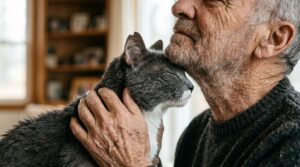
She looked at Lucky, who had now stood up and walked across the table to sit beside her hand. He didn’t knock the pen away. He simply lowered his head, inviting the touch he knew was coming. Marianne’s fingers found the soft, warm spot behind his ears.
“Lucky is not a ‘lap cat,'” she continued, the ink dark and bold on the page. “He is a ‘life cat.’ He follows me because he can. Because he wants to. Because he knows where I am, and that makes him calm. And I like it. I like being known.”
She finished the letter with the sentence she had been carrying since the day Sarah told her about the “siren” in the hallway. “If someone calls him ‘too much’ again, tell them I waited a long time for ‘too much.’ To one home, he was a problem. To me, he is exactly enough.”
Marianne folded the paper and tucked it into the envelope. She felt a lightness in her chest that had nothing to do with her recovery and everything to do with her choice. She wasn’t a “burden” and he wasn’t a “defect.” They were two beings who had refused to pretend they didn’t need each other.
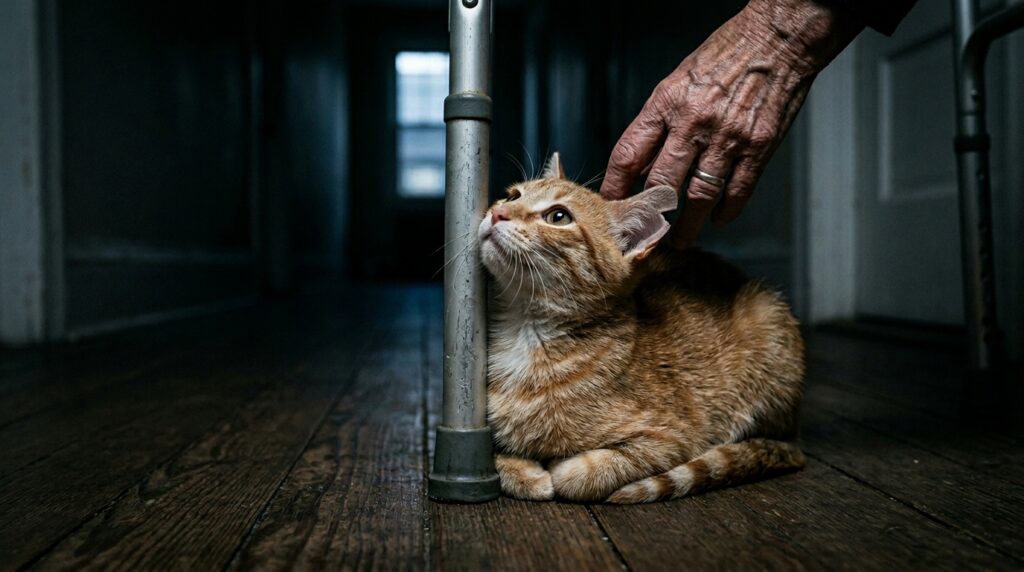
She stood up, reaching for her walker. Lucky was off the table before her feet even hit the floor. He didn’t trip her. He didn’t cry. He simply took his position—two inches behind her right heel—and waited.
Together, they walked toward the front door to put the letter in the box. The hallway rug was gone, the floor was clear, and the house was no longer quiet. It was full of the sound of a walker, the patter of paws, and the breathing of a pair that finally, truly belonged.
Epilogue: 6 Months Later
The Oak Creek spring had arrived with a riot of daffodils and the smell of wet earth. Marianne’s garden was thriving, the weeds kept at bay by a woman who moved a little slower than she used to, but with a lot more purpose.
She was sitting on her back porch in a new, sturdy wicker chair. Beside her, on a small rug she had specifically bought for the outdoors, Lucky was watching a robin with intense, professional interest. He didn’t chase it. He just kept one eye on the bird and one ear turned toward the sound of Marianne’s knitting needles.
There were no more “viral” posts. The neighbors had grown used to the sight of the ginger-and-white shadow following the walker down the sidewalk. Even Gladys had stopped making comments, mostly because she had seen Lucky sit on the porch during a thunderstorm, refusing to go inside until Marianne had safely gathered the laundry from the line.
Marianne looked down at the cat who had saved her, and who she, in turn, had saved. Her house wasn’t “empty quiet” anymore. It was “peaceful quiet.” She reached down and felt the familiar, grounding vibration of a purr against her knuckles.
In a world that worships being alone, they had found the courage to be together. And in the end, that was the only expert opinion that mattered.