CHAPTER 3: When the World Tips Over
The morning started with a stubborn sort of pride. Marianne had spent half the night rehearsing arguments against the people on the computer screen. To prove them wrong, she decided she would be more than just “fine”—she would be efficient. She would tackle the laundry, the dusting, and the kitchen floor, all before the mail arrived.
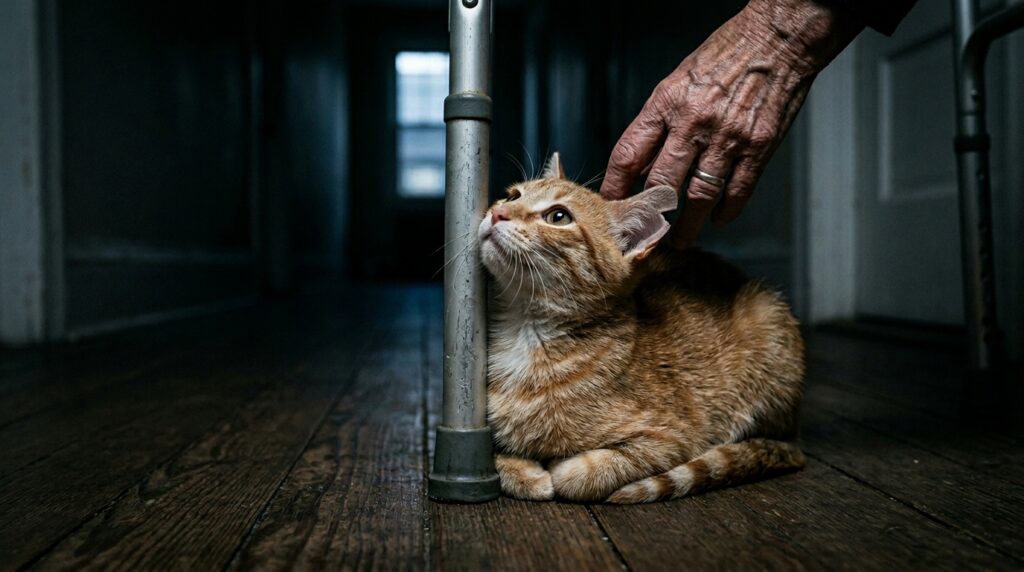
She moved through the house like a captain on a deck, her walker clicking with a sharp, determined rhythm. Lucky was there, of course. He didn’t seem to care about her newfound mission; he only cared that she was vertical. He paced alongside her, occasionally pausing to lean his weight against the wheels of the walker, a silent anchor in her sea of chores.
“I’m not going anywhere, Lucky,” she told him, though the words were really for herself. “See? I’m as steady as a rock.”
She avoided the hallway rug for two hours. It was a small, braided thing Arthur had bought at a craft fair years ago, its edges now slightly curled and treacherous. She had planned to fix it, to tape it down or throw it out, but it was a piece of the life she used to have.
By noon, the clouds had moved in, turning the golden October light into a flat, gray afternoon. Marianne headed toward the kitchen for a glass of water, her focus momentarily shifting to the ticking clock on the wall. She was tired, her knees singing with that familiar, dull ache.
It happened in a heartbeat.
The front right leg of the walker caught the lip of the rug. For a second, time stretched like taffy. Marianne felt the handles slip from her grip. She reached for the wall, her fingers grazing a framed photo of the Grand Canyon, but gravity was faster than seventy-eight-year-old reflexes.
The world didn’t crash; it simply tipped. She went down on her side, her hip meeting the floor with a hollow thud that seemed to vibrate through the very foundation of the house. The walker skittered away, landing with a loud, metallic clang against the baseboards.
Then, there was the silence. The heavy, suffocating silence of a house where no one else is breathing.
Lucky didn’t see a fall; he saw the end of the world. The tall, steady source of his safety—the one who smelled of lavender and brought the morning light—had suddenly collapsed into a heap of limbs and fabric. The sound of the metal walker hitting the wall sent a jolt of primal fear through his spine, his fur standing on end as he skidded across the linoleum.
He didn’t hide. He didn’t run to the basement. The bond that people called “clingy” was now a frantic, electric wire connecting him to the figure on the floor. He circled her, his paws dancing around her head. He let out a sound he had never made before—a sharp, ragged yowl that wasn’t a request for food, but a demand for a response. He leaned his face into hers, his wet nose pressing against her cheek, searching for the heat of her breath.
“Oh… oh, Lucky,” Marianne whispered. The pain in her hip was a white-hot bloom, making her breath come in short, shallow gasps. She tried to roll over, to find purchase on the floor, but her body felt like it belonged to someone else. It was heavy, uncooperative, and frighteningly still.
She looked toward the front door. It was locked. The curtains were drawn against the gray afternoon. The neighbors were inside their own warm houses, watching their own televisions. She was on the floor, hidden by the sofa, and the phone was miles away on the kitchen counter.
“Help,” she tried to call out, but it came out as a ragged sob.
Lucky felt the vibration of her fear. It was a cold, sharp thing. He realized the lavender woman couldn’t get up. He looked at the heavy wooden door, then back at Marianne. The panic that usually made him cry at closed doors now had a direction.
He didn’t sit and wait. He began to run.
He threw himself at the front door, scratching at the wood until his claws clicked like rain. Between the scratches, he let out a relentless, piercing yowl—a sound that carried through the thin glass of the sidelight and out into the quiet street. It was the sound of a creature who refused to be ignored.
Across the street, Sarah, a younger neighbor who usually walked her Golden Retriever around this time, stopped in her tracks. She looked toward Marianne’s house. She knew Marianne lived alone. She knew the cat was “the clingy one” from the shelter’s post. But this sound wasn’t the cry of a lonely cat. It was a siren.
Lucky didn’t stop. His chest was heaving, his throat raw. Every time he heard a footstep on the porch or a rustle in the leaves, he doubled his effort. He was a tiny, orange-and-white alarm system with no off switch. He paced from the door to Marianne and back again, his tail a frantic whip, until he heard the magic sound: the jingle of keys and a human voice.
“Marianne? Marianne, are you in there?”
Lucky didn’t back away when the door swung open. He stood his ground, pointing the way with his entire body, his eyes wide and unblinking.
As Sarah rushed to Marianne’s side, calling 911 on her cell phone, the room filled with the chaos of rescue. But amidst the noise, Marianne felt a small, warm pressure against her good side. Lucky had squeezed himself into the narrow space between her and the floor. He wasn’t crying anymore. He was purring—a deep, desperate rumble that felt like a heartbeat against her ribs.
“He didn’t leave me,” Marianne whispered as the sirens began to wail in the distance. “The ‘problem’… he stayed.”
She looked at the curling rug, now bunched and messy on the floor. The world had tipped over, just like the experts said it would. But as she gripped the fur on Lucky’s neck, she knew the experts had missed the most important part of the story.