CHAPTER 2: The Cold Breath of the World
“You really should see this, Marianne,” Gladys said, her voice pitched in that high, thin register people use when they’re about to deliver bad news they actually enjoy sharing.
She thrust the phone toward Marianne’s face. On the screen was a photo—blurry but unmistakable. It was Lucky, curled on the footrest of the recliner, his head resting on Marianne’s ankles. The caption from the shelter was sweet enough: Lucky found his person. But it was the scroll of text beneath the image that made the room feel suddenly smaller.
Marianne squinted through her bifocals. Her heart, usually steady and slow like an old clock, gave a sharp, indignant thump.
“Why would they give a cat with separation anxiety to someone that old?” one comment read. “It’s irresponsible. What happens when she falls or ends up in a home? That cat will be traumatized all over again.” Another person had written: “That cat doesn’t need a lap; he needs a vet and Prozac. Giving him to a senior is just setting him up for another return.”
Marianne felt a flush of heat crawl up her neck. It wasn’t just the word old that stung, though it felt like a slap in a house that usually treated her with quiet respect. It was the clinical way they talked about Lucky. They spoke as if he were a defective toaster, a “problem” to be managed by experts, rather than a living soul who had finally stopped shaking.
“The whole neighborhood is talking, dear,” Gladys added, her eyes darting to Lucky. “People are worried. You know how ‘clingy’ cats can be. They’re saying it’s a lot for a woman your age to handle. Especially a… well, a special needs case like this one.”
Lucky didn’t know about the internet. He didn’t know about “viral posts” or the opinions of strangers in distant cities. But he knew the scent of Marianne’s sweat had changed from the sweet, faded smell of tea to the sharp, acidic tang of distress.
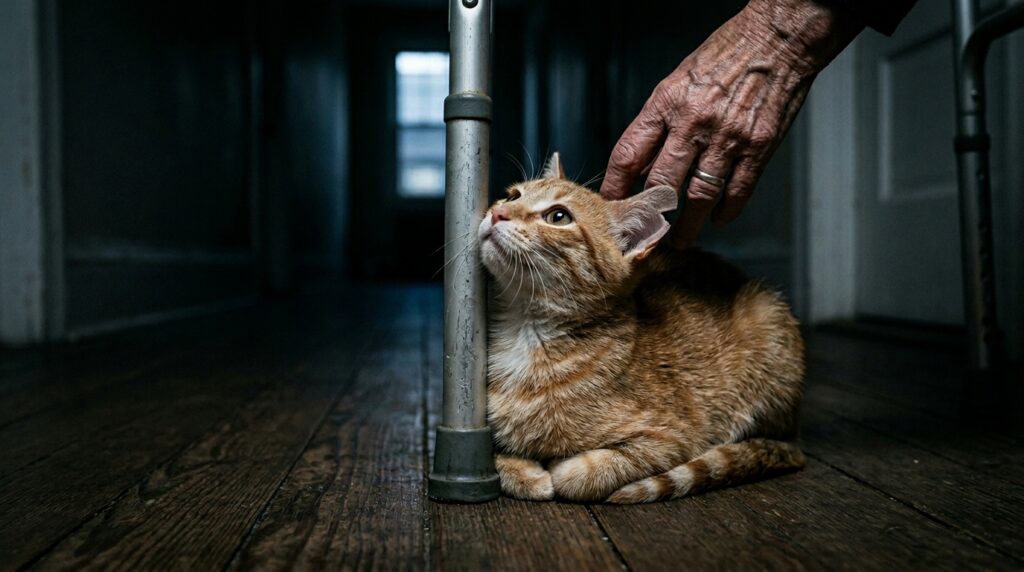
He felt the tension in her hand as it gripped the handle of her walker—a white-knuckled vibration that traveled down the aluminum and into the floor. He didn’t retreat. Instead, he moved. He paced a tight, protective figure-eight around Marianne’s ankles, his fur brushing against the hem of her housecoat. To a stranger, it looked like a symptom. To Lucky, it was a calibration. He was trying to absorb the static she was giving off, pressing his ribcage against her shin to offer the steady rhythm of his own lungs.
Marianne looked down at him. She looked at the nick in his ear and the way he refused to look at Gladys, keeping his focus entirely on his person.
“Is that right?” Marianne said, her voice trembling just enough to make her angry. She straightened her shoulders, moving with a deliberate slowness that signaled the end of the conversation. “They’re worried about what happens when I fall? Or when I’m ‘gone’?”
“Well,” Gladys hedged, looking a bit taken-back by the steel in Marianne’s tone. “They’re just thinking of the animal, Marianne. It’s a lot of responsibility. A cat that follows you into the bathroom… it’s not normal. It’s a burden.”
“He isn’t a burden, Gladys,” Marianne said, her hand finally dropping from the walker to find the top of Lucky’s head. “He’s an escort.”
When Gladys finally left, the house felt colder. Marianne sat in her recliner, but she didn’t turn on the ballgame. She stared at the empty space where Arthur’s chair used to be. The comments on the screen played on a loop in her mind. Traumatized all over again. Setting him up for failure. Too old.
Was she being selfish? The question gnawed at her. She was seventy-eight. Her knees ached when it rained, and her world had shrunk to the size of this zip code. Lucky deserved a long life. He deserved a family with children who would run with him for twenty years. If she kept him, and her time ran out, would he end up back in that cold metal cage, wondering why the lavender-scented woman had vanished like all the others?
Lucky jumped onto the footrest. He didn’t wait for her to settle. He pressed his forehead against her knee, a firm, insistent pressure. He wasn’t asking for food. He wasn’t asking for play. He was asking for her to come back from wherever her mind had gone.
Marianne looked into his amber eyes. She saw the reflection of her own tired face, but she also saw something else—a stubborn, unyielding recognition. He didn’t want a “long-term plan” or a “statistical guarantee.” He wanted the person who was in the room now.
But as she stroked his back, her gaze drifted to the rug in the hallway—the one with the corner that always curled up just a little too much. The “world” said she was a danger to him. And for the first time, as she looked at that rug, she felt a flicker of the very thing they were all talking about: fear.