CHAPTER 4: The Language of the Lost
The living room felt different now. It was no longer just a place of quiet memories; it felt like a battlefield where a small victory had been won. Marianne sat in her recliner, a heating pad draped over her hip, watching the late afternoon sun stretch across the carpet.
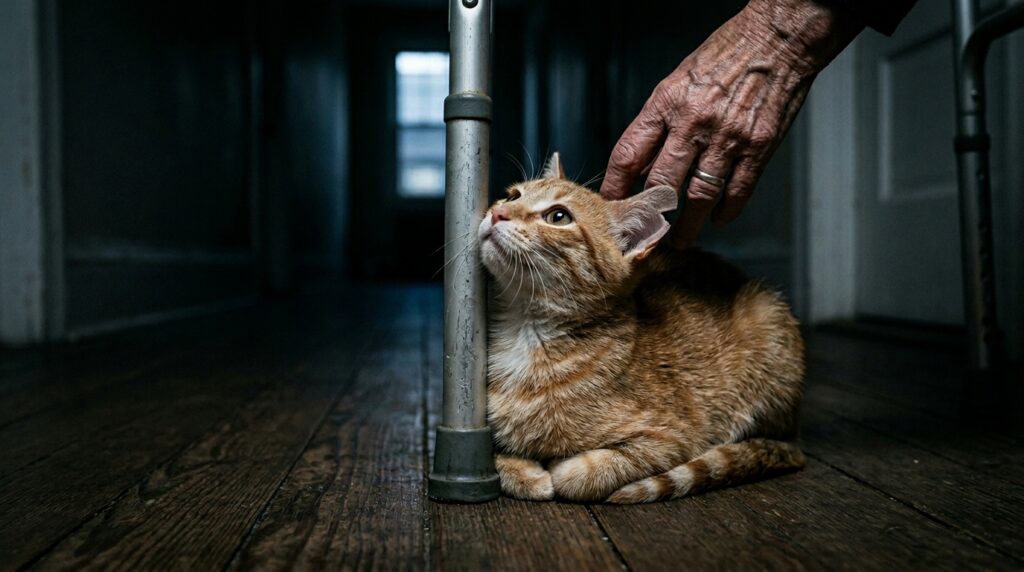
Lucky was not on the footrest today. He was tucked into the crook of her arm, his weight a steady, warm pressure against her ribs. He seemed to be vibrating with a purr so intense it felt like he was trying to stitch her back together from the outside in. Every time she shifted or let out a soft sigh of discomfort, his ears would swivel, and he would let out a tiny, questioning mrrp.
Sarah sat on the sofa opposite them, holding a mug of tea she’d insisted on making. She looked at Lucky, then at Marianne, her expression a mix of awe and lingering adrenaline.
“I keep thinking about it, Marianne,” Sarah said, her voice dropping to a whisper. “What would have happened if I hadn’t been walking Buster right then? If I’d decided to take the long way around the block?”
“I don’t like to think about it,” Marianne admitted, her hand trembling as she stroked Lucky’s ears. “I just thought he was scared. I thought he was just being… what the people on that website said. Clingy.”
Sarah shook her head slowly, setting her mug down on the coaster. “No. That wasn’t fear, Marianne. That was a mission. You didn’t see him from the outside. You didn’t hear what I heard.”
Lucky sensed the shift in Sarah’s voice—the sharp, staccato rhythm of a human telling an important story. He didn’t trust the stranger entirely, but he recognized the scent of the woman who had brought the “help” when his person was on the floor. He narrowed his eyes, leaning his chin more firmly against Marianne’s collarbone. To him, the house was finally safe again, but the perimeter had to be maintained. He wasn’t watching the door for himself; he was watching it for the heartbeat beneath his paws.
“I was halfway across the street,” Sarah continued, her eyes wide. “And I heard this sound. It wasn’t a normal cat meow. It was… it was a siren. It was rhythmic, loud, and it didn’t stop for breath. It sounded like he was trying to break through the glass with his voice.”
She leaned forward, her hands animated. “I looked up and saw him through the sidelight by your door. He wasn’t just crying. He was throwing his body against the wood, then running back into the hallway, then coming back to the door. He was pacing a path. He was literally showing me where you were before I even got inside.”
Marianne felt a lump form in her throat. She pictured the “problem” cat—the one rejected for being too needy—turning his greatest insecurity into a lifeline. “He didn’t hide?”
“Hide?” Sarah laughed, though there were tears in the corners of her eyes. “Marianne, he nearly tripped the EMTs because he wouldn’t get out of the way until they were kneeling right next to you. He was like a tiny, orange-and-white bodyguard. One of the medics told me he’d never seen anything like it. He said, ‘That cat isn’t anxious; he’s invested.'”
The word invested hung in the air, heavier and more beautiful than the word independent could ever be.
“The things they said online,” Marianne whispered, thinking of Gladys and the cruel comments. “They said his behavior was a defect. They said he was broken because he couldn’t stand to be alone.”
“Maybe he knew you shouldn’t be alone either,” Sarah said softly. “Maybe he wasn’t crying because he was weak. Maybe he was crying because he knew exactly what was at stake.”
Later that evening, after Sarah had gone and the house settled into its usual twilight, Marianne looked at the hallway rug. Sarah had moved it to the garage, leaving the floor bare and safe. The “danger” was gone, but the vulnerability remained.
Marianne looked down at Lucky, who was now groomed and sleek, his amber eyes reflecting the soft glow of the lamp. She realized that the “experts” were right about one thing: Lucky couldn’t handle being alone. But they were wrong about why. It wasn’t a flaw in his character; it was a choice of his heart.
She reached out and picked up her phone. She didn’t look at the comments. Instead, she began to type a message to the shelter, her fingers sure and steady. She had a reveal of her own to share, but as she began to write, a new thought struck her.
A shadow moved across the window—Gladys, walking her own dog, pausing to peer at the house. The world was still watching, still waiting for Marianne to fail. And as Lucky lifted his head, a low, protective growl vibrating in his throat, Marianne realized that the final battle wasn’t about the fall. It was about who got to decide what a “good life” looked like.