
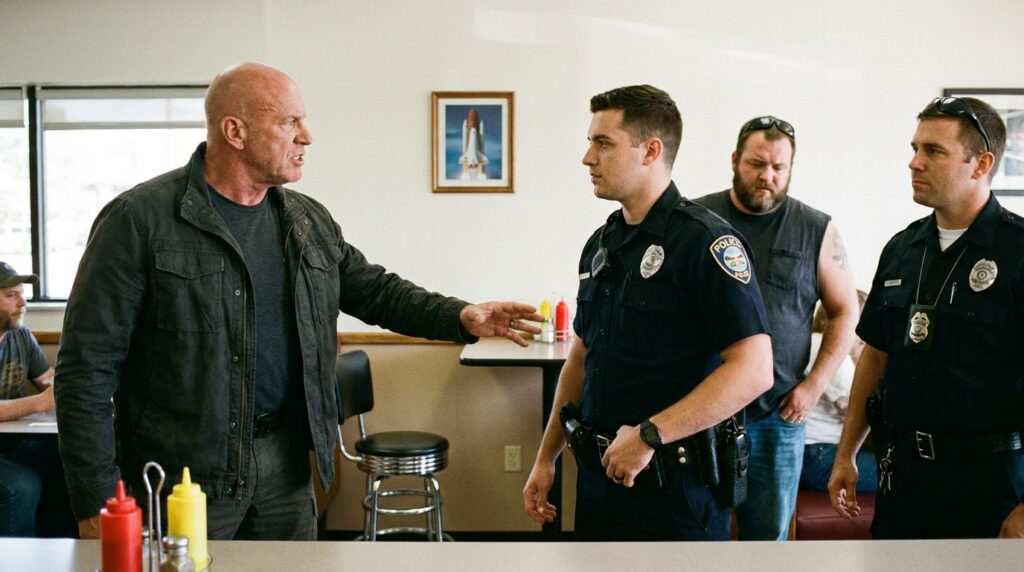
CHAPTER 3: THE WEIGHT OF THE RESTRAINT
The corridor walls were painted that standard federal seafoam green, but the salt air from the coast had blistered the plaster near the baseboards, leaving white, powdery trails of mineral rot that looked like dried bone. The young security officer didn’t look at the veteran. He kept his hand steady on the reinforced nylon handle of his baton, his boots squeaking rhythmically on the desaturated linoleum floor.
“Keep moving,” the officer said, his breath hitching slightly every time their shoulders neared the narrow, cold iron pipes of the fire suppression line. “Left at the bulkhead.”
The veteran didn’t answer. He adjusted his grip on the wet manila folder, his fingers tracing the disintegrating seam where the moisture had eaten through the cheap paper. The cold pine-scented floor stripper from the mess hall had begun to dry on his skin, leaving a stiff, irritating residue that felt like fine sand ground into his collar. He didn’t check his watch, but the internal cadence—the sixty-cycle hum of his blood that had kept him alive through seven non-permissive border crossings—told him they were moving away from the standard processing sectors. They were descending into the basement levels of the old administrative block, where the masonry was reinforced with iron plating from the late fifties.
The security officer pulled out an electronic log pad to clear the door locks, but when he swiped his credential, the screen flickered a dull, unformatted amber. The veteran’s eyes dipped to the glass interface. There was no base entry log. No routing number. The device was pulling raw encrypted telemetry directly from a non-standard subnet, bypass-coding the entire base provost marshal’s network.
“The order on that sheet,” the veteran said, his voice flat, matching the dull scrape of his boots on the concrete stairwell. “It didn’t come through the garrison clerk.”
“Shut up,” the officer snapped, though his fingers fumbled with the key override, his skin pale against the matte black composite of the lock casing. “You don’t ask questions about flag codes. You broke the perimeter restriction. That’s all the paperwork needs to say.”
A secondary guard, older, with the thick neck and broken nose of a career master-at-arms, stepped out from the shadows of the lower landing. He smelled of cold tobacco and the pungent, sulfurous grease used to clean heavy-caliber machine guns. He didn’t draw a weapon, but his eyes went straight to the veteran’s wrists, evaluating the distance between the civilian’s thumbs and the seams of his jeans.
“This the one from the dining facility?” the older guard asked, his voice a low, gravelly rasp that sounded like gravel shifting under a tank tread.
“The civilian who dropped Private Miller,” the young officer said, handing over the wet, red-stamped folder. “He’s carrying a level-four lockout order. Gate security missed the flag when he checked in at zero-six-hundred.”
The older guard took the paper, his rough thumb splitting the remaining fiber of the folder until the crimson-inked RESTRICTED block was fully visible under the yellow cage light of the stairwell. He didn’t look angry; he looked tired, his eyes narrowing as he read the specific paragraph code beneath the signature line. He reached out and tapped the edge of the sheet against the iron railing, leaving a small streak of red ink on the rusted metal.
“Miller is an idiot,” the older guard muttered, turning his back to lead them down a narrower corridor where the air grew heavy with the scent of damp wool and basement mold. “But this paper doesn’t exist in the local system. I ran the name when the gate alarm chimed. The terminal didn’t give me an infraction log. It just gave me a blank screen and a routing number for an annex in Alexandria.”
“It’s a DOD administrative bar,” the young officer insisted, his voice rising slightly, the thin bravado of his rank wearing thin against the heavy silence of the lower deck. “The signature is validated by the regional commander’s office.”
The veteran stopped walking. The young officer shoved his shoulder, but it was like pushing against an anchor chain; the veteran’s weight didn’t shift an inch. He turned his face slightly toward the older guard, his eyes shadowed by the brim of his olive cap.
“The private in the mess hall,” the veteran said, his words dropping into the space between them like heavy iron weights. “He had a non-standard brass clasp on his load-bearing vest. No serial number. Clean finish. That’s not garrison gear.”
The older guard paused, his hand on the heavy iron latch of the interrogation cell door. He looked at the veteran for three long seconds, his jaw tightening until the old scar across his chin turned white. He didn’t answer the question, but his fingers gripped the red-stamped paper a little harder, the wet paper tearing further under his callused palm.
“In the room,” the older guard said, gesturing toward the dark, unpainted concrete cubicle ahead. “The provost marshal’s investigator is already on his way down from the main terminal. He can look at your watch, he can look at your shirt, and he can decide if you’re a trespasser or a ghost. Move.”
The door groaned as it swung open, revealing a single steel table bolted to the deck and two matching chairs that showed the pitted, oxidized tracks of decades of salt-air corrosion. The veteran walked in, his wet clothes heavy against his skin, his mind already calculating the structural load of the iron hinges behind him.








