
CHAPTER 2: THE ANGLE OF THE COLLAR
“Get your hands where I can see them,” the private groaned from the floor. The cockiness was entirely gone, replaced by the thready, defensive wheeze of a man who had forgotten that concrete didn’t respect a starched camouflage collar. His boots kicked out blindly, scuffing against the rusted iron bases of the fixed dining stools, searching for leverage he had thrown away the moment he initiated the shove.
The veteran didn’t drop his hands into a fighting guard. He left them hanging loose at his hips, palms open, fingers curved slightly like old iron hooks. The dirty water from the bucket was already cooling against his chest, turning the gray fabric of his shirt into a stiff, salt-rimed shell that smelled of the base’s ancient boiler pipes.
“You’re down,” the veteran said, his voice flat, retaining the level cadence of an instructor monitoring a dull mechanical repetition. “Stay there until you understand where your weight went.”
Around them, the perimeter of the mess hall seemed to contract. The clatter of aluminum forks against divided trays had entirely ceased, replaced by the low, multi-layered rustle of two hundred bodies shifting simultaneously against vinyl cushions. A pair of junior corporals near the tray-return window slowly lowered their phones, their thumbs hovering over screens that were still recording the damp, grey stain spreading across the private’s starched chest. The illusion of the viral prank had cracked, leaving behind only the cold, unyielding reality of an unauthorized physical displacement on a secure installation.
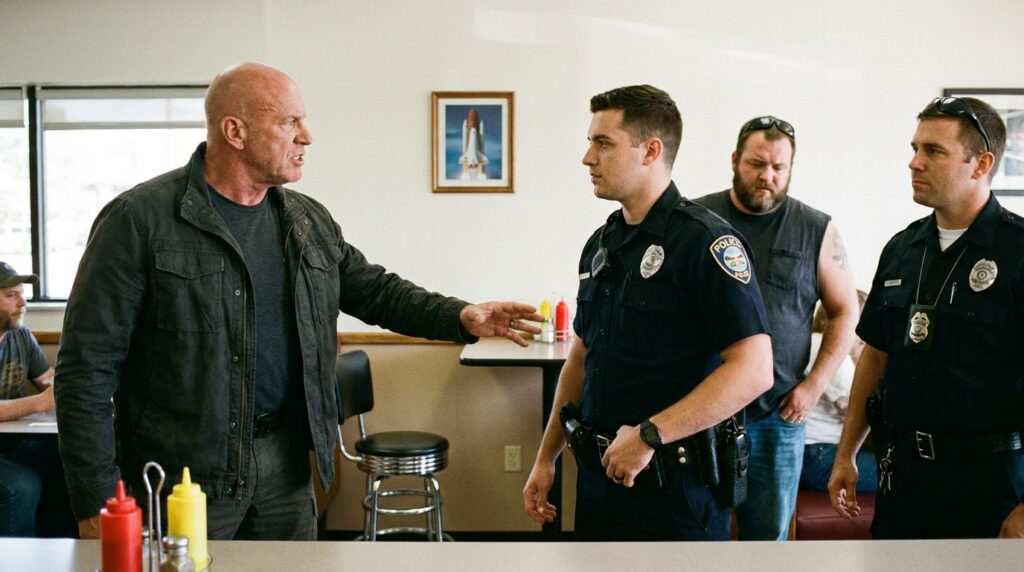
The veteran turned his back on the fallen soldier. It wasn’t a gesture of contempt; it was a calculated assessment of threat priority. The private on the deck was no longer a factor, but the three young men who had been holding the camera phones at the end of the table were already stepping into the gap between the benches. Their faces had hardened into that particular, aggressive brand of tribal defensiveness that occurs when a unit’s collective pride is punctured in front of outsiders.
“He’s a civilian,” one of them said, his fingers twitching toward the heavy nylon webbing of his empty utility belt. “Hey! You don’t lay hands on an active-duty soldier in this house. Who the hell authorized your gate pass?”
The veteran didn’t answer. He reached down toward the puddle on his Formica table, his thick fingers bypassing his dead smartphone to pick up the wet, manila folder that contained his transition documents. The water had already soaked through the cardboard, turning the corners into grey pulp. As he lifted it, the laminate cover peeled back, exposing the topmost sheet—a heavy, non-standard stock paper dominated by a violent, red-inked stamp that ran diagonally across his name.
The first word of the stamp was clear: RESTRICTED. But beneath it, the standard identification prefixes—the codes that usually designated an ordinary medical discharge or an administrative separation—were replaced by an irregular sequence of alphanumeric characters that ended in a double zero.
The corporal who had spoken stepped closer, his eyes dropping to the wet paper in the veteran’s hand. For a fraction of a second, his aggressive posture faltered, his gaze sticking to that irregular red seal. On a standard base, every clerk and gate guard knew the shapes of ordinary bureaucracy by heart. They knew the blue stamps of finance, the black ink of medical, and the green seals of logistics. They did not know this specific shade of red—the deep, iron-oxide hue that looked less like ink and more like dried blood on old machinery.
“That’s a lock-out notice,” the corporal muttered, his voice losing its confrontational edge, replaced by the narrow, suspicious focus of a guard who had just spotted an unlisted vehicle at the perimeter fence. “That’s a Department of Defense administrative exclusion. You’re barred from the installation.”
“The folder stays closed,” the veteran said, his hand flattening over the paper, his thumb covering the irregular double-zero prefix. The skin of his palm was rough, crosshatched with the small, pale lines of old rope burns and chemical blisters that didn’t match the clean, unblemished record of a standard administrative clerk.
The private on the floor was finally scrambling to his feet, his breath coming in ragged, humiliated gasps as he wiped the pine-scented floor water from his face. His right sleeve was dark and saturated where it had taken the brunt of the redirection, the fabric clinging to his forearm in a way that revealed the slight tremor in his muscles. He looked at his comrades, then at the veteran, his mouth twisting into a tight, defensive line as his pride struggled against the cold physical metric of the floor.
“He’s a fraud,” the private spat, his voice rising to carry across the silent rows of tables. “He’s got no rank. He’s got no unit patch. Look at him—he’s a trespasser trying to play tough because he picked up some defensive tactics at a strip-mall gym. Call the MP shack. Get this piece of garbage off our deck.”
The veteran didn’t look at the private. He looked past him, toward the heavy double doors at the rear of the dining facility. Through the wired safety glass of the portals, a pair of white-painted security vehicles had already pulled onto the gravel apron outside, their red and blue strobe lights casting long, desaturated pulses through the grease-filmed windows of the mess hall. The tires crunched against the dry gravel, a sound that the veteran’s ears registered three seconds before anyone else in the room shifted their gaze.
He picked up his olive-drab baseball cap from the bench, shaking the loose droplets from the brim before pulling it low over his eyes. The wet fabric was cold against his forehead, but his face remained entirely stationary, his mind already mapping the three corridors between the dining facility and the provost marshal’s office. He knew the weight of the handcuffs they would use; he knew the specific iron smell of the holding cells near the back gate. To him, it wasn’t a disaster—it was simply the next necessary friction in a sequence that had been set in motion the moment his retirement order had been stamped with the wrong ink.
“Keep your hands away from the folder,” the veteran murmured to the corporal who was still staring at the red stamp.
The heavy doors at the back of the room swung open with a sharp, metallic rattle, and the first pair of black-booted security personnel stepped into the grey light of the kitchen lane.








