
CHAPTER 8: THE PRICE OF STANDING STILL
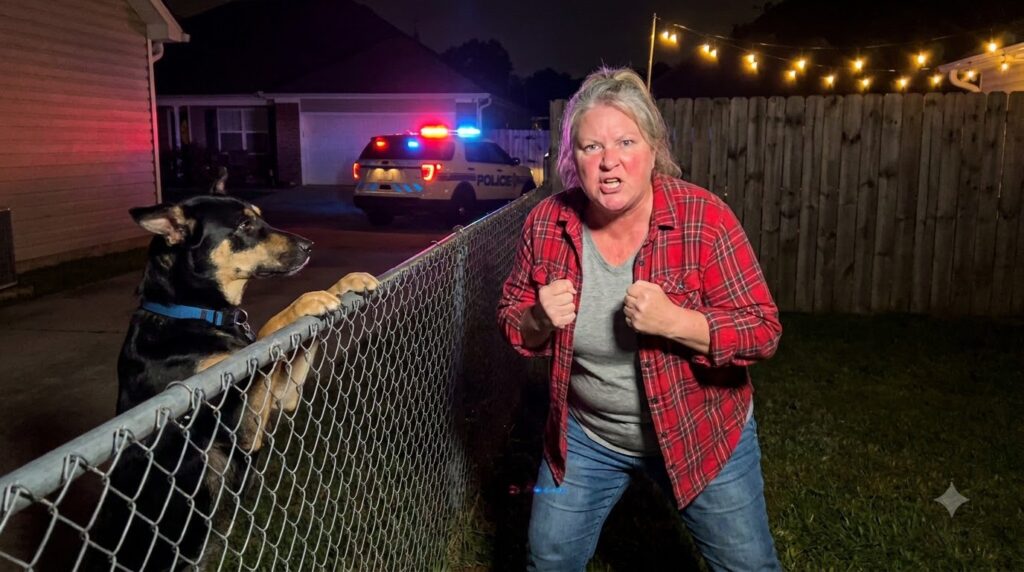
The siren stopped its mournful wail three streets over, replaced by the heavy, guttural rumble of a multi-ton county utility truck navigating the narrow turn into Oakridge Court. Orange amber strobes swept over the tree canopy, cutting through the red-and-blue pulse of Deputy Vance’s cruiser and painting the wet grass in blinding flashes of neon yellow.
Brenda didn’t move from the fence. Her knuckles remained white, locked around the cold zinc mesh like a prisoner holding the bars of a cell block. The red plaid overshirt hung loose off her shoulders, soaked at the cuffs where the dark, brackish silt from the ditch had splashed during her frantic retreat.
Two men in reflective orange vests jumped down from the high cab of the utility rig before the engine had even fully idled down. The lead technician, a burly man with graying stubble and a heavy brass sounder tucked under his belt, carried a long fiberglass probe and a heavy iron wrench. He didn’t ask questions. He didn’t look at me, and he barely glanced at Brenda. He looked at the ditch.
“Under Ordinance 402,” Vance told him, pointing a gloved finger down into the bubbling mud near the corner of Brenda’s shed. “Private line tapped into the old county easement.”
The technician knelt in the wet clover, the fiberglass rod sinking two feet into the silt until it struck something solid with a dull, hollow clack. He spat onto the grass and shook his head.
“Cast iron cleanout,” the man muttered, his voice gravelly from years of working civil drainage. “Seventy-fours or eighties vintage. Whoever ran this line bypassed the main sewer trunk when the county widened the road. It’s been weeping into this soil for twenty years, just waiting for somebody to knock the top cap loose.”
He reached down, applied the heavy iron wrench to the exposed stub, and gave it a sharp, calculated turn. Metal ground against rusted metal—a dry, screaming screech that made Buster tilt his head and whine softly behind my knee. With a heavy, sucking pop, the pressure released. The gurgling died down to a trickle, the stagnant water draining back into the subterranean channel below the culvert.
The technician stood up, wiping his muddy gloves on his canvas trousers. He looked at Vance, then turned his gaze to Brenda, who was staring blankly at the wet rut where her survey-stake battle had begun four hours ago.
“County Public Works will be out at eight in the morning with a backhoe, ma’am,” the technician said, his tone entirely professional, utterly devoid of sympathy or malice. “We’re going to have to trench ten feet along this line to cap it officially. That shed foundation is right in the right-of-way. It’ll have to come down.”
Brenda’s chest rose and fell in a slow, ragged shallow breath. “The shed?” she whispered. “My mother built that shed.”
“Your mother built it on county dirt,” Vance said quietly. He tucked his clipboard into his belt and stepped up beside her. “You’ve got until morning to clear out whatever you want to save from inside. After that, the site is under environmental containment.”
He didn’t hand her another ticket. He didn’t raise his voice. He simply held open the gate of her side yard, gesturing toward her porch. The authority she had tried to wield like a hammer had finally turned back on her, driven not by anger or revenge, but by the cold, indifferent mechanics of county civil law.
Brenda let go of the fence. Her fingers left ten pale ovals on the zinc mesh where her skin had been pressed tight against the cold metal. Without looking at me, without looking at the neighbors gathered under the streetlights, she turned and walked slowly up her wooden porch steps. The screen door opened with its familiar, whining spring, then clicked shut behind her with a quiet, final latch.
The neighbors slowly melted back into the shadows of their decks, the yellow lights winking out one by one until only the streetlamp at the corner remained.
Vance walked over to where I stood beside my garage. He looked down at the old, yellowed 1984 agreement still resting on my kitchen counter through the open door, then looked at the cold, straight line of the chain-link fence dividing our properties.
“The county will issue a formal easement boundary report by Friday, Arthur,” Vance said, his voice quiet against the idle of the utility truck. “They’ll reset the permanent iron monuments right where your surveyor put them. Nobody’s going to touch those stakes again.”
“Thanks, Deputy,” I said.
He gave a short nod, adjusted his belt, and walked back toward his cruiser. Within five minutes, the utility truck had backed out of the cul-de-sac, the orange strobes fading through the birch trees, leaving the night quiet again.
I knelt down in the damp grass and unhooked Buster’s leash, letting the heavy nylon strap slip into my pocket. The dog rubbed his snout against my knee, his dark eyes watching the fence line where the wet mud was already beginning to settle under the cool night air.
I walked over to the chain link and rested my hand against the top rail. The steel was cold, zinc-coated, unyielding. It didn’t care about thirty-year-old grievances, or rusted tackle boxes, or hand-drawn promises written on parchment that had expired before I was born. It just held the line.
I turned back toward my house, leaving the backyard in the dark, the quiet, unbroken boundary standing firm between two plots of land under the night sky.








