
CHAPTER 4: THE SHADOW OF THE SLEDGE
The red taillights dissolved into the blackness at the cul-de-sac’s mouth, but the smell of diesel remained, trapped beneath the damp ceiling of the oak canopy. I stood on the gravel driveway, my boots rooted to the crushed limestone while my mind ran over Deputy Vance’s words like a thumb over a jagged iron seam.
A.R.H.
My grandfather had died in a hospital bed in the spring of ninety-eight, leaving me this four-room cedar box, thirty years of unpaid property taxes, and a workbench stacked with tin cans of bent nails. He was a man who measured his life in six-inch increments of poured concrete and three-foot fence posts. He didn’t leave junk behind, and he certainly didn’t give gifts to the neighbors.
Beside my knee, Buster let out a soft whine, his nose twitching toward the sagging corner of Brenda’s tool shed.
“Stay,” I whispered again, though the dog didn’t move.
I didn’t head back toward the kitchen or the warmth of the back porch. Instead, I turned toward my garage. The side door creaked as I pushed it open, the smell of two-stroke oil, dry sawdust, and old battery acid rising up to meet me in the dark. I didn’t flip the overhead fluorescents; I didn’t want a beam of light cutting across the driveway to tell Brenda I was still awake.
I reached into the dark behind the heavy oak workbench where my grandfather’s hand tools lived. My fingers found the cold, square steel head of his ten-pound sledge, its hickory handle worn smooth and dark from forty years of palm sweat. Right above the rack, behind a loose slat of pine siding that had rattled every time the wind blew since I was ten, my index finger caught on something small and hard tucked into the gap.
I pulled it out.
It was a small, flat brass cabinet key, dark with verdigris and tarnished green at the teeth. Stamped into the square bow was a single four-digit number: 1984.
My thumb dragged across the raised brass numerals. Nineteen eighty-four. The exact year Brenda claimed her mother had planted hydrangeas along the fence line. The same year the county had widened Oakridge Court from a dirt utility trail into a two-lane paved strip.
I slipped the brass key into my pocket beside the warm glass of my phone, picked up a heavy tactical flashlight from the charging cradle, and stepped back out into the night air.
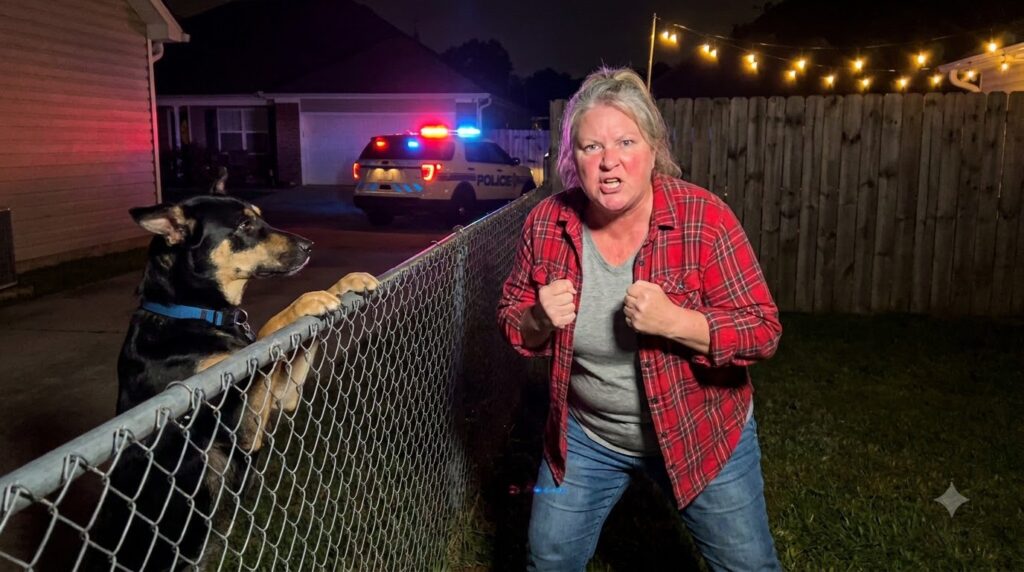
The grass along the easement was cold enough to soak through the leather toes of my boots in three strides. I kept the flashlight off, relying on the pale yellow bleed from my patio string lights to illuminate the zinc mesh of the chain link. Every step was deliberate, silent.
I reached the corner of Brenda’s shed. The tin roof overhung the property line by four inches, its rusted drip-edge shedding heavy drops of condensation onto the rotted pine pallets below.
I snapped the flashlight beam on, keeping it low, shielding the lens with my left palm so only a narrow bar of white light cut through the gap between the shed wall and the fence.
There it was.
Sitting on two waterlogged three-by-fours, half-choked by wild blackberry vines, was a heavy steel Sears Craftsman tackle box. The original forest-green enamel was blistered and flaking away in large, dry scales, exposing dark orange iron rot underneath. But on the top lid, painted in thick, white lead lettering that had yellowed like an old tooth, were three block initials: A.R.H.
Through the narrow slit between the shed’s vertical siding, I heard the faint, rhythmic creak of a floorboard inside Brenda’s house. She was up. She was moving behind her kitchen curtain, less than twenty feet away.
I didn’t care. I leaned over the top rail of the chain link, extending my arm until my fingers brushed the cold, pitted lid of the box.
The brass padlock hanging from the front latch was a monster—a two-inch Yale tumbler covered in a heavy crust of white zinc corrosion. But Vance was right: the shackle was bright and silver where someone had recently attacked it with a wire brush or a triangular file, trying to scrub away forty years of rust.
I took the small brass key from my pocket. My knuckles scraped against the wet tin of Brenda’s shed wall as I aligned the key with the padlock’s keyway.
It shouldn’t have fit. A cabinet key shouldn’t open a heavy exterior padlock. But as I pressed the bit into the rusted keyway, it slid in with a smooth, greasy snap. The internal springs weren’t seized at all; someone had oiled them recently.
I twisted my wrist.
CLACK.
The heavy shackle popped open with the sharp, mechanical strike of a deadbolt sliding home.
I froze, my heart pounding a hard, heavy rhythm against my ribs. Inside the house, the floorboard creaked again, followed by the metallic click of a porch light switch.
I didn’t hesitate. I reached over the fence, popped the steel catch, and lifted the hinged lid of the green box.
There were no fishing lures inside. No lead sinkers or rotted monofilament.
Resting in the top plastic tray was a thick, leather-bound county ledger book, its cover warped by moisture, alongside a folded sheet of heavy yellow parchment paper bearing an official red wax seal dated August 12, 1984.
I grabbed the folded parchment, the dry paper crackling under my calloused thumb like dry leaves, and shoved the heavy iron padlock back into its latch to hide the open shackle.
The yellow porch light above Brenda’s back door snapped on, bathing the shed and the chain-link fence in a harsh, mustard-colored glare.
“Who’s out there?” Brenda’s voice sliced through the dark, sharp and trembling with a volatile mixture of fear and rage. The screen door whined on its spring as she stepped onto the top deck board, holding a heavy wooden broom like a club. “I see you by my shed! I’ve got the deputy on speed dial, you trespassing bastard!”
I stepped back out of the light, slipping the folded parchment inside my canvas jacket, my hand resting flat against the hard, cold shape of the document against my chest.
“Go back inside, Brenda,” I said, my voice echoing off the tin roof of the shed. “You’re going to need your rest for court.”








