
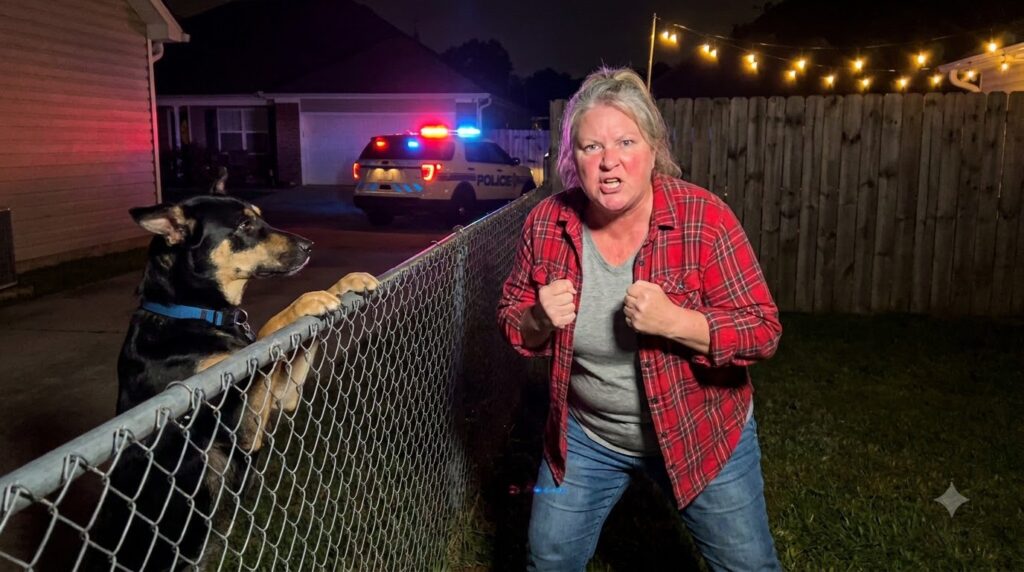
CHAPTER 6: THE COPPER VENT IN THE DITCH
“Put the iron down, Brenda.”
Deputy Vance’s voice didn’t come from the driveway this time. It came from five feet behind her, low and clipped, cutting through the damp night air like a cold blade. He stood at the edge of my porch steps, his heavy flashlight beam pinning Brenda’s red plaid back against the doorframe.
The crowbar trembled in her grip, the forged steel tip hovering an inch from my glass windowpane. For three seconds, nobody breathed. The only sound was the wet, ragged rattle in Brenda’s chest as she stared through the glass at the yellowed parchment resting beneath my palm on the Formica counter.
“I said put it down,” Vance repeated. The leather snap of his holster clicked open in the quiet.
Slowly, her shoulders sagging under the heavy beam of light, Brenda lowered the crowbar. It hit the wooden deck boards with a dull, hollow thud, rolling twice before coming to rest against my boot mat.
“He stole it, Vance,” she choked out, turning her face away from the glare, her hands clawing at the pockets of her jeans. “He broke into my mother’s box behind the shed. He took the paper.”
“I didn’t break anything, Deputy,” I said, pushing the back door open three inches, keeping my body wedged in the frame. “The key was in my grandfather’s shop. The box was on the property line. And this paper isn’t what she thinks it is.”
Vance stepped up onto the porch, his boots heavy on the wet pine. He didn’t look angry; he looked exhausted, his eyes bloodshot under the brim of his campaign hat. He looked at the crowbar on the floor, then reached out his gloved hand.
“Let me see it, Arthur.”
I handed the crackling parchment through the door. Vance unfolded it under his flashlight, his thumb tracing the faded blue fountain-pen lines, then stopping dead on the red typewriter stamp at the bottom margin: ORDINANCE 402.
“Where did you get this?” Vance asked, his eyes flicking up to Brenda.
“My mother kept it!” she cried, taking a step forward, her hands clenched into tight, white-knuckle balls. “It’s a legal agreement! Three hundred dollars! He sold her that three-foot strip!”
“Your mother bought a piece of paper from a man who didn’t own the dirt anymore, Brenda,” Vance said softly. He pulled a rolled blue blueprint from under his arm—the county engineering map he’d gone back to his cruiser to pull from the trunk. He spread it out over the wooden porch railing right next to her. “Look at the date.”
Brenda blinked, her flushed face turning pale under the yellow porch light as she stared at the blue grid lines.
“August twelfth, nineteen eighty-four,” Vance said, his glove pointing to the bottom corner of the county record. “Fourteen days before this agreement was signed, the county board executed a mandatory eminent domain taking along the entire south side of Oakridge Court for Ordinance 402. They widened the road easement by six feet to put in the regional storm culvert.”
He looked from Brenda to me, his voice dropping into a flat, unyielding register.
“Your grandfather didn’t own that three-foot strip when he signed her mother’s paper, Arthur. The county took it two weeks earlier. And when they widened the road, they shifted the entire civil utility corridor four feet north—right under that chain-link fence.”
The air on the porch seemed to freeze. Brenda’s mouth opened, her eyes darting frantically across the technical symbols on the blueprint. “What… what does that mean?”
“It means neither of you owns that three-foot strip,” Vance said, turning his head toward the dark gap between our houses where the smell of damp earth was suddenly overwhelmed by a sharp, sour stench rising from the drainage ditch. “And it means when you pulled those survey stakes this afternoon, Brenda, you weren’t just messing with Arthur’s property line. You knocked the cap off a buried forty-year-old county septic relief pipe.”
A low, gurgling hiss echoed from the dark ditch beside the shed—a sound like water bubbling through a choked pipe, followed by the undeniable, rotten-egg tang of ancient, backed-up waste seeping into the wet grass.
Brenda backed away from the railing, her hand coming up to cover her nose, her eyes wide with a new, terrifying realization. The paper in her mother’s box hadn’t preserved her land; it had buried a civil disaster right under her feet for four decades.








