
The Iron In The Earth And The Price Of Standing Still On A Three Foot Strip

CHAPTER 1: THE IRON IN THE DAMP

“You keep pushing me, and I am calling the police right now!”

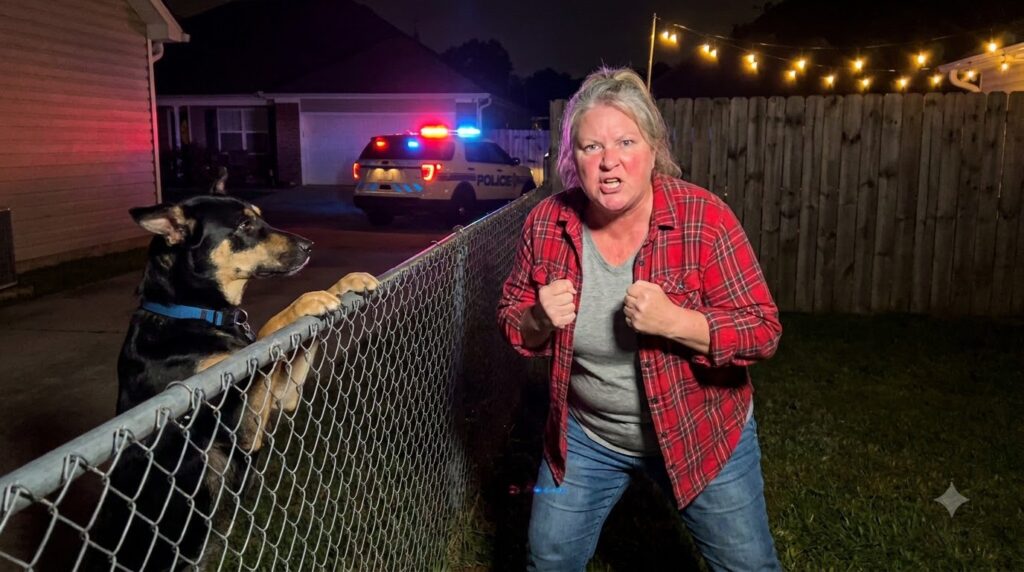
Brenda’s voice didn’t just carry across the waist-high chain link; it scraped against the humid July air like a rusted shovel dragging over concrete. She stood squared into the beam of my patio floodlight, her stocky frame locked in a fighting stance, fists balled at the hem of her red plaid overshirt. Her round face was flushed the deep, bruised color of a winter turnip, blonde-gray hair slipping from a tight ponytail as she leaned her chest within six inches of the steel top rail.

I didn’t answer. I didn’t shift my feet in the wet grass. I just kept the smartphone held steady at chest height, the screen glowing hot against my knuckles as the lens locked onto her twitching jawline.

Beside my left knee, eighty pounds of black-and-tan muscle shifted weight. Buster didn’t growl. He didn’t bare teeth. He just stepped into the gap, planted his front paws high on the zinc mesh, and let his weight bow the fence. The chain link groaned—a dry, metallic rattle that echoed off the wooden privacy fence lining the rear property line.

“Get that animal off my fence!” Brenda barked, her hand snapping forward, index finger hovering an inch from Buster’s wet nose. “He’s aggressive! He’s an unlicensed hazard and you’ve got him on land that isn’t even yours!”

“It’s not your fence, Brenda,” I said. My voice sounded flat, stripped of friction by three months of the same speech. “And he’s on my side of the iron.”

“Your side?” A sharp, ragged laugh burst from her throat. She gestured wildly toward the dark strip of crabgrass between us—a three-foot swath where fresh yellow survey flags had been pinned into the mud four hours ago. Now, only shallow square holes remained, filled with murky groundwater. “This is easement! My mother planted hydrangeas on this line in ninety-two before you ever bought this mortgage from the bank! You think you can put wooden sticks in my dirt and tell me where I walk?”

She pumped her fists against her ribs, her body vibrating with the strange, intoxicated energy of someone who believed the universe ran on sheer volume. She didn’t know about the greasy thumb-drive sitting in the pocket of my canvas work pants. She didn’t know about the 4K lens mounted under the eaves of my garage that had recorded her at 2:15 PM, bent double in her red plaid shirt, using a pair of heavy bypass loppers to snip the surveyor’s orange ribbons before kicking the wooden stakes into the drainage ditch.

“You’ve got five seconds to turn that camera off and get that hound inside,” she sneered, stepping closer until the fabric of her jeans brushed the mesh. “Or I swear to God, I’m calling the sheriff’s office and having them haul that dog to county control.”

I didn’t blink. Over the crown of her head, past the dark outline of her tool shed, a sudden pulse of crimson washed across the white siding of her garage. Then blue. A slow, heavy strobe that cut through the humid dark, catching the hanging string lights above my patio and turning the dew-soaked grass into a grid of fire and ice.

Brenda froze, the shadow of the fence bars whipping across her face as the red-and-blue lights strobe-flashed through the birch trees in her driveway. A low, idling rumble echoed from the gravel curb—the distinct, heavy diesel thrum of a Ford Police Interceptor.

A triumphant, ugly grin split her flushed face. She spun toward the driveway, then whipped back to my lens, pointing a shaking finger toward the front yard.

“They are already here!” she shouted, her voice rising into a sharp, mocking crescendo. “They’re already here, you hear me? So explain yourself when they come over! Go ahead—tell them what happened to my property line!”

I lowered the phone half an inch, my thumb resting on the cold glass. Through the gap between our houses, a heavy flashlight beam flickered against the damp fence posts, illuminating a dark blue uniform sleeve and a silver badge pinned to a high-visibility strap.

Deputy Vance wasn’t walking toward her front porch. He was walking straight down the side easement toward the back yard, and in his left hand, he wasn’t holding a citation book—he was carrying a bundle of snapped, mud-stained wooden survey stakes.


CHAPTER 2: THE EVIDENCE ON THE SCREEN

“They aren’t here for my dog, Brenda.”

My voice barely carried over the steady idling thrum of the Ford Interceptor parked in the gravel turn-around. Brenda didn’t hear me—or if she did, the sound was swallowed by her own ragged laughter as she turned her back on the fence, waving both arms in dramatic, sweeping arcs to flag down the officer cutting through the shadow of the birch trees.

“Over here, Deputy!” she yelled, her voice pitching up into a raspy screech that made Buster shift his front paws, his claws clicking hard against the steel chain link. “Right back here! I’ve got the owner on camera right now refusing to restrain his animal on my property line!”

Deputy Vance didn’t rush. He moved with the slow, heavy cadence of a man who spent eight hours a day dragging two hundred pounds of duty belt through civil disputes. His flashlight beam didn’t sweep the yard in an aggressive arc; it stayed low, pinning the dark, muddy depressions where my yellow survey stakes had rested four hours ago.

“Evening, Brenda,” Vance said. His voice was a dry gravel-crunch. He stopped two feet short of her shoulder, his left hand holding a thick, fiber-board clipboard against his chest, while his right rested naturally over the leather snap of his holster. “Mind stepping back from the fence line for a second?”

“Stepping back?” Brenda’s shoulders hitched high inside her plaid overshirt. She spun around, her round face flushed nearly purple under the harsh white spill of my patio floodlight. “Vance, I called your dispatch three times yesterday about this fence! He’s got an illegal Shepherd mix leaning over my easement, and he put wooden stakes in my turf this afternoon! I want a citation issued right now!”

Vance didn’t look at her. He looked past her, his eyes locking onto mine over the top rail of the fence. He gave me a single, clipped nod. “Evening, Arthur.”

“Deputy,” I said, lowering the smartphone to my side but keeping the screen active. The battery heat was soaking through my palm, warm and damp. “Thanks for coming around back.”

“Hold on—hold on just a minute!” Brenda’s voice cracked as she wedged herself between Vance and the mesh, her hands coming up to her hips. “You know him? Why are you thanking him? I’m the complainant here! I’m the one who called in the code violation!”

“You called in a barking dog complaint at seven-forty, Brenda,” Vance said, his tone entirely flat. He lifted the clipboard, unclipping a small, clear plastic bag that held three splinters of orange-painted pine. “Problem is, my log shows a priority call logged at four-fifteen this afternoon from this address. Criminal mischief and destruction of marked county survey property.”

Brenda’s mouth stayed open, but the sound cut out completely. For two seconds, the only noise in the yard was the rhythmic clack-clack-clack of my string lights swinging in the night breeze and the heavy, wet panting of Buster beside my leg.

“What… what are you talking about?” she stammered, her hands dropping off her hips to clutch at the hem of her gray T-shirt. “Those sticks were on my land. That’s my dirt!”

“It’s county-certified private property, ma’am,” Vance replied calmly. He reached into his breast pocket, pulled out a small, greasy tablet with a cracked screen, and tapped the glass twice. A sharp yellow timestamp flickered to life on the screen: 14:15:22 PM. “Arthur here has a four-camera wired array hooked to an off-site cloud server. The angle from his garage eave is clean. High-definition. Caught the red plaid overshirt, the hair tie, and a pair of Fiskars bypass loppers coming across the line.”

Brenda froze. The red and blue emergency lights from the patrol SUV continued to sweep across her back, painting the faded plaid of her shirt in alternating shades of dark crimson and bruised navy. Her eyes darted from the deputy’s tablet down to my hand, where the phone screen was still recording her face.

“That’s… that’s an invasion of privacy!” her voice dropped an octave, rising into a desperate, defensive snarl. “He’s filming my yard! He’s been spying on me for months! That tape doesn’t prove anything—my mother planted the hydrangeas along that line in eighty-four! We have an agreement! A legal agreement!”

“If you have a recorded deed or an easement variance, Brenda, you can show it to the magistrate,” Vance said, pulling a yellow carbon-copy pad from his back pocket. “But right now, the county surveyor’s stamp from this morning says the chain-link fence sits two inches inside Arthur’s boundary. Which means those stakes were on his dirt. And cutting them is a Class 2 misdemeanor.”

Behind her, down the length of the cul-de-sac, the yellow deck lights on the Miller house clicked on. Then the porch light at the Henderson place. Dark silhouettes began to emerge onto the raised wooden decks, watching the blue strobe reflect off the damp grass. Brenda saw them. Her head snapped left, then right, taking in the silent audience gathering in the dark.

“This is a setup,” she whispered, her fists trembling as she backed away from the fence, her heels catching in the muddy rut where she had kicked the survey flags earlier. “You two planned this. You waited until dark just to humiliate me in front of the street!”

“Nobody set a trap, Brenda,” I said softly, stepping closer to the fence until my boots pressed against the zinc mesh. “You just spent three months convinced the law was whatever you shouted loudest. The iron was always here. You just refused to look down.”

Vance clicked his pen—a sharp, mechanical sound that cut through the humid air like a trigger reset. “I need you to step over to the driveway, Brenda. We’re going to write up the summons, and then we’re going to talk about the restitution for the surveyor’s fee.”

Brenda stood pinned between the deputy, the flashing lights, and the cold steel rail of the fence. Her lips moved, trying to form another threat, another reference to her mother’s hydrangeas, but no sound came out. The false authority that had held the boundary line hostage for three months collapsed into a hollow, shivering silence.

Vance gestured toward the driveway, his arm an unyielding barrier. “Let’s walk, ma’am. Now.”

As she turned and stumbled over the uneven turf toward the patrol truck, her shoulders hunched against the flashing strobe, I leaned down and rested my hand on Buster’s head. The dog let out a single, long exhale, his ears flattening as he watched her go. The boundary line was clear. The paper trail was stamped. But as Brenda reached the corner of her garage, she paused, looking back through the red light with a dark, hollow stare that promised this war wasn’t finished—it had only changed venues.

CHAPTER 3: THE DUST ON THE DRIVEWAY

The red and blue strobes died with a faint, metallic click of a dashboard switch, plunging the driveway back into the heavy, oil-scented gloom of the gravel turn-around. Without the flashing lights masking the dark, the exhaust from Deputy Vance’s Interceptor hung low over the damp crushed stone, smelling sharply of unburnt diesel and wet earth.

I didn’t move from my side of the fence until the driver’s side door slammed shut, the heavy latch ringing once across the silent cul-de-sac. Across the street, the yellow deck lights on the Miller house flickered off one by one. The neighbors had seen their show; the authority had spoken, the citation pad had been flipped open, and as far as the street was concerned, the boundary war of Oakridge Court was settled over a carbon-copy slip of paper.

They didn’t know about the grit grinding inside my boots. They didn’t know about the cold, hollow weight that sits in your stomach when a three-month siege ends not with a clean break, but with a written summons to a county court building twenty miles away.

“Stay,” I muttered to Buster, unhooking his collar strap just enough to let him drop from the chain link. The dog landed softly in the wet clover, his tail giving a single, cautious thump against my shin before he turned his head to track the red taillights idling at the curb.

I unlatched the small pedestrian gate near the rear of my garage. The rusted iron hinges groaned—a high, dry screech that made the skin on the back of my neck prickle—and stepped out onto the shared driveway strip. The crushed limestone was cool through my soles, dotted with dark puddle rings where Brenda’s leaking lawn tractor had sat all afternoon.

Fifty feet down the incline, Vance stood beside his open driver’s door, writing notes across his clipboard with a heavy brass pen. Brenda stood on the bottom step of her side porch under the yellow glow of a bug light. Her hands were jammed deep into the pockets of her red plaid overshirt, her chin tucked tight against her chest as Vance handed her a narrow yellow slip of paper.

She didn’t take it at first. She let it hover in the air between them, her jaw locked so tight the muscle beneath her cheekbone twitched under the yellow light. When she finally yanked it from his fingers, the paper tore slightly along the perforated top edge.

“Court date is on the bottom, Brenda,” Vance said, his voice carrying clearly down the gravel lane. “Eighth of next month. You bring whatever documentation you think you’ve got, but leave the loppers at home.”

She didn’t answer. She turned on her heel, her sneakers dragging over the wooden step, and slammed her screen door shut with a sharp, rattling crack that echoed off the metal sides of her tool shed.

Vance watched the door frame settle, then turned his head toward the dark where I stood beside the garage corner. He didn’t smile. He adjusted his belt, the leather gear creaking under his weight, and walked up the incline until his boots stopped two feet from mine.

“She’s not going to pay the surveyor fee quietly, Arthur,” Vance said, leaning his shoulder against the side panel of his patrol truck. He pulled a pack of peppermint gum from his shirt pocket, folded a stick into his mouth, and tucked the foil wrapper back into his seam. “She thinks she’s defending a holy relic.”

“She destroyed county-certified markers, Deputy,” I said, my thumb tracing the rough, unpolished edge of the phone still clutched in my pocket. “I’ve got eighteen hundred dollars in survey invoices sitting on my kitchen counter. I’m not paying for a second crew to come out here and reset those wooden stakes.”

“I know,” Vance said softly. He looked down at the gravel between his boots, using the toe of his work shoe to kick a loose piece of slag into the ditch. “And the citation stands. The video you gave me goes into the case file tonight. But you need to know something before you go filing for a civil injunction tomorrow morning.”

I narrowed my eyes, the cold night air stinging the back of my throat. “What are you talking about?”

Vance reached out with his flashlight, not turning on the main beam, but using the heavy aluminum barrel to point toward the shadow of Brenda’s tool shed—a sagging, tin-roofed structure sitting less than four feet from the chain-link boundary.

“When I was waiting on dispatch to run her ID, I walked the rear line,” Vance said quietly. “Beside her shed foundation, sitting on a couple of rotted pine pallets, there’s a heavy green metal tackle box. Old Sears craftsman model, locked with a brass padlock so rusted the tumbler is swollen shut.”

I frowned. “She’s got junk all over her yard, Vance. That’s not news.”

“It’s not junk, Arthur,” Vance replied, his tone shifting into something heavier, stripped of the dry official cadence he’d used at the fence line. “The lock has fresh scratch marks on the shackle. Like someone’s been taking a wire brush to it for three days trying to get it open. And painted on the side of that box, under fifty years of grease and rust, are your grandfather’s initials. A.R.H.”

The air in my chest turned cold. Arthur Richard Hayes. My grandfather had built the original cabin on this lot in 1962, thirty years before the subdivision was platted and the chain-link fence was poured into concrete footings.

“Why would she have his tackle box?” I asked, my voice dropping an octave.

“I don’t know,” Vance said, pushing himself off the truck and reaching for his door handle. “Maybe it’s just old scrap. Maybe her mother bought it at a yard sale in ninety-four. But Brenda kept staring at that shed corner the whole time I was writing the ticket. She wasn’t worried about the court date, Arthur. She was watching that box.”

He slid into the driver’s seat, the heavy door closing between us before I could ask another question. The engine roared to life, the dual tailpipes blowing a cloud of gray condensation over the wet gravel as the Interceptor backed out onto Oakridge Court, leaving me alone in the dark with the smell of exhaust and the faint, rhythmic rattle of Brenda’s screen door vibrating in the night wind.

CHAPTER 4: THE SHADOW OF THE SLEDGE

The red taillights dissolved into the blackness at the cul-de-sac’s mouth, but the smell of diesel remained, trapped beneath the damp ceiling of the oak canopy. I stood on the gravel driveway, my boots rooted to the crushed limestone while my mind ran over Deputy Vance’s words like a thumb over a jagged iron seam.

A.R.H.

My grandfather had died in a hospital bed in the spring of ninety-eight, leaving me this four-room cedar box, thirty years of unpaid property taxes, and a workbench stacked with tin cans of bent nails. He was a man who measured his life in six-inch increments of poured concrete and three-foot fence posts. He didn’t leave junk behind, and he certainly didn’t give gifts to the neighbors.

Beside my knee, Buster let out a soft whine, his nose twitching toward the sagging corner of Brenda’s tool shed.

“Stay,” I whispered again, though the dog didn’t move.

I didn’t head back toward the kitchen or the warmth of the back porch. Instead, I turned toward my garage. The side door creaked as I pushed it open, the smell of two-stroke oil, dry sawdust, and old battery acid rising up to meet me in the dark. I didn’t flip the overhead fluorescents; I didn’t want a beam of light cutting across the driveway to tell Brenda I was still awake.

I reached into the dark behind the heavy oak workbench where my grandfather’s hand tools lived. My fingers found the cold, square steel head of his ten-pound sledge, its hickory handle worn smooth and dark from forty years of palm sweat. Right above the rack, behind a loose slat of pine siding that had rattled every time the wind blew since I was ten, my index finger caught on something small and hard tucked into the gap.

I pulled it out.

It was a small, flat brass cabinet key, dark with verdigris and tarnished green at the teeth. Stamped into the square bow was a single four-digit number: 1984.

My thumb dragged across the raised brass numerals. Nineteen eighty-four. The exact year Brenda claimed her mother had planted hydrangeas along the fence line. The same year the county had widened Oakridge Court from a dirt utility trail into a two-lane paved strip.

I slipped the brass key into my pocket beside the warm glass of my phone, picked up a heavy tactical flashlight from the charging cradle, and stepped back out into the night air.

The grass along the easement was cold enough to soak through the leather toes of my boots in three strides. I kept the flashlight off, relying on the pale yellow bleed from my patio string lights to illuminate the zinc mesh of the chain link. Every step was deliberate, silent.

I reached the corner of Brenda’s shed. The tin roof overhung the property line by four inches, its rusted drip-edge shedding heavy drops of condensation onto the rotted pine pallets below.

I snapped the flashlight beam on, keeping it low, shielding the lens with my left palm so only a narrow bar of white light cut through the gap between the shed wall and the fence.

There it was.

Sitting on two waterlogged three-by-fours, half-choked by wild blackberry vines, was a heavy steel Sears Craftsman tackle box. The original forest-green enamel was blistered and flaking away in large, dry scales, exposing dark orange iron rot underneath. But on the top lid, painted in thick, white lead lettering that had yellowed like an old tooth, were three block initials: A.R.H.

Through the narrow slit between the shed’s vertical siding, I heard the faint, rhythmic creak of a floorboard inside Brenda’s house. She was up. She was moving behind her kitchen curtain, less than twenty feet away.

I didn’t care. I leaned over the top rail of the chain link, extending my arm until my fingers brushed the cold, pitted lid of the box.

The brass padlock hanging from the front latch was a monster—a two-inch Yale tumbler covered in a heavy crust of white zinc corrosion. But Vance was right: the shackle was bright and silver where someone had recently attacked it with a wire brush or a triangular file, trying to scrub away forty years of rust.

I took the small brass key from my pocket. My knuckles scraped against the wet tin of Brenda’s shed wall as I aligned the key with the padlock’s keyway.

It shouldn’t have fit. A cabinet key shouldn’t open a heavy exterior padlock. But as I pressed the bit into the rusted keyway, it slid in with a smooth, greasy snap. The internal springs weren’t seized at all; someone had oiled them recently.

I twisted my wrist.

CLACK.

The heavy shackle popped open with the sharp, mechanical strike of a deadbolt sliding home.

I froze, my heart pounding a hard, heavy rhythm against my ribs. Inside the house, the floorboard creaked again, followed by the metallic click of a porch light switch.

I didn’t hesitate. I reached over the fence, popped the steel catch, and lifted the hinged lid of the green box.

There were no fishing lures inside. No lead sinkers or rotted monofilament.

Resting in the top plastic tray was a thick, leather-bound county ledger book, its cover warped by moisture, alongside a folded sheet of heavy yellow parchment paper bearing an official red wax seal dated August 12, 1984.

I grabbed the folded parchment, the dry paper crackling under my calloused thumb like dry leaves, and shoved the heavy iron padlock back into its latch to hide the open shackle.

The yellow porch light above Brenda’s back door snapped on, bathing the shed and the chain-link fence in a harsh, mustard-colored glare.

“Who’s out there?” Brenda’s voice sliced through the dark, sharp and trembling with a volatile mixture of fear and rage. The screen door whined on its spring as she stepped onto the top deck board, holding a heavy wooden broom like a club. “I see you by my shed! I’ve got the deputy on speed dial, you trespassing bastard!”

I stepped back out of the light, slipping the folded parchment inside my canvas jacket, my hand resting flat against the hard, cold shape of the document against my chest.

“Go back inside, Brenda,” I said, my voice echoing off the tin roof of the shed. “You’re going to need your rest for court.”

CHAPTER 5: THE DEED IN THE DUST

The heavy kitchen screen door slammed shut behind me, the spring whining as it pulled the frame flush against the oak casing. Outside, Brenda was still screaming, her voice muffled through the glass panes as she cursed into the humid darkness, her broom handle clattering rhythmically against the corrugated tin of her shed.

I didn’t turn on the overhead lights. I walked straight to the kitchen table, where the yellow glow from the stove hood illuminated the cold Formica countertop. My fingers were stiff, dark with iron rust and green verdigris from the Sears tackle box lid.

I pulled the folded parchment from inside my canvas jacket. The paper was heavy, brittle at the creases, smelling faintly of dried mildew and old motor oil. As I flattened it against the Formica, the yellowed edges crackled under my thumbs.

It wasn’t a standard land record. It was a hand-drawn 1984 property agreement executed on county clerk letterhead, bearing the faded red wax seal of the county recorder in the bottom left corner.

In sharp, black fountain-pen ink, the top line read: INFORMAL BOUNDARY EASEMENT & SETTLEMENT AGREEMENT — AUGUST 12, 1984.

My eyes scanned the cursive script, tracing the faded blue fountain lines drawn across a crude sketch of the lot lines. There was my grandfather’s signature—Arthur R. Hayes—written in a heavy, forward-leaning slant. Right beneath it, in a small, shaky hand, was Brenda’s mother’s name: Evelyn Miller.

My heart hammered against my ribs as I read the central paragraph:

“In consideration of three hundred dollars cash and mutual boundary maintenance, Arthur R. Hayes hereby grants Evelyn Miller an unrecorded, perpetual three-foot land allowance along the southern property boundary, measuring from the eastern oak post to the drainage ditch, for the placement of garden beds and a private drainage line.”

I stared at the paper. The breath locked in my throat.

The decoy secret hit me like a physical blow to the sternum. The three-foot strip wasn’t just Brenda’s unhinged entitlement. It wasn’t an imaginary line born from suburban arrogance or neighborhood malice.

There was a real document. An actual, signed 1984 agreement between my grandfather and her mother, tucked away in my grandfather’s own tackle box for forty years. Brenda had been right about the history—her mother had bought that land allowance.

The confidence I had felt while holding the smartphone camera at the fence line suddenly felt brittle, hollowed out by forty years of forgotten family history. If Brenda produced this paper in civil court, my new county survey wouldn’t just be an open-and-shut case of property damage; it would spark a messy, prolonged legal battle over implied easements, unrecorded deeds, and forty years of continuous open possession.

Outside, a heavy boot struck the wooden steps of my back porch.

Buster let out a low, vibration-heavy growl from the hallway, his tail stiffening against the doorframe.

Through the small window in the back door, I saw the dark, square outline of Brenda’s red plaid shirt. She wasn’t holding the broom anymore. In her right hand, she held a long iron crowbar, its curved foot gleaming under my patio floodlight.

She didn’t knock. She leaned her flushed, sweat-slicked forehead directly against the glass, her dark eyes locking onto the yellowed paper lying open on my kitchen counter.

“You took it,” she hissed, her voice rattling the glass pane. “You went over my fence and took my mother’s box.”

I kept my hand flat on the parchment, my thumb covering my grandfather’s signature. “This box belonged to my grandfather, Brenda. And this paper isn’t recorded at the county courthouse.”

“It doesn’t have to be recorded!” she screamed, her breath fogging the windowpane in small, jagged bursts. “He took three hundred dollars from my mother when she was dying of cancer! He signed that line! You put those police on me tonight, but you’re the thief, Arthur! You’re the one stepping on a dead woman’s dirt!”

She raised the crowbar three inches, the iron tip tapping against the glass—a cold, metallic clink that sounded like a chisel hitting slate.

“Give it back,” she whispered, her voice dropping into a desperate, jagged rasp. “Give me the paper, or I swear to God I’ll smash every lens on your garage before the sun comes up.”

I looked down at the hand-drawn map on the counter, then back at her wild, desperate eyes through the glass. The victory from twenty minutes ago—the deputy’s yellow ticket, the neighbor porch witnesses, the recorded video—was crumbling under the weight of this rusted parchment. But as I shifted the paper under the light, my eye caught a small, stamped red note squeezed into the bottom margin beneath the wax seal, something I had missed in the initial shock.

It was a single line of typewriter print added two weeks after the original signatures: SUBJECT TO COUNTY ROAD RIGHT-OF-WAY DEDICATION & DRAINAGE OVERLAP — ORDINANCE 402.

I looked up at Brenda, the crowbar still poised against my back door, and realized that neither of us actually understood what had happened to this three-foot strip forty years ago.

CHAPTER 6: THE COPPER VENT IN THE DITCH

“Put the iron down, Brenda.”

Deputy Vance’s voice didn’t come from the driveway this time. It came from five feet behind her, low and clipped, cutting through the damp night air like a cold blade. He stood at the edge of my porch steps, his heavy flashlight beam pinning Brenda’s red plaid back against the doorframe.

The crowbar trembled in her grip, the forged steel tip hovering an inch from my glass windowpane. For three seconds, nobody breathed. The only sound was the wet, ragged rattle in Brenda’s chest as she stared through the glass at the yellowed parchment resting beneath my palm on the Formica counter.

“I said put it down,” Vance repeated. The leather snap of his holster clicked open in the quiet.

Slowly, her shoulders sagging under the heavy beam of light, Brenda lowered the crowbar. It hit the wooden deck boards with a dull, hollow thud, rolling twice before coming to rest against my boot mat.

“He stole it, Vance,” she choked out, turning her face away from the glare, her hands clawing at the pockets of her jeans. “He broke into my mother’s box behind the shed. He took the paper.”

“I didn’t break anything, Deputy,” I said, pushing the back door open three inches, keeping my body wedged in the frame. “The key was in my grandfather’s shop. The box was on the property line. And this paper isn’t what she thinks it is.”

Vance stepped up onto the porch, his boots heavy on the wet pine. He didn’t look angry; he looked exhausted, his eyes bloodshot under the brim of his campaign hat. He looked at the crowbar on the floor, then reached out his gloved hand.

“Let me see it, Arthur.”

I handed the crackling parchment through the door. Vance unfolded it under his flashlight, his thumb tracing the faded blue fountain-pen lines, then stopping dead on the red typewriter stamp at the bottom margin: ORDINANCE 402.

“Where did you get this?” Vance asked, his eyes flicking up to Brenda.

“My mother kept it!” she cried, taking a step forward, her hands clenched into tight, white-knuckle balls. “It’s a legal agreement! Three hundred dollars! He sold her that three-foot strip!”

“Your mother bought a piece of paper from a man who didn’t own the dirt anymore, Brenda,” Vance said softly. He pulled a rolled blue blueprint from under his arm—the county engineering map he’d gone back to his cruiser to pull from the trunk. He spread it out over the wooden porch railing right next to her. “Look at the date.”

Brenda blinked, her flushed face turning pale under the yellow porch light as she stared at the blue grid lines.

“August twelfth, nineteen eighty-four,” Vance said, his glove pointing to the bottom corner of the county record. “Fourteen days before this agreement was signed, the county board executed a mandatory eminent domain taking along the entire south side of Oakridge Court for Ordinance 402. They widened the road easement by six feet to put in the regional storm culvert.”

He looked from Brenda to me, his voice dropping into a flat, unyielding register.

“Your grandfather didn’t own that three-foot strip when he signed her mother’s paper, Arthur. The county took it two weeks earlier. And when they widened the road, they shifted the entire civil utility corridor four feet north—right under that chain-link fence.”

The air on the porch seemed to freeze. Brenda’s mouth opened, her eyes darting frantically across the technical symbols on the blueprint. “What… what does that mean?”

“It means neither of you owns that three-foot strip,” Vance said, turning his head toward the dark gap between our houses where the smell of damp earth was suddenly overwhelmed by a sharp, sour stench rising from the drainage ditch. “And it means when you pulled those survey stakes this afternoon, Brenda, you weren’t just messing with Arthur’s property line. You knocked the cap off a buried forty-year-old county septic relief pipe.”

A low, gurgling hiss echoed from the dark ditch beside the shed—a sound like water bubbling through a choked pipe, followed by the undeniable, rotten-egg tang of ancient, backed-up waste seeping into the wet grass.

Brenda backed away from the railing, her hand coming up to cover her nose, her eyes wide with a new, terrifying realization. The paper in her mother’s box hadn’t preserved her land; it had buried a civil disaster right under her feet for four decades.

CHAPTER 7: THE CRUMBLING FOUNDATION

The gurgling didn’t stop. It deepened into a thick, rattling suction sound that vibrated straight through the damp soles of my boots.

Deputy Vance swung his heavy flashlight away from the porch, pinning the ditch line in a cold, white circle of light. Ten feet down the easement, right where Brenda’s wooden survey stakes had been hacked apart four hours ago, dark, brackish silt was bubbling up through the grass, pooling around the rotted pine pallets supporting her tool shed.

“Back up,” Vance said, taking two long strides down the porch steps and placing his left arm out to block Brenda as she stumbled forward. “Both of you. Don’t touch that water.”

“That’s my drain!” Brenda gasped, her hands flying to her throat as the sour, metallic stench of ancient effluent rolled up the slope. “My mother installed that line in eighty-six! It runs straight to the storm ditch!”

“Your mother tied a private line into an abandoned county easement, Brenda,” I said, stepping down onto the wet grass beside Vance, my thumb hooked into my belt loop as my mind pieced together forty years of buried rot. “When they widened Oakridge Court in eighty-four, the county didn’t just move the road line. They capped the main line and buried the relief valve right under where you built your shed.”

Brenda’s eyes darted frantically between the bubbling ditch and the blue engineering map still fluttering against my porch railing. “No… no, that’s impossible! The fence has been here for forty years! The fence makes it mine!”

“The fence sits on a county easement that neither of us owns,” Vance said flatly. He unclipped his radio from his shoulder strap, his thumb pressing the talk button with a sharp, static pop. “Dispatch, this is Unit Four. I need County Environmental and Public Works out to 114 Oakridge Court. We’ve got an active sewage line breach on an unrecorded utility easement. Notify the health inspector on call.”

Across the street, the porch lights didn’t just flicker on—doors began to open. Mr. Henderson stepped out onto his raised deck, squinting over his railing through a pair of thick reading glasses. Down the cul-de-sac, two more neighbors walked out to their driveway curbs, phone screens glowing in their palms as they pointed toward the flashing blue strobe still bouncing off Brenda’s white garage siding.

The public authority she had tried to weaponize against my dog two hours ago was now assembling a multi-department county investigation right on her lawn.

“Cancel the call!” Brenda screamed at Vance, her hands reaching out as if she could grab the radio signal out of the air. “You can’t call environmental! They’ll condemn the shed! They’ll dig up the whole yard!”

“They’re going to dig up more than the yard, Brenda,” Vance said, unclipping the microphone and tucking it back into his collar. “They’re going to trace that line straight back to your house foundation. And if that illegal tie-in caused environmental contamination on Arthur’s dirt, the county isn’t going to give you a parking ticket—they’re going to file a lien against your deed.”

Brenda’s knees seemed to give way. She stumbled back until her spine hit the zinc mesh of the fence—the same fence she had threatened me across for ninety days. Her fists clutched the steel top rail, her fingers digging into the cold galvanized zinc as she looked at the neighbors watching from the street.

The false authority, the thirty-year-old feud, the screaming matches over string lights and dog bark—all of it had collapsed under the weight of a three-inch cast-iron pipe buried in the mud.

“I didn’t know,” she whimpered, her voice dropping into a flat, broken monotone as the sour water lapped against her red plaid shirt sleeve hanging over the lower rail. “My mother told me we owned the iron. She told me the line was ours.”

“Your mother left you a lie in a green Sears box, Brenda,” I said, stepping up to the fence until I was looking down at her across the top rail. “And you spent three months trying to make me pay for it.”

Far down the avenue, the heavy, mournful wail of a county utility truck siren cut through the humid night, echoing off the damp brick chimneys of Oakridge Court as the final reckoning rolled toward the boundary line.

CHAPTER 8: THE PRICE OF STANDING STILL

The siren stopped its mournful wail three streets over, replaced by the heavy, guttural rumble of a multi-ton county utility truck navigating the narrow turn into Oakridge Court. Orange amber strobes swept over the tree canopy, cutting through the red-and-blue pulse of Deputy Vance’s cruiser and painting the wet grass in blinding flashes of neon yellow.

Brenda didn’t move from the fence. Her knuckles remained white, locked around the cold zinc mesh like a prisoner holding the bars of a cell block. The red plaid overshirt hung loose off her shoulders, soaked at the cuffs where the dark, brackish silt from the ditch had splashed during her frantic retreat.

Two men in reflective orange vests jumped down from the high cab of the utility rig before the engine had even fully idled down. The lead technician, a burly man with graying stubble and a heavy brass sounder tucked under his belt, carried a long fiberglass probe and a heavy iron wrench. He didn’t ask questions. He didn’t look at me, and he barely glanced at Brenda. He looked at the ditch.

“Under Ordinance 402,” Vance told him, pointing a gloved finger down into the bubbling mud near the corner of Brenda’s shed. “Private line tapped into the old county easement.”

The technician knelt in the wet clover, the fiberglass rod sinking two feet into the silt until it struck something solid with a dull, hollow clack. He spat onto the grass and shook his head.

“Cast iron cleanout,” the man muttered, his voice gravelly from years of working civil drainage. “Seventy-fours or eighties vintage. Whoever ran this line bypassed the main sewer trunk when the county widened the road. It’s been weeping into this soil for twenty years, just waiting for somebody to knock the top cap loose.”

He reached down, applied the heavy iron wrench to the exposed stub, and gave it a sharp, calculated turn. Metal ground against rusted metal—a dry, screaming screech that made Buster tilt his head and whine softly behind my knee. With a heavy, sucking pop, the pressure released. The gurgling died down to a trickle, the stagnant water draining back into the subterranean channel below the culvert.

The technician stood up, wiping his muddy gloves on his canvas trousers. He looked at Vance, then turned his gaze to Brenda, who was staring blankly at the wet rut where her survey-stake battle had begun four hours ago.

“County Public Works will be out at eight in the morning with a backhoe, ma’am,” the technician said, his tone entirely professional, utterly devoid of sympathy or malice. “We’re going to have to trench ten feet along this line to cap it officially. That shed foundation is right in the right-of-way. It’ll have to come down.”

Brenda’s chest rose and fell in a slow, ragged shallow breath. “The shed?” she whispered. “My mother built that shed.”

“Your mother built it on county dirt,” Vance said quietly. He tucked his clipboard into his belt and stepped up beside her. “You’ve got until morning to clear out whatever you want to save from inside. After that, the site is under environmental containment.”

He didn’t hand her another ticket. He didn’t raise his voice. He simply held open the gate of her side yard, gesturing toward her porch. The authority she had tried to wield like a hammer had finally turned back on her, driven not by anger or revenge, but by the cold, indifferent mechanics of county civil law.

Brenda let go of the fence. Her fingers left ten pale ovals on the zinc mesh where her skin had been pressed tight against the cold metal. Without looking at me, without looking at the neighbors gathered under the streetlights, she turned and walked slowly up her wooden porch steps. The screen door opened with its familiar, whining spring, then clicked shut behind her with a quiet, final latch.

The neighbors slowly melted back into the shadows of their decks, the yellow lights winking out one by one until only the streetlamp at the corner remained.

Vance walked over to where I stood beside my garage. He looked down at the old, yellowed 1984 agreement still resting on my kitchen counter through the open door, then looked at the cold, straight line of the chain-link fence dividing our properties.

“The county will issue a formal easement boundary report by Friday, Arthur,” Vance said, his voice quiet against the idle of the utility truck. “They’ll reset the permanent iron monuments right where your surveyor put them. Nobody’s going to touch those stakes again.”

“Thanks, Deputy,” I said.

He gave a short nod, adjusted his belt, and walked back toward his cruiser. Within five minutes, the utility truck had backed out of the cul-de-sac, the orange strobes fading through the birch trees, leaving the night quiet again.

I knelt down in the damp grass and unhooked Buster’s leash, letting the heavy nylon strap slip into my pocket. The dog rubbed his snout against my knee, his dark eyes watching the fence line where the wet mud was already beginning to settle under the cool night air.

I walked over to the chain link and rested my hand against the top rail. The steel was cold, zinc-coated, unyielding. It didn’t care about thirty-year-old grievances, or rusted tackle boxes, or hand-drawn promises written on parchment that had expired before I was born. It just held the line.

I turned back toward my house, leaving the backyard in the dark, the quiet, unbroken boundary standing firm between two plots of land under the night sky.

Similar Posts

Leave a Reply

Your email address will not be published. Required fields are marked *






