CHAPTER 4: THE SHADOW OF THE FOURSTAR
The reinforced steel pneumatic valves of the facility’s main security seal ruptured with a violent, concussive hiss, blowing a cloud of dry, oxidized concrete dust straight down the corridor. Outside, the deafening scream of multi-engine turbines reversed torque. The immense weight of General Arthur Pendleton’s four-star tactical command transport slammed into the flight-line asphalt, its heavy vulcanized tires groaning under absolute kinetic friction, throwing off the bitter smell of scorched rubber and raw hydraulic fluid.
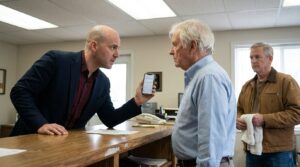
General Bradley stumbled back against the dead biometric terminal, his pristine white uniform collecting a thin, mocking layer of gray grit from the ventilation backdraft. He didn’t look at the dust. His eyes were pinned to the heavy exterior security hatch as it slowly ground upward against unlubricated iron tracks.
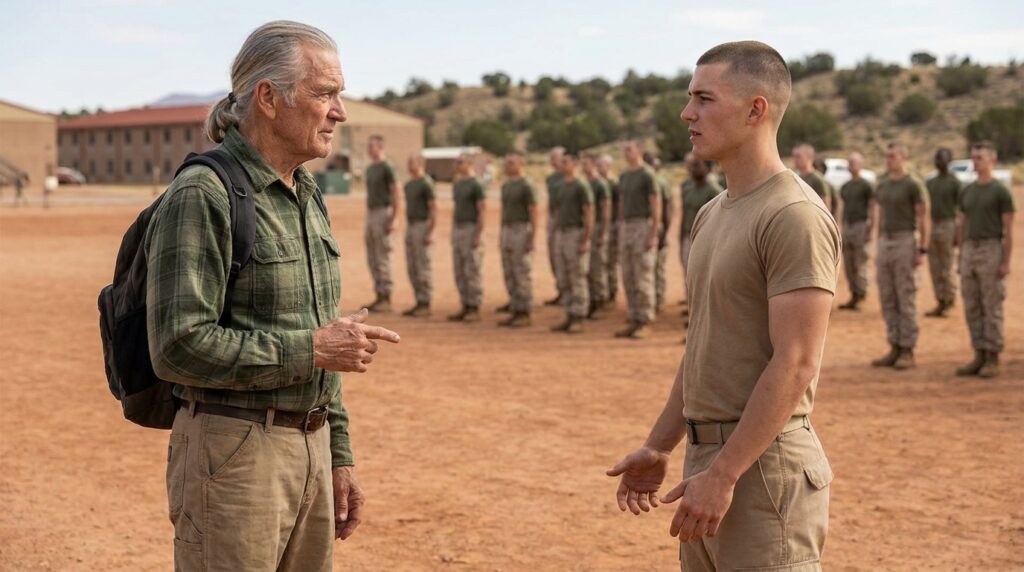
Through the opening, the desert sun spilled back into the hallway, blinding and severe. Standing in the center of the brilliant frame of light was General Arthur Pendleton. He wore simple, oil-stained field fatigues, completely stripped of peacetime decoration save for the four dark, oxidised stars pinned to his collar. His face looked as though it had been carved out of dry river stone, hardened by decades of decisions made in rooms that didn’t exist on any map.
Pendleton didn’t look at Bradley. He marched directly into the corridor, his heavy combat boots crunching over the concrete debris. Behind him, two silent operators in matte-black tactical armor took positions at the threshold, their weapons held at a low, mechanical ready.
“Arthur,” Bradley started, his voice a desperate, strained rasp as he tried to pull his remaining dignity back into his posture. He gestured sharply toward MacAllister, who still leaned casually against the rusted doorframe. “Thank God your network link held. We have a catastrophic breach on the staging line. This traveler bypassed the outer perimeter using an active Tier-1 override. The system flagged him for high treason—the old ninety-eight sector sabotage. I have him under immediate isolation protocol.”
Pendleton stopped precisely three feet from MacAllister. The silence between them was old, heavy, and absolute. Slowly, the old general reached into his deep chest pocket and pulled out a heavy, unpolished command coin. He dropped it onto the metal surface of the nearby security desk. It rolled once before stopping with a heavy, dull thud. MacAllister glanced at it—the silver core was completely oxidized, showing the exact microscopic wear pattern of an asset that had been carried through twenty years of classified brush wars.
“Stand down, Vance,” Pendleton said. His voice wasn’t loud, but it carried the absolute, unyielding density of a man who commanded the theater’s entire logistical grid.
Bradley froze, his fingers twitching against the seams of his immaculate white trousers. “Arthur, you aren’t looking at the manifest. The tablet is showing a complete systemic lockout. The man is a rogue operator. He burned the telemetry grid—”
“The treason file was authorized by my office five years ago, General,” Pendleton interrupted, his eyes shifting from MacAllister to Bradley with a cold, transactional finality. “It was a mandatory deep-cover fabrication. We needed a ghost to pull the black-budget airspace defense network entirely off the congressional oversight ledger. Every piece of data MacAllister ‘stole’ was routed directly into a secure terminal in the basement of the Pentagon. He didn’t destroy the grid. He became the grid.”
The words hit the small, enclosed corridor like a physical impact. The security escort slowly lowered his tablet to his side, his face completely pale as the ultimate reality of the architecture collapsed over him. The treason wasn’t a crime; it was a shield. The rugged man in the grease-stained brown jacket wasn’t a prisoner waiting for a federal brig—he was the sole architect of the nation’s deepest defensive shadow.
Bradley looked from Pendleton to MacAllister, his mouth opening slightly but producing no sound. The rigid, peacetime structure he had built his entire career upon—the salutes, the crisp white uniforms, the absolute certainty of the chain of command—was nothing more than a superficial layer of dust being swept away by a cold, pragmatic wind. His localized authority hadn’t just been bypassed; it had never truly existed in the spaces where the real wars were fought.
MacAllister slowly pushed himself away from the wall. The brass casing on his wrist felt lighter now, its signal fully integrated into the base’s primary network. He looked down at the oxidized silver coin on the desk, then met Pendleton’s gaze.
“You’re late, Arthur,” MacAllister said, his voice a low, gravelly scrape that cut through the dying whine of the transport’s turbines outside.
“The headwind over the flats was worse than expected, Mac,” Pendleton replied flatly. He turned his back on Bradley, completely dismissing the base commander as if he were a piece of discarded flight-line hardware. “The stealth asset on the runway is fueled and prepped for the northern corridor. The network is waiting for your biometric confirmation to clear the airspace.”
MacAllister nodded once. He reached down, swept the command coin into his calloused palm, and slipped it into the pocket of his worn utility jacket. He walked past Bradley without a single word, his boots leaving a final set of tracks in the gray dust of the facility floor.
Behind him, General Bradley stood entirely isolated in the dim emergency lighting of his own command center, his pristine white uniform looking remarkably small against the vast, dark reality of the protocol he had tried to control.