
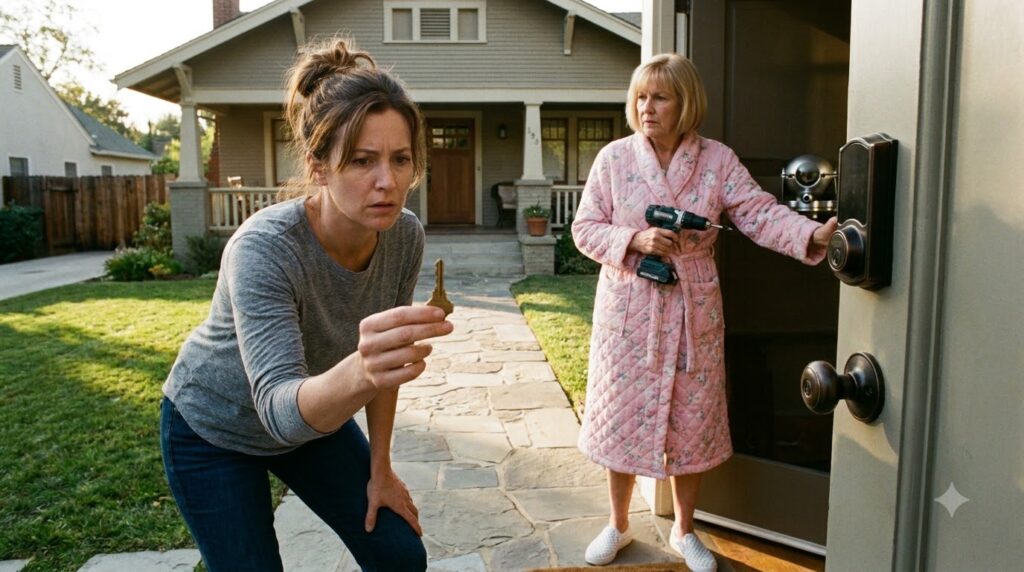
CHAPTER 6: THE BEDROCK CONFRONTATION
“Clear the perimeter!”
The voice above was muffled by tongue-and-groove pine and two layers of subflooring, but the authority was unmistakable. Miller.
Directly over our heads, the kitchen floorboards groaned under heavy boot leather. Dust—fine, gray pulverized lime and seventy-year-old cedar shavings—sifted through the seams between the joists, drifting into my hair and stinging the rims of my eyes.
Karen clamped both hands over her mouth, her knuckles white, her knees trembling violently in the black earth. The pale lavender pattern of her robe was smeared with clay. She stared up at the sagging floor with the wild, unfocused terror of a captive who realized the cage was about to be dropped into a crusher.
I didn’t look up. Looking up was an instinct for prey.
I grabbed the heavy brass sighting scope and the wax-sealed envelope, shoving both inside the zippered inner pocket of my utility jacket. Then I reached into the steel chest, fingers curling around the third item nestled beneath the journals: a two-foot steel cold chisel and a three-pound drilling hammer, their handles darkened with the dry sweat of my father’s hands.
“Claire,” Karen breathed through her fingers, her whisper a dry rattle. “They’re directly above us. They’re going to breach the trapdoor.”
“Let them open it.”
I swung around the concrete pier, pressing my back against the cold, damp stone of the north foundation wall. The flashlight beam stayed pinched under my fingers, throwing a narrow slit of amber across the base of the pier where the poured cement met the living rock.
There, embedded flush into the gray granite shelf, was a four-inch disc of solid yellow brass.
It was not a standard county benchmark. Stamped into its rim in deep, hand-punched relief were the words: UNITED STATES GENERAL LAND OFFICE — INDEPENDENT RESURVEY 1954. Across the center, cold-chiseled over an older obliterated mark, was David Mercer’s personal stamp: REC-884-D.
A heavy thud shook the ceiling. The pantry door upstairs was wrenched open. The sound of wire shelving crashing against tile echoed down through the subfloor.
“Trapdoor’s here!” the technician shouted from above. “The latch is warm. They’re down in the footings.”
“Hold position,” Miller’s voice cut in, sharp and flat from the kitchen entryway. “Do not enter the crawlspace. Signal the operator. Shove the bucket through the north sill plate. If the superstructure shifts two inches off the foundation, the state emergency code permits total structural demolition without a judicial hearing.”
Karen’s head snapped toward me, her eyes wide with shock. “They aren’t coming down here to arrest us,” she whispered, the realization finally breaking through the last layer of her bureaucratic denial. “They’re bringing the house down on the hole.”
“That’s why your smart lock was wired to ping an offshore server, Karen,” I whispered back, my voice stripped of heat. “They didn’t want the data. They wanted proof of digital tampering to justify an emergency condemnation.”
Outside, the dual diesel turbines of the CAT excavator revved into a sustained, ear-splitting scream. The vibrations traveled not through the air, but straight up through the granite bedrock beneath our boots. Small pebbles rattled against the foundation footings.
Above, the cedar trapdoor was kicked upward with a crack of splintering trim. A beam of white tactical light knifed down into the crawlspace, sweeping frantically across the dirt floor, catching the empty field chest and the scattered tracks of our knees.
“They’re by the central pier!” the technician yelled down the hole.
I didn’t run. I stepped directly into the cone of light.
I held the three-pound drilling hammer in my right hand, the cold steel chisel planted squarely on the edge of the brass federal datum disc embedded in the granite.
“Miller!” I shouted, projecting my voice straight into the square cut of the trapdoor. The acoustics of the crawlspace amplified the tone, deadening the echo into a solid, threatening wall of sound. “Tell your machine to cut the engine, or I take five pounds of steel to this benchmark.”
The tactical light jerked, blinding me for half a second before dipping to illuminate the hammer resting on the brass disc.
Silence followed, thick and suffocating, punctuated only by the mechanical thrum of the excavator idling at the curb.
Boots approached the opening above. Miller’s face appeared in the rectangular gap, illuminated from below by the spill of the flashlight. His dark coat was dusted with plaster; his tie was pinned straight. His eyes flicked from the hammer to the cold chisel, then locked onto the small, stamped letters of the federal seal.
For the first time since he had stepped out of the black sedan, the administrative smoothness vanished from his face. His lips thinned into a pale, bloodless line.
“You don’t want to do that, Miss Mercer,” Miller said softly. “Damaging a federal survey marker is a Class C felony under Title Eighteen.”
“It’s only a felony if the marker is recognized by the state,” I said, leaning my full weight onto the chisel, letting the hardened point scratch the edge of the brass disc with a screech that made Karen cringe. “Your fraudulent seizure brief claims Lot 409 is private municipal surplus. If this property is private surplus, this disc doesn’t exist under county record. But if I shatter it right now, the baseline for every deed within six square miles—including the high-density corporate corridor your offshore clients just bought—loses its point of origin.”
Miller did not blink. His hand tightened on the wooden rim of the trapdoor.
“You think you’re holding a shield, Claire,” Miller murmured, his eyes sweeping across the dark foundation walls, cataloging the shadows. “Your father didn’t hide that marker to protect your house. He hid it because he was paid to bury the fact that forty years ago, the Mercer survey stole thirty acres from the state reserve to create this entire development.”
He paused, letting the words hang in the freezing subterranean air.
“The records in your jacket don’t prove your ownership,” Miller said, his voice dropping into a razor-sharp whisper. “They prove your father was the architect who erased the public trust. The zoning board isn’t seizing this land to steal it. We’re seizing it to cover up the fraud he left behind.”
Above us, the horn of the excavator sounded three short, rhythmic bursts—the universal construction signal for an immediate structural breach.








