CHAPTER 3: THE STRIPPED TUMBLERS
“The twenty-fourth,” I said, voice flat, letting the words drop like lead weights into the narrow breezeway. “Today is the tenth. You brought an execution order for a judgment that hasn’t cleared the clerk’s desk.”
The man with the pry bar didn’t flinch, but his eyes shifted—a fractional, calculating sweep toward the gap between our shoulders. The paper remained suspended in the dead space between us, crisp bond sheet trembling in the draft slipping between the siding and the fence.
“Clerical expedience,” he murmured. “The county moves faster than it used to, Miss Mercer. I’d advise you not to contest the physical perimeter.”
“I don’t contest paper.”
I swung my left arm in a tight, violent arc—not at his jaw, but down across the plane of his forearms, knocking the heavy legal brief from his grip. The sheets fluttered into the wet gravel, the red ink smearing against damp mulch. In the same breath, I drove the toe of my work boot against the base of his pry bar, levering the heavy steel tip out of the bulkhead seam with a screech of tortured iron.
He lunged forward to reassert leverage, boots slipping on the slick flagstones. I didn’t stay to fight for the door. An actuary and a field technician were pawns; the lever was on the front porch.
I pivoted on the heel of my right foot, cutting back toward the gate with a lung-burning burst of acceleration. The gravel kicked up behind me, striking the cedar fence in sharp, erratic taps.
“Vance!” the man bellowed behind me, his calm bureaucratic facade cracking into a dry bark. “She’s circling back!”
I burst through the gate into the late-afternoon glare. The black sedan at the curb hadn’t moved, its dual exhaust still curling into the cold air, but the passenger door cracked open an inch.
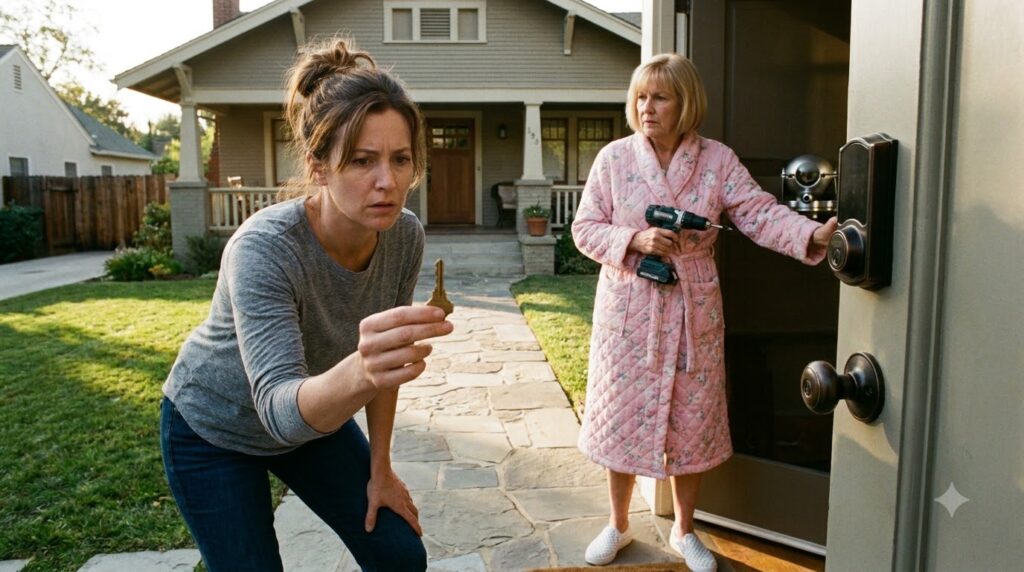
On the porch, Karen had finally driven the last casing bolt into the door jamb. Hearing the technician’s shout, she spun around, her cardigan flaring out, her pale hand frantically pressing a strip of heavy-grade industrial seal over the rear flange of the deadbolt. Her face twisted into an ugly, triumphant snarl as she saw me clear the fence line.
“Stay off the steps, Claire! The recording device is active under statutory notice!”
I didn’t head for the door. I dove toward the dying hydrangea bush beside the porch skirt.
My knees hit the frozen dirt with a dull shock that jarred my teeth. My fingers plunged into the soft potting soil, clawing through damp roots and crushed leaves until my knuckles struck cold, milled brass.
The original cylinder.
Karen had discarded it like trash, assuming a mechanical lock was useless once its housing was hollowed out. But in county surveying, every deadbolt keyed to a municipal master carries its origins in the tailpiece.
“Get your hands out of there!” Karen shrieked, taking one unsteady step down the porch riser, the cordless drill held out like a blunt truncheon. “That is surplus county hardware!”
I dragged the cylinder out of the dirt, wiping the grime across my jeans in a single, rough swipe.
The brass was heavy, solid, pitted with small burrs from where her drill bit had skipped across the faceplate. But the back end told the real story. The retaining clip hadn’t been picked or slipped; it had been sheared off with a jeweler’s punch. Pinned inside the rear plug, exposed by the missing cap, were five brass tumblers.
They weren’t standard residential pins.
Each pin was micro-stamped with a four-digit index code. And across the flat face of the brass plug, etched with the precision of a diamond drag-bit, was a registration mark: REC-884-D.
The air went clean out of my lungs.
REC-884 wasn’t an HOA code. It wasn’t even a county parcel ID. It was the personal survey stamp of David Mercer—my father. A stamp that was supposed to have been incinerated in the county courthouse fire twelve years ago, the very incident that had allegedly cleared the paper trail on the eastern ridge easements.
My father hadn’t lost this key. He had built this cylinder to prevent someone from reaching the structural hollow behind the doorframe.
Behind me, the curb door of the black sedan slammed open with a hollow thump. Heavy footsteps struck the asphalt, moving with rapid, synchronized purpose.
“Miss Mercer,” a voice called out from the street—smooth, resonant, carrying the effortless weight of institutional command. “Hand the core to Mrs. Vance and step into the vehicle. We have the revised appraisal right here.”
I stood up slowly from the dirt, my back to the street, closing my hand around the brass cylinder until the sharp edges of the sheared pins bit deep into my palm, drawing a bead of warm, iron-tasting blood.
I looked up at Karen. The arrogance was gone from her mouth. Her hand was shaking so violently against the smart lock’s casing that the blue LED on the keypad flickered between standby and alarm. She wasn’t an operative. She was terrified.
“You didn’t swap the lock to keep me out,” I whispered, the realization locking into place with the click of a falling tumbler. “You swapped it because the old deadbolt wouldn’t open with the master key they gave you.”
Karen’s throat bobbed. Her eyes darted over my shoulder to the men advancing from the road.
“You don’t know what he buried under the foundation, Claire,” she hissed under her breath, barely audible beneath the rustle of the dry lawn. “They aren’t buying the house. They’re razing the block.”