
CHAPTER 4: THE OVERRIDE CODE
“Razing the block doesn’t wipe the county registry, Karen,” I whispered, the copper taste of my own blood settling hot beneath my tongue. “Paper burns. Subsurface survey pins don’t.”
The footsteps behind me ceased. The man in the dark trench coat who had stepped from the idling sedan stopped at the bottom riser of the porch steps. His wingtip shoes were mirror-polished, catching the sharp white glare of the halogen streetlamps flickering to life overhead. He held a leather binder under one arm, his free hand buried deep in his wool coat pocket.
“Miss Mercer,” he said smoothly. His voice had the flat, practiced cadence of an arbitrator reciting an eviction notice. “My name is Miller. Regional Acquisitions. The core in your palm is technically county property under the salvage clause of the deed.”
“My father’s name is stamped on the barrel, Miller,” I replied without turning my back on Karen.
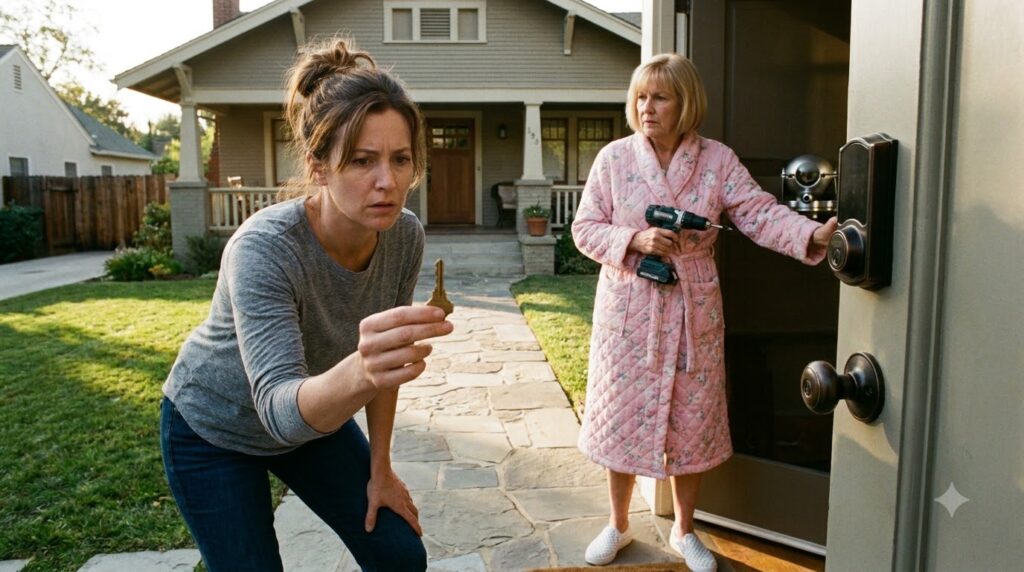
Karen had gone rigid against the doorframe. Her cordless drill dangled by its cord, its chuck smeared with fresh white paint shavings. She was trapped between me on the porch step and the men on the sidewalk, a middleman who had suddenly realized her commission was written in vanishing ink.
“Step aside, Karen,” I commanded.
She didn’t move. Her jaw worked silently, her eyes pleading with Miller down on the pavement. “You told me she wouldn’t be back until six,” she stammered, the brittle authority from twenty minutes ago entirely gone. “You said the bypass team would be done before the streetlights turned.”
“Move your hand off the casing, Karen,” Miller instructed quietly. There was no rage in his voice, only the dry, administrative fatigue of a bureaucrat swatting a persistent moth. “You’ve done your part for the committee.”
Instead of moving away, Karen pressed harder against the newly fitted digital deadbolt, her knuckles purple in the twilight. “You swore my house was off the clearance manifest. You swore the red line ended at lot four-oh-eight.”
Miller didn’t answer her. He tilted his chin toward the man with the pry bar, who had emerged from the side alleyway, his boots dragging through the damp mulch.
I didn’t wait for them to synchronize.
I lunged upward, throwing my shoulder directly into Karen’s chest. She let out a sharp gasp of expelled air as her back hit the door panel. Before she could regain her balance or raise the drill, I grabbed the heavy casing of the new smart deadbolt with my left hand and jammed the broken brass cylinder of my father’s lock straight into the exposed hollow beneath her thumb.
The sheared pins shrieked against the raw metal interior.
“Don’t—!” Karen screamed, clawing at my forearm. Her fingernails caught the cuff of my utility jacket, tearing the seam, but I drove the cylinder home like a machinist setting a punch.
The bypass module didn’t reject it. It clicked.
A violent, high-pitched chirp erupted from the lock’s internal buzzer. The thin copper jumpers running into the door mortise flashed with a sudden, searing spark that smelled of scorched resin and melting vinyl. Across the face of the sleek touchscreen, the generic blue standby light died, replaced by a row of crimson digits cycling through an automated pairing sequence.
Then the digital display froze.
It didn’t show an HOA portal or a municipal utility code. Stamped in glowing green phosphor across the LCD panel was a twelve-character alpha-numeric string:
SUR-884-D // APEX OFFSHORE HOLDINGS // BREEZEWAY EXCAVATION ORDER.
I twisted the old core hard to the right. The internal teeth caught the unauthorized actuator, shearing the tiny micro-wire that Karen had spent ten minutes trying to hide. The heavy steel deadbolt slid backward into the housing with a clean, pneumatic clack.
The front door drifted inward half an inch, breaking the seal. The interior of my own home was dark, cool, and silent—except for the faint, steady pulsing of an external hard drive rack humming in the crawlspace below the floorboards.
“You’re not seizing my records,” I said, stepping backward onto the porch edge, keeping the heavy door between myself and the threshold. “You’re trying to destroy the master survey markers before the federal boundary audit tomorrow morning.”
Miller didn’t draw a weapon. He didn’t rush the steps. He simply reached up with his gloved hand, tapped the earpiece hidden behind his collar, and took a single step back toward the open door of the black sedan.
“Call the site superintendent,” Miller said into the collar mic, his gaze locked on mine with icy indifference. “The resident accessed the primary junction. Initiate the structural hazard condemnation. Bring the backhoe.”
Behind him, from around the corner of the tree-lined suburban street, the low, earth-shaking rumble of heavy diesel engines began to vibrate through the flagstones beneath our feet.
Karen fell to her knees on the welcome mat, staring at the flashing green code on the ruined lock, her hands trembling against her floral robe. “The whole street…” she whispered, her voice breaking into the empty air. “He surveyed the whole street.”
🏁 MODULE: SILENT HORIZON CHECK (AUTO-EVALUATE IF TARGET == TOTAL)
🥻Structural Status: [INITIATE_CASE_B]








