CHAPTER 6: THE FINAL LINE
The sharp, metallic snap of Officer Harris’s clipboard frame echoed down the driveway asphalt like a small caliber round. He didn’t look at the neighbors who had migrated from their porches to the curb edge, their phone lenses glinting like tiny glass beads under the harsh afternoon glare.
With a slow, deliberate stroke of his ballpoint pen, the deputy tore the top carbon copy from his pad. The paper was thin, gray-tinted, and its perforated edge rasped dryly against the aluminum backing board. He held it out into the hot space between his uniform vest and Elena Vance’s limp hand.
“This is a formal citation for unlawful interference with a public safety emergency line under code section forty-four,” Harris said, his voice flat, dropped entirely into a low, procedural drone that brooked no debate. “Along with a secondary summons for civil trespass and intentional damage to a designated municipal landmark. The court date is stamped at the margin. Sign the lower ledger block.”
Elena didn’t look at the paper. Her sunglasses had slipped completely down her nose, catching on her lip before she pushed them back with a hand that rattled against the leather grain of her folder. The blue sheet with the fake gold toner seal was folded double now, stuffed into the pocket of her white trousers like an old grocery receipt.
“Officer,” she whispered, her chin dropping toward her collarbone as the bright pattern of her floral top seemed to lose its artificial color in the raw heat. “This is an administrative misunderstanding. The landscaping company was supposed to confirm the easement offsets before the trenching unit arrived. I didn’t direct the blade.”
“You handed the operator the blue form, ma’am,” Harris said, his fingers clicking the pen into its pocket with a final, mechanical snap. “The camera stream we verified matches the log. Your name is on the service ticket. If you refuse to sign the notification block, I’ll be required to take custody of your person for non-compliant transport.”
Behind Harris, the contractor’s heavy diesel engine turned over with a deep, shuddering roar. The truck bed vibrated, sending a cloud of blue oil smoke across the yellowed grass of the boundary line as the worker slammed the tailgate shut. The safety chains clinked against the bumper—dull, heavy thuds of iron on steel—as the vehicle began to back out of the driveway, its tires crunching heavily over the loose stone shoulder. The worker didn’t look back at the fence line; his team was already pulling their administrative file from the company ledger to avoid a county-level license suspension.
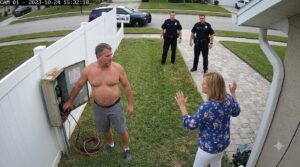
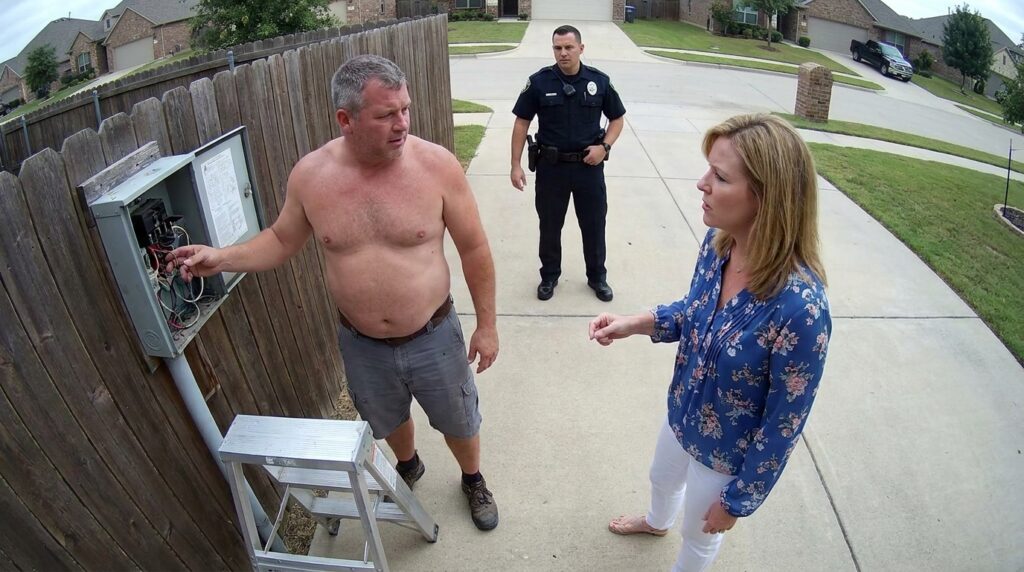
Miller stood up from the turf, his bare chest damp with grease-streaked sweat, his fingers caked with the dark rust scaling from the surveyor’s iron monument pin. He didn’t follow the deputy to the curb. He walked back to his porch ladder, where his original pile of pressure-treated lumber lay stacked across the joist frames. The wood smelled of clean cedar and zinc oxide under the blinding sun.
“Miller,” Elena said, her voice jagged enough to make the neighbors lower their devices by a fraction of an inch as she took two paces back toward the lot line. Her fingers clutched the corner of her stone walk where the concrete was already buckling under the pressure of her wall. “The entire eastern segment of the subdivision wall is built on this alignment. If you enforce the three-foot setback, the structural integrity of the upper tier collapses. It will ruin the property value for the entire block.”
Miller picked up his old framing hammer from the top plate of the porch joist. The steel head was cold, scratched with gray zinc lines from a hundred driven spikes. He turned it over in his hand, feeling the balance of the hickory handle against his calloused palm. He looked down at the iron cylinder still exposed in the shallow trench—the unyielding, forty-pound anchor of 4-2-A that had been driven through the shale before any of these houses had names.
“You can call whoever you want, Elena,” Miller said, his voice flat enough to match the unforgiving grid of the plat map. “But you can’t rewrite the county surveyor’s pins. If the wall collapses, I suggest you call the masonry firm that put it on my dirt.”
Harris walked back toward his Interceptor, his heavy leather duty belt giving one last, drawn-out creak before he opened the driver’s door. The strobes were still cutting red-and-blue slivers through the white heat haze on the street, but the siren stayed dead. He looked at Miller once over the roof of the cruiser, gave a single, brief nod of professional acknowledgment, and slid behind the glass.
The neighborhood crowd began to break apart, their heels scraping quietly on the dry asphalt as they drifted back toward their own air-conditioned living rooms. The show was over, the parameters were locked, and the true geometry of the lot was settled. Miller adjusted his grip on the hammer, stepped onto the first rung of his own ladder, and drove the first structural nail straight into the clean timber of his porch.