CHAPTER 3: THE ARRIVAL ZONE
The crown of the asphalt curb didn’t just meet the tires; it deflected them with a harsh, metallic scrape as the white-and-black Interceptor settled into the gravel edge of Miller’s driveway. The lightbar didn’t wail anymore, but the strobes kept pulsing—sharp, rhythmic cuts of red and blue that turned the blistering heat haze into a fragmented lens.
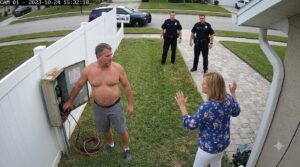
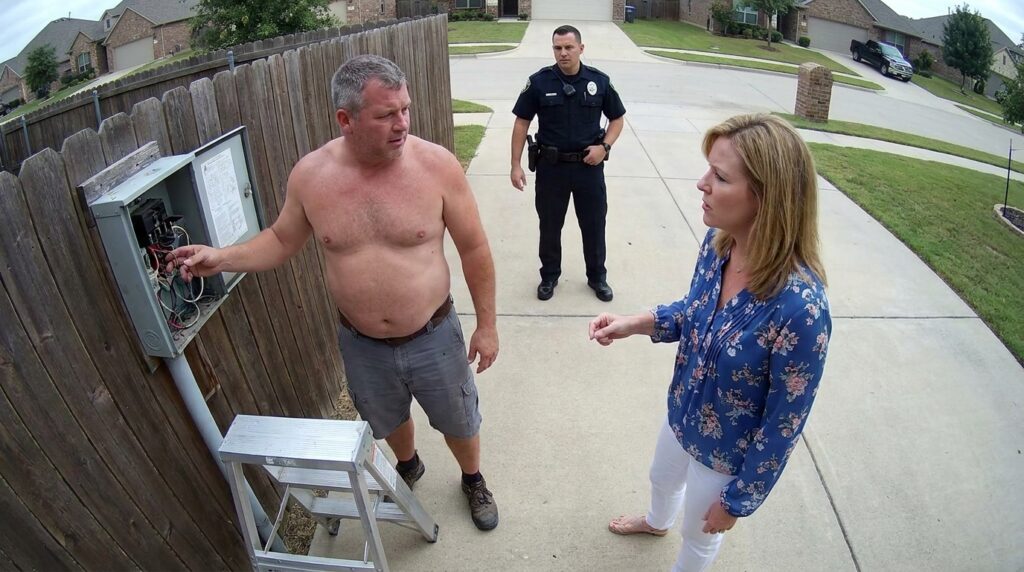
The door pane groaned as the deputy threw his weight against it. Officer Harris was a solid man whose uniform shirt was already dark with sweat beneath the rigid ballistic panels of his vest. His leather utility belt gave a rhythmic, heavy creak—handcuffs against chemical spray, the heavy polymer frame of his sidearm clicking against its retention holster—as he stepped onto the parched grass. He didn’t look at Elena first. He looked at Miller’s bare torso, then down at the grease-stained shorts, his boots tracking straight down the visual line of the confrontation.
“Step away from the box and calm down now,” Harris said, his voice flat, carry-over gravel from a long shift on the interstate grid. He didn’t drop his hand to his belt, but his forearm rested naturally across the high-ride holster, his fingers curved into a loose, ready anchor.
Miller took one slow step back, his boots finding the harder, sun-cracked dirt of his own property line. He kept his palms open, fingers spaced widely apart, pointing toward the ground. He didn’t speak. He knew the protocol of an opening intervention; the first person to yell was usually the one the county paperwork classified as the primary disruptor.
“Officer, thank goodness,” Elena said, her flat shoes clicking with sudden velocity against the concrete walk as she moved behind the deputy’s right shoulder, establishing the classic alignment of the reporting party. Her hand was up, pointing past Harris’s badge straight at Miller’s chest. “He’s been shouting at my contractor, threatening him while he’s on the ladder, and attempting to physically block access to the neighborhood infrastructure. I have the municipal clearance right here, and he refuses to comply with the district code.”
Harris didn’t take the blue security paper she thrust toward his face. He kept his eyes on Miller, his head tilted slightly to account for the glare coming off the Interceptor’s hood. “Sir, is this your lot?”
“It is,” Miller said. His voice was steady, filtered through dry throat and the smell of exhaust fumes cooking on the hot grass. “Lot 42. The fence is mine. The utility panel is mounted to my structural posts.”
“He’s lying about the easement boundaries,” Elena cut in, her blue floral top rustling as she shifted her stance, trying to look around the officer’s shoulder to maintain eye contact with Miller. “The entire drainage and auxiliary lane belongs to the development association’s common grid. We are simply rerouting a secondary line to ensure the lower retaining wall doesn’t saturate during the fall rains. He’s deliberately delaying code-enforced maintenance.”
The worker on the ladder had finally cleared the bottom rung. He dropped his side-cutters into a canvas pouch with a dull, heavy clink, his eyes tracking the deputy’s movements with professional caution. He reached for a blue rag in his back pocket, wiping his palms down without looking up. “I’m just the hand here, Officer. She called the shop, gave us the ticket number, and said the homeowner was cleared. I don’t have a dog in the dirt line.”
Harris adjusted his duty belt with a quick, upward bump of his hips. He turned his head three inches toward Elena, his sunglasses reflecting her white pants and the blue folder clutched against her side. “Ma’am, did you state on the recorded line that there was an active physical threat?”
“He told my man to drop the tools or there’d be an infrastructure violation,” Elena said, her chin rising as she adjusted her posture, performing an entitlement that had worked in three different HOA disputes across the subdivision this season. “In this county, intentional interference with a contracted utility technician constitutes a Class B misdemeanor under the public safety code. I know the ordinance.”
Miller watched the deputy’s eyes behind the tinted lenses. Harris wasn’t looking at the blue paper yet; he was looking at the severed brass locking tag hanging from the lower hinge of the electrical box. The metal was too clean, the scrape marks on the green powder-coated steel too fresh.
“You pull a tool to get into that box?” Harris asked the worker.
“The lady gave me the key code,” the contractor muttered, his face turning an uneasy shade of mottled red under his dusty ball cap. “Or… she said the latch was already cleared by the inspector. I just used the wedge to lift the seal.”
“There is no inspector code for a manual bolt cut,” Miller said to the officer. He didn’t raise his arm; he simply tilted his phone forward, the screen waking up to display a black-and-white grid of the county plat index. “Officer, I suggest you take a look at the timestamped registry before we discuss who’s interfering with public infrastructure. Because what’s inside that leather folder isn’t an administrative continuation. It’s an outdated form with a deceased board member’s signature block.”
Elena’s hand twitched, her fingers slipping across the smooth grain of the leather binder. The low-frequency rattle of the cruiser’s loose catalytic converter vibrated through the parched soil, a steady, irritating hum that seemed to tighten the air between them. Harris shifted his weight, his boots crunching on the loose stone as he reached out his left hand toward Elena’s folder.
“Let me see the blue slip, ma’am,” Harris said, his tone dropping the initial urgency, settling into the heavy, procedural drag of a man who realized he had been dragged into a civil boundary trap on a ninety-five-degree afternoon. “Let’s see what the county actually signed off on.”