
CHAPTER 4: THE STRATEGIC RETREAT
Miller’s thumb left a dark smudge across the tempered glass of his screen as he swiped down, initializing the localized playback loop from the overhead optical housing beneath his garage eave. The digital timeline buffered for half a second, the progress bar a thin, gray vein ticking under the harsh midday sun.
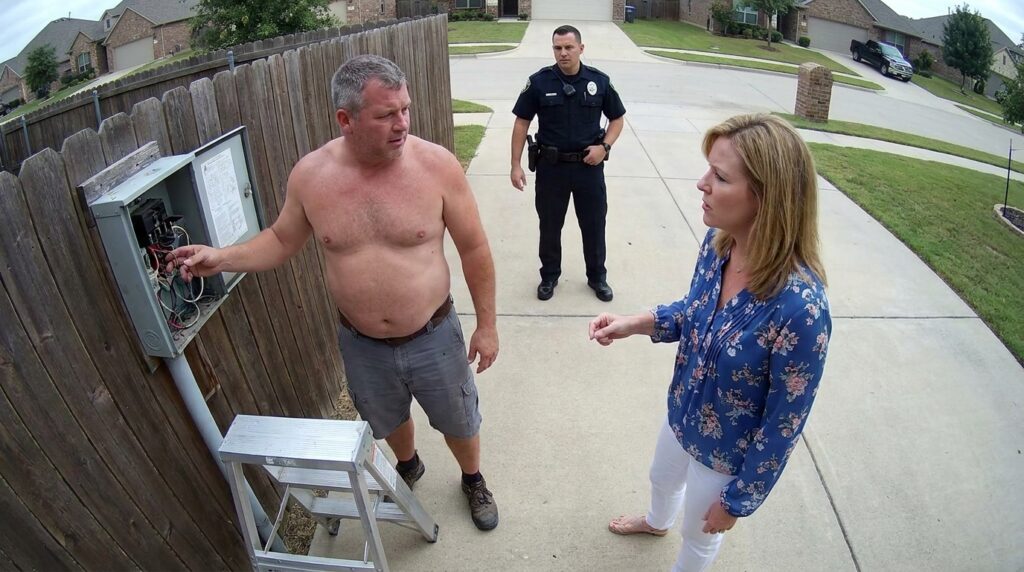
“Alright, I’m stepping back,” Miller said, his boots grinding into the parched dirt as he cleared a five-foot radius around Officer Harris’s utility belt. His hands stayed extended at hip height, fingers wide, empty, and dry.
Elena pulled her leather folder tighter against her blue floral top, the stiff grain of the material letting out a faint creak against her ribs. She took a step toward Harris, her white pants coming within inches of the unsealed box. “Officer, he’s trying to stall. The contractor needs to finish that junction re-route before the county inspectors close the Friday log. If Miller continues to obstruct this project, I intend to press full civil damages for construction delay.”
Harris didn’t take the folder. He kept his attention locked on Miller’s wide, open palms, then glanced down at the black-and-white grid lines of the plat survey currently glowing on the smartphone screen. The deputy’s jaw worked slowly, chewing through the silence and the sharp, chemical odor of raw engine exhaust from the idling patrol car behind them.
“Sir,” Harris said, his hand dropping away from the polymer grip of his sidearm but remaining anchored near his pocket. “What am I looking at on this screen?”
“This is the cloud ledger for Lot 42, logged into the county geographic information system four hours ago,” Miller said. He held the screen steady, despite the glare bouncing off the hood of the black Interceptor. “Look at the four-frame sequence from 0900 this morning. That’s five hours before your dispatch logged the call.”
The contractor shifted his weight from boot to boot, the tools in his heavy leather belt clinking like structural chains against his thighs. He peered over Harris’s shoulder, his sun-chapped face wrinkling as he squinted into the high-intensity display. “Hey… that’s my truck.”
On the screen, a crisp, 1080p stream showed the gray wooden fence line in real time, then skipped backward to the morning hours. The video played. Elena Vance was clearly visible standing at the base of the fence rail, her arm extended as she handed a folded blue slip of security paper to a different man—the contractor’s field foreman. The audio track on the omnidirectional microphone gave a sharp, metallic pop before her voice came through Miller’s speaker, clear despite the distance.
“The homeowner isn’t here on weekends,” the recorded version of Elena said, her digital image pointing directly at the brass security lock on the utility hub. “Just cut the seal. The board cleared the administrative continuation. We need the auxiliary feed tied into my line before he finishes his porch inspection.”
The actual Elena on the driveway froze. Her sunglasses slipped down the bridge of her nose as her fingers slipped across the brass corners of her binder. The speed of her breath tripped, her chest rising sharply under the bright pattern of her blouse.
“That’s a private recording,” she said, her voice thinning into a brittle, defensive register. “Officer, he has cameras oriented toward my active property line. That’s a direct violation of neighborhood privacy covenants. That footage is completely inadmissible.”
“It’s oriented downward at my own utility panel, Elena,” Miller said, his voice flat, matching the unyielding heat rising off the sandstone dust beneath his boots. “And it shows you instructing a commercial crew to cut a county-administered security tag on a main trunk feed. That’s a federal utility infraction, not an HOA dispute.”
Harris leaned in closer, his dark uniform shirt absorbing the ambient glare as his eyes followed the timestamp on the screen. The footage continued to loop, showing the contractor’s worker pulling the first blue wire from the internal bus bar. Then Harris’s gaze dropped down to the paper Elena was still attempting to press against his midsection.
The blue slip lacked the distinctive, three-dimensional indentation of a heavy mechanical press. Under the direct, unshaded sunlight, the gold seal at the bottom didn’t catch the light like metallic foil; it diffuse-reflected like high-density toner from an office printer. The ink on old man Garrison’s signature block had a faint, glossy sheen—the mark of a low-grade thermal transfer copy, not a live-ink signature from a municipal desk.
“Ma’am,” Harris said, his tone dropping into the cold, flat register of an officer who realized he had been dispatched under a fraudulent emergency flag. He didn’t take the folder. Instead, he unclipped a heavy steel flashlight from his utility belt, using the blunt metallic end to point toward the bottom of the blue sheet. “This signature block belongs to an officer who hasn’t been active since the winter cycle. Why did you tell dispatch this man was threatening you when you were actively directing an unpermitted bypass on his fence line?”
“The variance was approved,” Elena stammered, her heels clicking backward on the walkway as she tried to change her alignment, her white pants catching a smear of dark grease from the ladder frame. “It’s an administrative adjustment. The development has an easement privilege for utility maintenance.”
“The easement privilege requires a twelve-digit validation code entered into the public portal forty-eight hours before ground is broken,” Miller said, taking a slow step forward, his boots crossing back over the dry turf. “And your crew didn’t just open the box. Look at what your guy dug up right under the ladder rail before the officer got here.”
Miller pointed with the edge of his boot toward a fresh, shallow trench where the contractor’s shovel had peeled back three inches of dry sod. Nestled in the sandstone dust, where the gray wood of the fence post entered the earth, was a glint of dark, gray powder-coated wire shielding—and right next to it, a jagged piece of rusted iron that had been completely severed by a motorized trenching blade.
Harris frowned, stepping into the interaction lane between Miller and Elena. He knelt down, his utility belt clattering against his thighs as he adjusted his sunglasses to peer into the narrow gap in the turf. His hand went to his pocket, pulling out a pair of disposable nitrile gloves with a dry, latex snap.
“What did you hit down there?” Harris asked the contractor.
The worker looked at his boots, his hands dropping to his sides. “I told her we hit something solid when we were leveling the turf for the drainage pipe. She told me it was just an old irrigation pipe and to cut right through it.”
Miller watched the deputy’s fingers trace the edge of the severed iron object. It wasn’t an irrigation line. It was thick, solid, and square-headed—the top of an original county surveyor’s monument pin that had been driven into the subsoil thirty years ago when the development grid was first laid out. The metal was dark with rust, but the fresh cut from the blade was bright, silver, and unforgiving.
“Officer,” Miller said, his gaze shifting from the buried pin straight to Elena’s pale face. “That pin doesn’t mark the edge of her lot. That pin marks the original boundary of my parcel from 1996. And her entire retaining wall is sitting three feet on my side of the line.”








