CHAPTER 6: THE CRACKED GROUND UNDER THE COLD SUN
The needle on the brass manifold gauge slapped against the zero-pin with a metallic ping that resonated through the steel frame of the service truck.
Gideon didn’t spin the dial. He grabbed the heavy iron T-handle of his main valve wrench, his gloved palms burning as he twisted the tool down into the street box. The stem was jammed tight. Below the asphalt, the iron sleeve was warping under the shifting weight of the entire cul-de-sac. The subterranean suction wasn’t just pulling water anymore; it was drawing the gravel bed out from beneath the road, a low, wet gurgle vibrating through the iron shaft straight into his chest.
“Get off the blacktop!” Gideon shouted, his voice cracking through the humid air as he strained against the frozen iron handle.
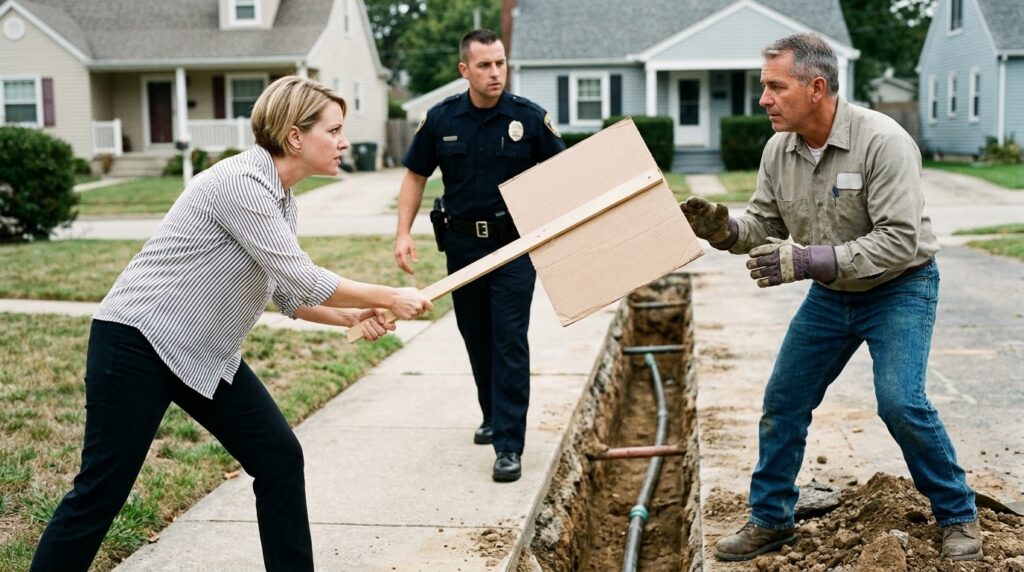
The road surface under his boots was no longer solid. The black aggregate was softening, heat and pressure forcing gray slurry up through the expansion seams. Ten yards away, Officer Miller was grabbing Victoria Vance by the elbow, dragging her bodily across the shifting turf toward the higher, dry ground of her neighbor’s lot. Victoria’s striped shirt was torn at the cuff, her hands empty, her polished shoes abandoned somewhere in the mud near her cracking driveway. She didn’t struggle against the officer’s grip. Her face had gone entirely gray, her mouth working in small, silent twitches as she watched the brick porch of her house separate from the main frame, exposing the empty black void beneath her foundation.
The two neighbors who had been watching from across the street were running now, their tennis shoes slapping against the pavement as the first deep fracture tore past their mailbox. The old man on the colonial porch stood frozen behind his screen door, his hands pressed flat against the glass as the low, rhythmic vibration of the dissolving limestone shelf traveled up the structural pillars of his own home. The illusion of suburban boundary lines was vanishing; the ground beneath them didn’t care about deeds or association rules.
Gideon braced his boots against the iron rim of the curb box, using his whole body weight to force the wrench one final quarter-turn. The metal screamed—a dry, screeching complaint of overstressed iron—and then the valve stem sheared off inside the casing. The T-handle spun free, sending him stumbling back against the hot fender of his idling service truck.
He didn’t check for bruises. He looked down into the open utility trench.
The water from the broken main had stopped geysering upward. The hole was dry, but the silence inside the pit was absolute. The white PVC bypass line had vanished entirely, swallowed by the collapsing silt. In its place was a widening cavern, five feet across, its dark limestone walls wet with the sulfurous runoff of the old regional water table. The sheared gas sleeve he’d found earlier was now suspended in mid-air, a cold iron pipe jutting out over a drop that had no visible bottom.
“It’s the whole hill,” Miller said, his boots crunching onto the asphalt as he approached the truck, his face slick with sweat. He kept his arm around Victoria, who was staring down into the road without blinking. “The dispatch radio just went down. The main plant at the bottom of the ridge is reporting a total structural displacement. They’re shutting down the county pumps, but the backpressure is already here.”
Gideon wiped the grit from his forehead with the back of his leather glove. He looked at the cracked screen of his tablet, which was flickering with a single, looping red error code. The data from the district office wasn’t an accident. The failure wasn’t Victoria’s illegal tap, nor was it the local lateral he’d been sent to fix. The entire subdivision had been built on a hollowed crust, a ten-year-old administrative secret buried beneath clean sod and high-end landscaping.
“We can’t plug it, Officer,” Gideon said, setting the broken iron wrench down onto the truck’s tailgate with a slow, heavy clink. The metal was cold to the touch, matching the air rising from the fissure. “The city didn’t repair the main line ten years ago. They just redirected the valley drainage into the old coal seams to keep the developers happy. Victoria wasn’t the only one with a pump. Every house on this side of the lane has been floating on an engine that just ran out of fuel.”
Victoria turned her head, her eyes vacant as she looked at the silver maples. The roots of the nearest tree were exposed now, hanging like gray claws over the edge of the widening sinkhole. “They told us the rock was stable,” she whispered, her voice barely rising above the low rumble of the settling earth. “They said if we kept the pressure even, the association would never have to pay for the municipal stabilization.”
“The association didn’t have the tools for this kind of depth, ma’am,” Gideon said. He reached into his truck cab and turned the ignition key, shutting down the diesel engine. The sudden silence that followed was heavier than the roar of the water. It was the sound of a structural perimeter resetting itself in real-time.
Across the cul-de-sac, the cracks were widening into clean, geometric fault lines, tracing the exact path of the unmapped gas sleeve. The concrete sidewalk stayed bridged for one more second, then dropped six inches into the silt with a dull, concussive thud that shook the service truck on its suspension. The old man behind the screen door finally stepped back into his house, his shadow disappearing into the interior dark as the first hairline fracture reached his concrete step.
Gideon strapped his manual tool pouch shut, his fingers moving across the cold brass buckles with practiced, slow-motion discipline. He had spent his life working the edges of things that were built to break, and he knew when the earth was done bargaining. He looked back at Victoria Vance one last time—no longer a gatekeeper, just another resident watching the public easement reclaim her private lawn.
He stepped off the asphalt and began the long walk down the ridge toward the main service station, his heavy mud-stained boots marking the grey dust of the road with every step, while behind him, the empty spaces beneath the suburb continued to settle into the old iron veins of the valley.