CHAPTER 4: THE MEASUREMENT OF FAULT LINES
The drop forged steel of the three-pound sledge hammer struck the top of the surveyor’s iron stake with a sharp, metallic ring that silenced the low chatter of the neighbors across the pavement.
Gideon didn’t double-tap the strike. He held the cold iron shaft steady between his thick leather gloves, checking the yellow-and-black grading tape wrapped around its neck. The stake didn’t seat firmly into the earth. It sank two inches into the silt beneath the grass line and then vibrated against something massive, dense, and hollowed out directly beneath the sidewalk. The granular aggregate of the concrete slab gave off a dry, popping sound as the lateral stress from the hammer blow forced a microscopic hairline fracture through the gray surface, tracing a path straight toward Victoria Vance’s driveway.
“Hold the line there, Mr. Miller,” Officer Miller said, his boots stepping over the yellow hazard tape as he leaned down to look at the alignment. The heavy nylon fabric of his vest bunched against his chin as he tracked the straight line from the corner monument. “The boundary stake isn’t squaring up with the original curb map. We’re off by nearly five inches.”
Gideon wiped a fresh layer of gritty clay dust from his face, his skin stinging from the heat and the abrasive residue rising out of the cut. “The curb didn’t migrate on its own, Officer. The whole sidewalk is leaning toward her crawlspace. Look at the pitch on the joints.”
He knelt by the edge, his boots braced against the loose dirt lip, and slid his tape measure down the side of the cut. The white PVC bypass line—the illegal diversion he’d exposed minutes ago—was under severe physical tension. The knuckle-joint coupling, still smelling of toxic blue solvent, wasn’t just crooked; it was being actively pinched by the massive concrete sub-base of the sidewalk. The soil surrounding the pipe wasn’t solid clay anymore. It was a slurry of liquid silt, bubbling with small, cold pockets of sulfurous gas that hissed as they broke the surface.
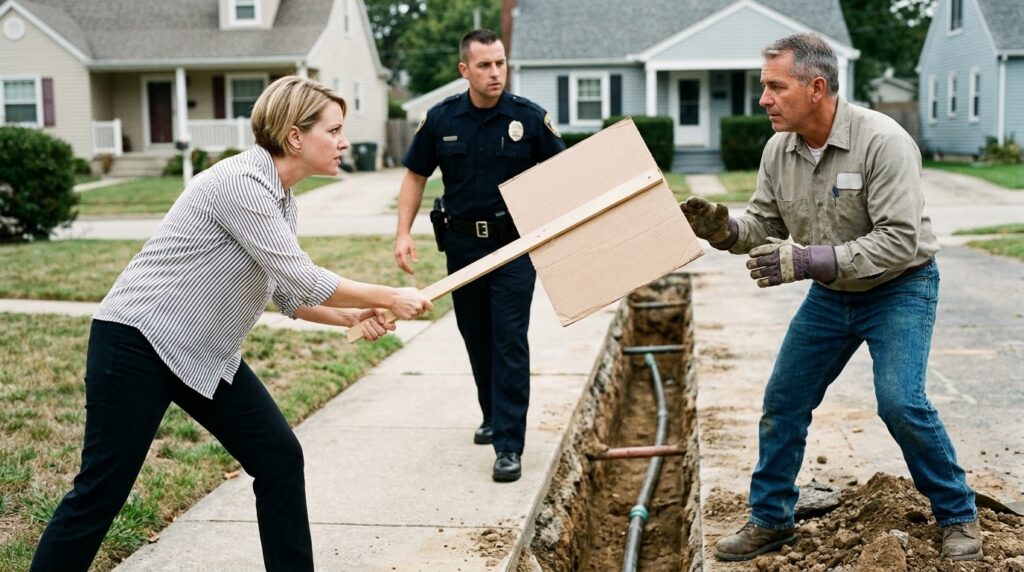
“This is an entirely fabricated measurement,” Victoria said, though she didn’t step past the sidewalk boundary this time. She stood on her lawn, her arms crossed tightly over the striped fabric of her shirt, her clipboard held up like a small wooden shield against the gathering crowd. The two women in tennis clothes had moved past the mailbox, their leather shoes crunching into the dry grass of the neighboring lot, while the old man from the colonial house stood at the curb line, his jaw slack as he watched the water pressure level on the contractor’s screen drop. “You’re manipulating the physical stakes to justify an administrative fine. The homeowners association records clearly state the original footings were poured on solid rock.”
“The association records are ten years out of date, ma’am,” Gideon muttered, his thumb scrolling through the historic infrastructure logs on his field tablet. He zoomed into the section marked with the red variance code. “Look at the pressure drop. It’s not a leak from a cracked fitting. Something is pulling the water. Something big.”
He took his trench shovel and plunged the steel blade behind the white PVC line, intending to clear the block of loose pea gravel. Instead of hitting solid subsoil, the shovel vanished up to the iron handle into a completely empty pocket of space beneath the walkway. The sudden loss of friction sent him forward, his shoulder slamming hard against the muddy trench wall.
The officer caught Gideon’s safety vest, pulling him back onto his heels with a rough, heavy lift of his arms. “Easy, Gideon. What do you have down there?”
Gideon didn’t answer right away. He reached into the empty space with his gloved hand, feeling the rush of freezing, localized vapor that he’d noticed earlier near the abandoned gas sleeve. The air inside the dark cavity was moving fast, a sub-surface draft that tasted like stagnant iron and lime dust. When he pulled his hand out, his leather glove was coated in a gray, slimy sludge—crushed structural slurry, the disintegrated remains of the neighborhood’s main foundational barrier.
The white PVC line chose that exact second to fail. Under the shifting weight of the sidewalk slab, the blue-glued joint cracked with a wet, explosive pop, spraying a high-pressure jet of stolen municipal water directly into the dark void beneath Victoria’s yard. The water didn’t pool. It didn’t rise out of the trench. It vanished instantly into the empty space, a loud, gurgling roar echoing from the darkness beneath her house as the earth beneath the lawn began to settle.
Victoria dropped her clipboard. The wood hit the turf with a dull thud, her sunglasses sliding down her nose as she stared at the spot where her green grass was beginning to dip like an unbaked crust.
“The main line isn’t feeding her house, Officer,” Gideon said, his voice dropping into a cold, hard certainty as he pointed his flashlight down into the collapsing soil. The beam cut through the muddy spray, illuminating the true nature of the bypass. “She wasn’t stealing water for her grass. She’s been running a high-pressure pump for years to flush an active sinkhole under her living room so the house wouldn’t split in half.”
Miller stepped back, his hand dropping to the radio on his shoulder, his eyes wide as he looked from the cracking concrete sidewalk to the shifting porch of the Vance home. The entire block was quiet now, the neighbor witnesses freezing where they stood as the low, rhythmic vibration of the settling ground began to travel through the soles of their shoes.
Gideon reached for his tablet to shut down the main street valve, but the screen didn’t update. The digital plat map suddenly flickered, the blue vectors disappearing as a new, massive red fault line opened across the county utility grid, indicating that the main water lateral failure was happening three blocks away, beneath the city’s own water treatment facility.