
CHAPTER 5: THE DISCLOSURE OF EMPTY SPACES
The digital matrix on the field tablet shattered into a jagged spiderweb of frozen white pixels, completely erasing the blue municipal grid lines at the exact second the ground beneath Gideon’s boots dropped another half-inch.
He didn’t drop the dead hardware. He shoved the heavy, rubber-armored casing into his tool belt, his fingers sliding across the wet, flaking rust of his manual wrench. The low, guttural roar from beneath Victoria Vance’s driveway wasn’t stopping. It carried a rhythmic, mechanical pulse, a deep water weight chugging behind the concrete facade of her house like an iron lung. The high-pressure spray from the fractured PVC line had turned into a muddy geyser, eating away at the soft limestone aggregate under the walkway with terrifying velocity.
“Step away from the pavement edge, Officer,” Gideon called out, his throat dry from the sour sulfur vapor venting out of the expanding cavity. He grabbed the officer’s heavy nylon shoulder strap, pulling the man back onto the solid asphalt of the road gutter. “The sub-base is gone. That concrete slab is bridging a dead drop.”
Officer Miller didn’t look down at his notes anymore. His black aluminum flashlight flickered twice and died, the intense humidity inside the trench shorting out the battery casing. He shoved the useless tube into his belt, his boots crunching on the loose grit as he backed toward his cruiser, his left hand instinctively checking the retention clip on his duty weapon. “Ms. Vance, you need to evacuate the front porch structure immediately. The grading lines are unstable.”
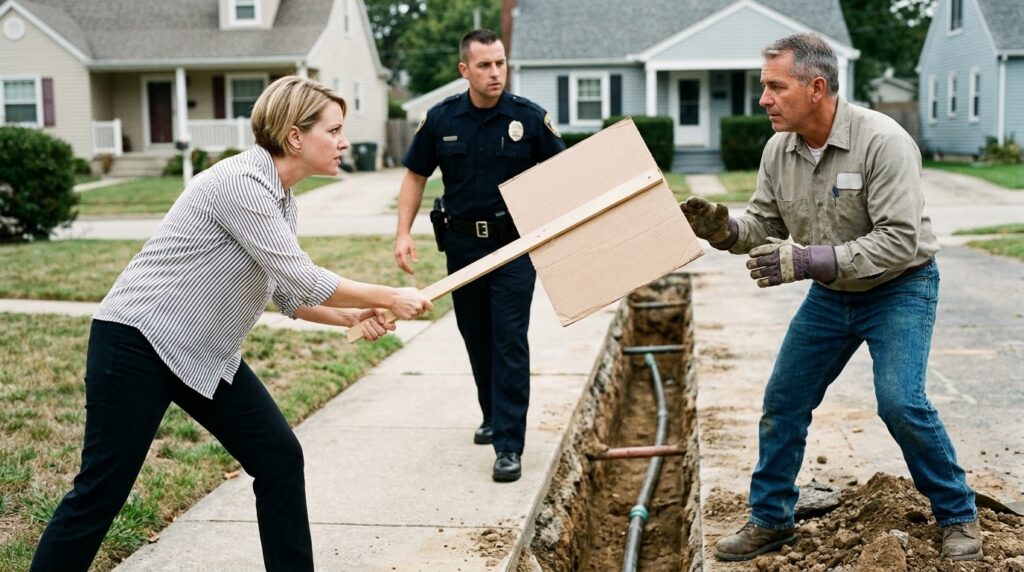
Victoria didn’t move toward the house. She stood entirely frozen on the edge of her manicured lawn, her polished shoes sinking into the turf as the grass fibers began to separate over a three-foot fissure. The striped fabric of her blouse caught the harsh mid-day light, showing dark, wet spots where the subterranean mist was settling. The clipboard she’d used as an administrative weapon lay face down in the dirt, its steel clip rusted orange in a matter of minutes by the chemical vapor.
“It wasn’t supposed to drop this fast,” she murmured. Her voice had lost its rigid, transactional snap, reduced to a hollow, mechanical cadence that barely cleared the sound of the rushing water. She looked past Gideon, past the officer, out toward the two neighbors across the street who were now backing down their own driveway with their phones raised to their chests. “The engineers from the district office told me the settlement plateaued five years ago. They said if I kept the hydraulic head pressure stable with the auxiliary loop, the sinkhole would remain stagnant.”
Gideon locked his jaw, his gloved hands clamping around the cold iron rim of his emergency shut-off key. “Who from the district office, Victoria? The city water records don’t show an auxiliary loop on this entire sector. They show a clean lateral repair from ten years ago.”
“The repair was a shell,” she said, her sunglasses slipping completely off her face and landing in the wet silt at her feet, revealing pale, dilated eyes fixed on the trench. “The contractor who handled the main water treatment facility expansion back then hit the limestone shelf. They cracked the deep water table and ran the overflow into the old abandoned gas conduits to avoid a stop-work order from the state inspectors. They paid the association board to handle the localized settlement privately.”
The officer stopped his retreat, his hand frozen on his shoulder radio. His eyes shifted from the woman’s pale face down to the sheared, cold iron gas sleeve Gideon had uncovered in the mud. The piece of the puzzle clicked into place with a sickening physical weight—the freezing vapor, the rapid suction of the water, the unmapped variance on the grid. This wasn’t an isolated case of an entitled neighbor stealing utility water. It was a localized institutional cover-up, and Victoria Vance was simply the gatekeeper left holding the manual pump.
“Gideon,” Miller said, his voice dropping into a tense, rapid growl as he unclipped his microphone. “We’ve got a massive structural failure opening on the primary line. The asphalt is spider-webbing out to the double yellow.”
Before Gideon could step into the street to drop his manual shut-off key into the main gate valve, the entire sidewalk slab between the silver maples fractured with a sound like a rifle shot. A clean, three-inch gap tore through the aggregate, the concrete tilting downward toward the house foundation like a drawbridge. The remaining section of the white PVC pipe was sheared in half, releasing the full eighty pounds of municipal water pressure directly against the exposed structural footer of the home.
The old man across the street slammed his front door shut, the hollow sound echoing across the cul-de-sac as the first visible ripple traveled through the asphalt under the police cruiser’s front tires. Gideon lunged for his service truck, his heavy boots slipping on the slick mud slurry as he tried to reach the manual line valve before the hydraulic backpressure tore the rest of the sub-surface main apart. But as he reached the metal tool box, the main pressure gauge on the truck’s manifold didn’t spike—it dropped straight to zero. The water wasn’t pumping from the street main anymore; the street main was being sucked backwards into the dark, empty space under the development.








