CHAPTER 2: SUBSURFACE INFRACTIONS
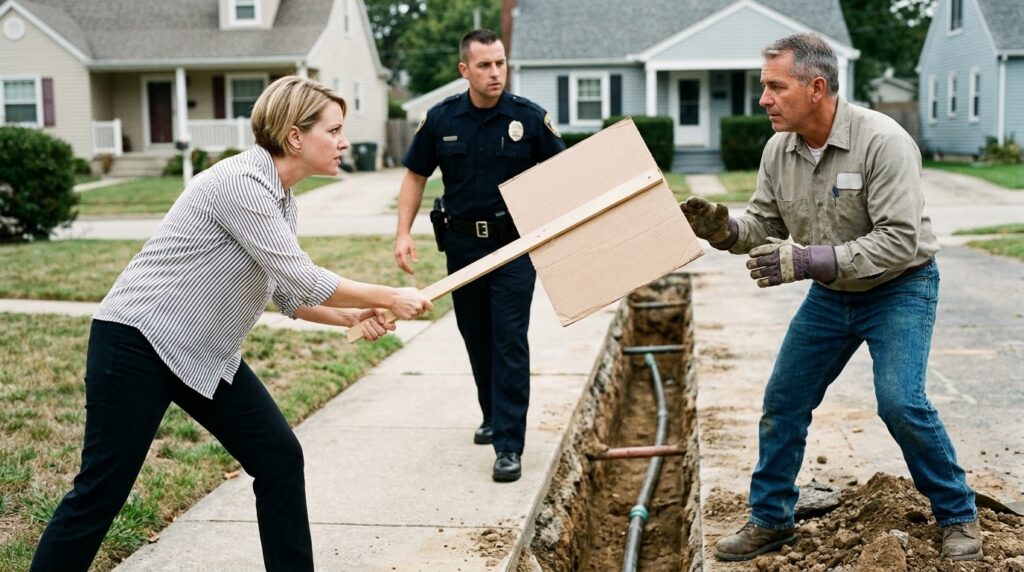
The heel of the officer’s heavy leather boot ground a wedge of dried clay into the edge of the pit, sending a scattering of grey grit down across the smooth, clean flank of the rogue PVC line.
Gideon didn’t shift his gaze from that white plastic pipe. In the shadows of the six-foot-deep cut, the pipe stood out like an artificial bone against the dark, iron-veined clay. It was pristine—far too clean to have been laid when the sub-base of the development was poured back in the nineties. More importantly, the knuckle-joint coupling was smeared with a ring of bright, chemical-blue PVC cement that hadn’t completely lost its chemical shine. Someone had cut into the city’s lateral easement within the last six months.
“Let’s keep the space clear, folks,” Officer balance checked his entry, his voice dropping into the low, gravelly baritone of a man who spent his mornings sorting out property line disputes before they turned into tire-iron theater. He stood broad-shouldered, his uniform shirt dark with sweat patches beneath the heavy nylon straps of his ballistic vest. He didn’t look into the hole yet. His eyes were locked onto the Resident Protester’s sign, his right palm extended toward the painted plywood like a wall. “Ma’am, pull the sign back. Sir, keep the shovel down.”
The woman—Gideon remembered her name from the neighborhood watch notices posted on the mailboxes, Victoria Vance—didn’t drop her hands, but she took a half-step back onto the manicured turf of her lawn. The striped fabric of her shirt rustled against her dark pants as her chest heaved. “Officer, thank God you’re here. This man is operating heavy machinery without a neighborhood clearance. Look at what they’re doing to the root barrier. They’re destroying the structural easement of the entire curb.”
Gideon wiped the back of his forearm across his forehead, leaving a dark streak of damp soil across his skin. The heat was thickening, rising off the raw trench like steam from a kettle. “I’m not on her barrier, Officer. I’m three feet eleven inches out from the concrete line. The lateral is failing. I’ve got forty gallons an hour of municipal water turning her foundation into quicksand, and she’s blocking the tap.”
“It’s a lie,” Victoria said, her voice dropping into a razor-thin hiss that carried across the silent asphalt of the cul-de-sac. Across the street, the two tennis-clad neighbors had stopped entirely, their rackets tucked under their arms, leaning against a mailbox like front-row spectators. “The water levels are fine. This is an unauthorized municipal overreach to cover up the contractor’s billing cycle. We have a private infrastructure clause in our deed.”
The officer turned his head slightly, his gaze drifting over the open cut. His eyes passed over the old, pitted cast-iron water main—corroded to a dull orange-black, its surface sweating with fine beads of pressurized moisture—and then they snagged on the white PVC pipe. He paused. The casual weight of his stance shifted, his boots squaring up against the hazard tape.
“What’s that line there?” the officer asked, pointing a gloved finger down into the shadow. “The white one. That part of the city lateral?”
“No,” Gideon said. He leaned heavily on his shovel, the steel tip sinking an inch into the loose clay at his feet. He allowed himself a small, slow breath through his nose, tasting the dust. “The city uses ductile iron or copper for the service leads in this district. That’s a private four-inch schedule-forty bypass. It’s taped directly into the downstream side of our meter box.”
Victoria’s posture stiffened. The wooden handle of her sign jerked slightly in her grip, the pine tip scraping against the concrete sidewalk with a dry, screeching sound that made the old man on the porch across the street lean forward. “That is an auxiliary sump discharge line. It’s fully compliant with the interior drainage code. It has nothing to do with this illegal excavation.”
Gideon reached down with his left hand, his thumb clearing the dust from the glass face of his rugged field tablet. He didn’t look at her; he looked at the digital plat schematic. The red variance marker he’d noticed earlier wasn’t an error. It was a footprint. The schematic showed the official water department lines as a straight blue vector, but his current physical location showed a massive, unrecorded drop in pressure right where the white PVC line intersected the old main.
“Sump pumps don’t use high-pressure pressure-rated couplings, Ms. Vance,” Gideon murmured, his thumb tapping the screen to lock the data. “And they don’t use blue glue that’s still smelling like a plastics factory. You aren’t pumping water out of your basement. You’re drawing it in before it hits the house meter.”
The officer didn’t say a word. He reached into his pocket and pulled out a heavy, black aluminum flashlight, clicking the beam on despite the glaring morning sun. The white light cut through the gloom of the trench, reflecting off the damp clay walls and illuminating the precise spot where the white pipe vanished into the unexcavated earth beneath Victoria’s lawn. The dirt around that insertion point was dark, loose, and packed with fresh pea gravel—the universal signature of a quick, unpermitted midnight plumbing job.
“Ma’am,” the officer said, his voice losing its neutral diplomatic edge and turning into something heavy, bureaucratic, and cold. He turned his body completely away from Gideon, facing the woman with his hands resting flat on his duty belt. “I need you to set that sign down on the grass right now. Don’t hold it, don’t lean on it. Set it down.”
Victoria looked at the officer, then down at the blue glue visible in the beam of the flashlight. For a second, her mouth opened slightly, her face flushing a deep, mottled red that reached the collar of her striped shirt. The authority she’d been performing for the last hour didn’t evaporate—it hardened, turning into the brittle, defensive logic of a cornered animal.
“This is my property,” she whispered, her fingers tightening on the pine handle until the wood creaked. “You don’t know what they did to this block ten years ago. You don’t know what’s under here.”
Gideon didn’t answer. He knelt at the edge of the pit, his gloved fingers reaching down toward the damp gravel near the rogue coupling. His hand brushed against something else buried in the mud—a second, older piece of rusted iron pipe that had been intentionally sheared off with a torch. It wasn’t a water line. It was an old municipal gas sleeve, and it was cold as ice.