
CHAPTER 6: THE QUIET HOLLOW
“Get them on their feet, Evelyn. No buzzers. No fire alarms.”
Arthur tossed the blue ledger onto the coffee table. It landed among the stained gauze pads with a flat, dry slap that startled the boy.
“Why not the pull station?” Todd’s voice rattled, thin and shrill, his fingers hooking into the waistband of his sweatpants. “If it’s coming down, pull the damn station!”
“You pull the bell, three dozen retirees try the elevators at once,” Arthur said, turning toward the doorway without breaking stride. “The counterweights in the shaft are already binding. Two cars jam between floors, and people die in a metal box. Go door-to-door on the east wing. Tell them there’s a gas leak in the crawlspace. Tell them to take their slippers, their coats, and their medications, and walk down the west stairwell to the visitor curb. Move.”
Evelyn didn’t argue. The petty tyrant of the fourth-floor laundry committee had completely dissolved, replaced by a hollow-eyed woman who understood, for the first time, the physics of forty years of delayed maintenance. She grabbed Todd by the scruff of his collar and shoved him toward the hallway.
Arthur took the stairs down two at a time, his boots hitting the raw concrete risers with deliberate, heavy thuds. Every flight lower brought the air down five degrees. By the time he hit the basement threshold, the corridor smelled like a newly excavated grave—pulverized mortar, ancient soil, and the unmistakable ozone reek of overloaded copper wiring.
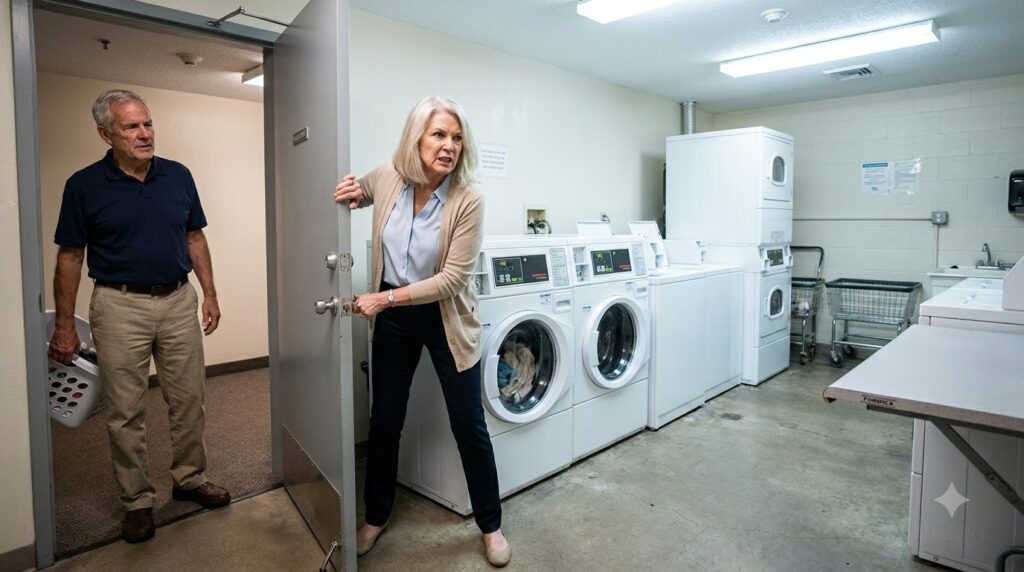
The laundry room door was still propped open where he had left it. Inside, Washer Three stood dead and dark, its stainless drum smeared with gray residue.
Arthur didn’t look at it. He ducked into the maintenance alcove, reaching past the hanging mop heads to the metal rack where the boiler tools were kept. He selected an eight-pound sledge, a pair of steel track wedges from an old elevator carriage, and a canvas tool belt loaded with hardened iron cold-chisels.
He dropped the sledge through the open floor hatch first. It landed with a dull, sickening thud on the dirt subgrade below.
Arthur swung his legs through the opening, caught the rusted lip of the hatch frame with his gloved fingers, and dropped five feet into the crawlspace.
The cold hit him like wet sheet metal against bare skin.
The space beneath the building was barely four feet high. He had to bend double, the rough underside of the concrete subfloor scraping the back of his navy polo as he clicked on his flashlight.
Dust hung in the air, dense as river fog. It wasn’t the drifting dust of an old attic; it was airborne concrete powder, forced into the atmosphere by extreme compression. Every breath tasted of lye and dry stone.
Ten yards ahead, illuminated in the tight beam of his light, stood the southeast footing.
Koval hadn’t just used depot jacks. He had set them on rotting four-by-four timber blocking that was already crushed to half its original thickness, the grain splintering into matchsticks under the concentrated load. The center fifty-ton hydraulic cylinder was leaned at an eight-degree pitch, its piston rod curved like a drawn bow.
Beside it, a thick diagonal fracture—two inches wide and jagged as lightning—ran clean through the concrete pier. The crack didn’t stop at the footing; it climbed directly into the underbelly of the slab that supported the ground-floor apartments.
Ping.
The sound was sharp, high-pitched, echoing off the damp rock walls.
Arthur froze, shining the flashlight beam onto the base of the pier. Another steel shoring bolt had sheared its threads, flying across the crawlspace to bury itself in the earth twenty feet away.
The entire ceiling shifted. It wasn’t an earthquake roll; it was a microscopic, terrifying lurch downward, accompanied by the dry skrrr-ch of crushed aggregate grinding together. A trickle of gray powder fell across Arthur’s neck, settling into the collar of his shirt like freezing water.
He scrambled on hands and knees over the jagged limestone rubble until he reached the leaning jack.
He laid his bare palm against the steel cylinder. The metal was burning hot to the touch, vibrating with a high-pitched whine that hummed straight into his skull. The hydraulic fluid inside was boiling, foaming through the deteriorated seal rings around the collar.
If that seal blew, the hydraulic pressure would drop to zero in a fraction of a second. Without the fluid holding the piston, fifty tons of dead load would drop instantly onto the splintered wood cribbing. The cribbing would pancake, and the entire southeast corner of the floor above would tear away from the shear wall.
He unhooked the canvas belt, pulling out the first eight-inch steel track wedge.
He needed to drive the mechanical wedge between the fractured concrete lip and the solid limestone shelf beneath it. If he could transfer just ten percent of the static load away from the failing hydraulic cylinder, the seals might hold long enough for Evelyn to clear the third and fourth floors.
He positioned the thick iron wedge into the gaping jaw of the fissure.
Arthur drew back the eight-pound sledge. The cramped ceiling gave him barely two feet of swing. He brought the hammer down with all the leverage in his shoulders.
CLANG.
The impact rang like a church bell in the subterranean vault. The wedge bit half an inch into the fracture.
He swung again. CLANG.
Concrete fragments peppered his face, stinging his cheeks. Through the floor joists overhead, he heard the faint, muffled sounds of doors slamming, the frantic bark of a dog, and the rapid, uneven pounding of old feet moving toward the fire escape.
Arthur swung the hammer a third time.
Instead of a ring, the blow produced a hollow, wet crunch.
The wedge sank three inches deeper, but beneath it, the limestone shelf didn’t resist. It crumbled into soft, gray talc.
Arthur dropped the hammer, reaching his light into the hole he had just opened.
It wasn’t solid foundation bedrock.
Beneath the thin layer of skim-coat cement lay an empty, unmapped void—and inside it, driven deliberately into the structural seam like a butcher’s cleaver, sat a heavy steel surveying wedge, painted safety-orange, stamped with the private seal of the development company that had underwritten the building’s original construction bond.
Someone hadn’t just failed to fix this foundation.
Someone had surveyed this exact fault line decades ago, mapped its inevitable shearing angle, and left the wedge behind to monitor the rate of descent.
Above him, the floor groaned a deep, agonizing note that vibrated the fillings in his teeth.








