
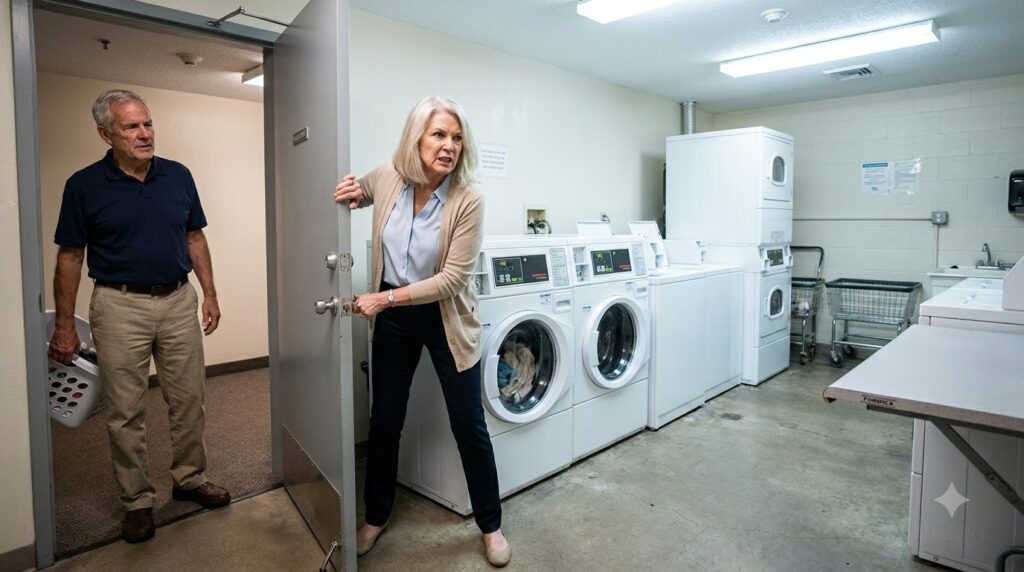
CHAPTER 3: THE EXTRACTION
The magnetic solenoid in Washer Three let go with a flat, hydraulic thump.
Inside the locked room, the chime rang once—a shrill, cheap chirp that cut through the drone of the belt drive. Arthur didn’t wait for Evelyn to gather whatever she had wedged under the lip of the sump drain. He slid the filed blank into the deadbolt cylinder, gave the brass head two sharp, upward taps with the plastic spine of his laundry basket, and turned his wrist.
The tumbler pins dropped with a dull snick.
He hit the door with his shoulder, catching Evelyn completely off-balance as she yanked the round glass hatch wide. The suction broke with an obscene sucking sound. A cloud of scalding, sour steam rolled out into the room, reeking of boiling bleach, wet zinc, and oxidized mineral oil.
“Get away from that,” Evelyn hissed, spinning around. Her hands were clad in yellow household rubber gloves that reached past her elbows.
Arthur caught the door with his heel, kicking it shut behind him to choke off the corridor draft. He didn’t answer her. He reached straight past the flailing yellow latex of her forearm, plunging his bare fingers into the tangled mass of still-warm cloth sitting in the stainless steel drum.
“Don’t touch those!” Her fingernails dragged across the stiff twill of his navy polo, hooking into the fabric, trying to tear him away from the opening.
Arthur clamped both hands around the heavy slate-gray bundle and hauled it into the light of the fluorescent tube.
The wet fabric weighed twenty pounds. It wasn’t standard laundry. The coarse weave was stiff, scorched, and plastered together in sodden, stiff folds. As the bundle unfolded across the stainless-steel folding table, the yellow safety strip fell open.
Across the chest pocket was an embroidered oval patch: METRO-WEST INFRASTRUCTURE & DRAINAGE. Beneath it, a plastic-laminated security badge swung from a broken lanyard, smeared with gray grease and dried crimson that the hot wash had failed to lift. The name stamped on the laminate was clear: M. KOVAL — SITE CHIEF.
The entire lower torso of the coverall was shredded. Not cut with shears, but torn by the rotational torque of a high-pressure auger. Brownish-red stains haloed the frayed nylon threads, locked forever into the synthetic fibers by the scalding water Evelyn had forced through the lines.
Arthur stared down at the name. Mikhail Koval had been the lead engineer on the municipal culvert project running along the property line two years ago—the project the condo board claimed had been abandoned due to soil settlement.
“He caught his sleeve in the bypass pump,” Evelyn said, her voice dropping down into a rough, dry rattle. She didn’t lunge this time. She backed against the vibrating metal flank of Dryer Two, her rubber-gloved hands hovering near her collarbones like dead birds. “Two hours ago. Down in the vault. We couldn’t call the city. You know the bylaws, Arthur. If an unpermitted worker bleeds out on private common elements, the city condemns the foundation. The whole building gets red-tagged. Four hundred families on the street by morning.”
Arthur looked from the torn fabric to her face. Her cheeks were mottled red from the steam, but her pupils were dilated wide, black rings swallowing the pale blue of her irises.
“You’re cleaning his clothes so they can take him to the county clinic without an industrial incident report,” Arthur said. It wasn’t a question; it was the cold arithmetic of a former depot foreman. “A workplace accident in an unpermitted crawlspace. Who authorized him down there, Evelyn?”
“The board,” she whispered, her chin trembling as she pointed toward the open hatch in the floor. “We pooled a contingency fund. Just to patch the weeping tiles before the annual inspection. It was just water seepage, Arthur. That’s all it was. Koval said he could seal the culvert from inside for five thousand in cash.”
Arthur looked down at the floor hatch. The split wooden wedge was still holding the cast-iron plate three inches off its seat.
From the dark gap beneath, no water was sloshing. There was no sound of a leaking sump pump, no trickling drain line.
Instead, a steady, chilling draft blew up through the crack, smelling of damp limestone, crushed shale, and dry, powdered concrete. Along with the air came a faint, rhythmic vibration—not the vibration of a residential water line, but the heavy, low-frequency hum of industrial hydraulic jacks taking load under thousand-ton footings.
Arthur reached out with the tip of his boot and kicked the wooden wedge free.
The cast-iron plate didn’t slam down. It hung suspended on an iron pry-bar that had been jammed into the hinge from below. Tangled around the pry-bar was a piece of stamped brass—a sheared state seismic inspection seal, snapped clean down the center line, bearing yesterday’s date.








