
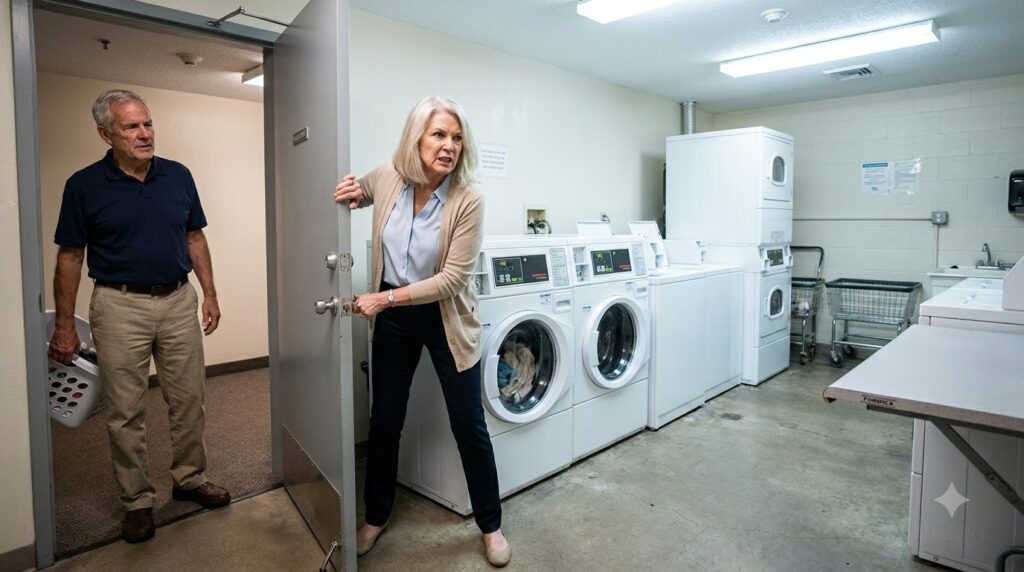
CHAPTER 2: THE CURRENT BENEATH THE CONCRETE
The latch pin didn’t settle clean. It ground inside the strike plate, dry zinc scraping against flaking lead paint, before the spring finally threw it home.
Arthur stood motionless on the green-gray runner of the corridor. The smell came through the door frame before the heat did: hot copper, scorched lint, and the sulfurous, cabbage-rot stink of sulfur-cured pipe sealant curing against an exhaust line that was running twenty degrees too hot.
Behind the wire-reinforced glass, Evelyn’s silhouette remained squared off, rigid as a surveyor’s stake. She didn’t retreat to the folding table. She didn’t turn off the overhead strip lights. She simply waited, her breath fogging a tiny oval against the glass at head height, waiting for the shuffle of his rubber-soled shoes to signal retreat.
Arthur didn’t give her the satisfaction of the sound. He turned on the balls of his feet, his knees emitting a faint, familiar pop, and walked twelve paces down the hallway toward the emergency stairwell door. He pushed the crash bar with the flat of his hip, let the heavy fire door slip shut behind him without letting the latch catch, and tucked himself into the dark triangular recess under the concrete riser.
The basement level smelled different than the upper landings. Up on four, where the retirees lived, it was boiled cabbage, furniture polish, and the stale talc of old carpet. Down here, below grade, the building breathed its real air: damp lime, the iron tang of thirty-year-old galvanized pipes, and the hum of the transformer vault humping its sixty-cycle vibration directly into the marrow of Arthur’s shinbones.
He set the empty laundry basket upside down on the cold floor, lowered himself onto the ribbed plastic base, and pulled his wristwatch up into the slice of amber light cutting through the door’s inspection slit.
9:44 PM.
A commercial Speed Queen front-loader on heavy cycle took twenty-eight minutes from wash fill to final spin. If she had just entered the rinse cycle when she shoved him, the pump would engage at 9:51. Then three minutes of high-velocity extraction, a pause, and an unlock chime.
Arthur unbuttoned his left cuff, his calloused thumbs working the plastic thread. His chest still carried the dull imprint of her palms. She was sixty-three, maybe sixty-four, thin-boned from a lifetime of clerical posture, but she had shoved him with the leverage of someone bracing against a cellar door in a windstorm. Desperation gave people strange torque. You didn’t push a neighbor of twelve years over laundry hours unless the machine contained something that could get you evicted, or indicted.
Through the cinderblock partition, the rhythmic thwap-thwap-thwap of the Kevlar twill against the glass drum continued.
Arthur reached into his trouser pocket and pulled out a brass key on a split ring. It wasn’t an apartment key. It was an old flat Corbin blank, filed down sixty thousandths of an inch on the third notch—a bump key he’d cut himself twenty years ago when the board had tried to lock the boiler room during the freeze of ’04.
He leaned his head back against the cold poured concrete of the stair stringer. Directly above him, the main electrical feeder conduit ran along the ceiling, four inches of rigid steel pipe carrying six hundred volts from the city vault.
The hum changed.
It wasn’t a rise in pitch; it was a drop. A sudden, brownout shudder that caused the emergency exit sign above the fire door to flicker twice, its internal battery relay clicking with the dry snap of a dead beetle hitting the floor.
The laundry room washers didn’t draw from the main lighting panel; they were tapped off sub-panel 3B in the maintenance alcove. That panel was rated for forty amps, single-phase. Nothing in a residential wash cycle—not even three heating elements running concurrently—could drop the line voltage enough to chatter a secondary emergency relay.
Arthur stood up. The stiffness in his lumbar spine flared, a sharp pinch of compressed vertebrae, but he ignored it. He stepped out from beneath the concrete stairs, his boots making no sound on the unfinished slab, and moved to the recessed utility panel mounted beside the standpipe.
The grey enamel door of the sub-panel had a paper tag wired through the latch loop. It wasn’t the city inspector’s yellow card. It was a strip of blue masking tape, curled and dried out around the edges, with a number scrawled in faded grease pencil: 408.
Apartment 408 was Evelyn’s unit. Two bedrooms, north-facing, directly above the trash compactor chute.
Arthur reached out. With the blunt edge of his thumbnail, he scraped back the corner of the blue tape. Beneath it, stamped directly into the sheet metal with a steel die, was an older designation: PUMP 2 – SUMP DRAIN / EMERGENCY BYPASS.
The conduit coming out of the bottom of the box was warm. Not ambient warm, but the dry, prickly fever of copper wire carrying ten percent more current than its gauge was drawn for. The faint smell of melting thermoplastic insulation—acrid, sharp, like burning fish scales—drifted from the seam of the steel cover.
Through the fire door, the sound of the washing machine changed. The heavy rinse had cut out. The drain pump whined, straining against a choked discharge hose, followed by the deep, resonant growl of the high-speed spin cycle kicking in.
Along with it came a metallic vibration that didn’t belong to any balance ring Arthur had ever rebuilt: a harsh, cyclic clack-clack-clack, like steel cable whipping against the side of a hollow iron pipe.
Evelyn wasn’t washing work clothes to save three dollars in quarters.
Arthur stepped through the stairwell door, moving back into the corridor. The wire-mesh glass of the laundry room was clouded with steam now, the internal exhaust fan failing to clear the moisture. Through the dense fog on the pane, he could see Evelyn standing with her back to him, both hands bracing against the vibrating top of Washer Three, her head bowed as if she were trying to hold the entire vibrating machine down into the concrete by sheer will.
Beside her feet, the second utility access hatch—the one that led down into the unmapped crawlspace below the building’s drainage sump—sat open an inch, its rusted iron lip propped up with a split wooden wedge.








